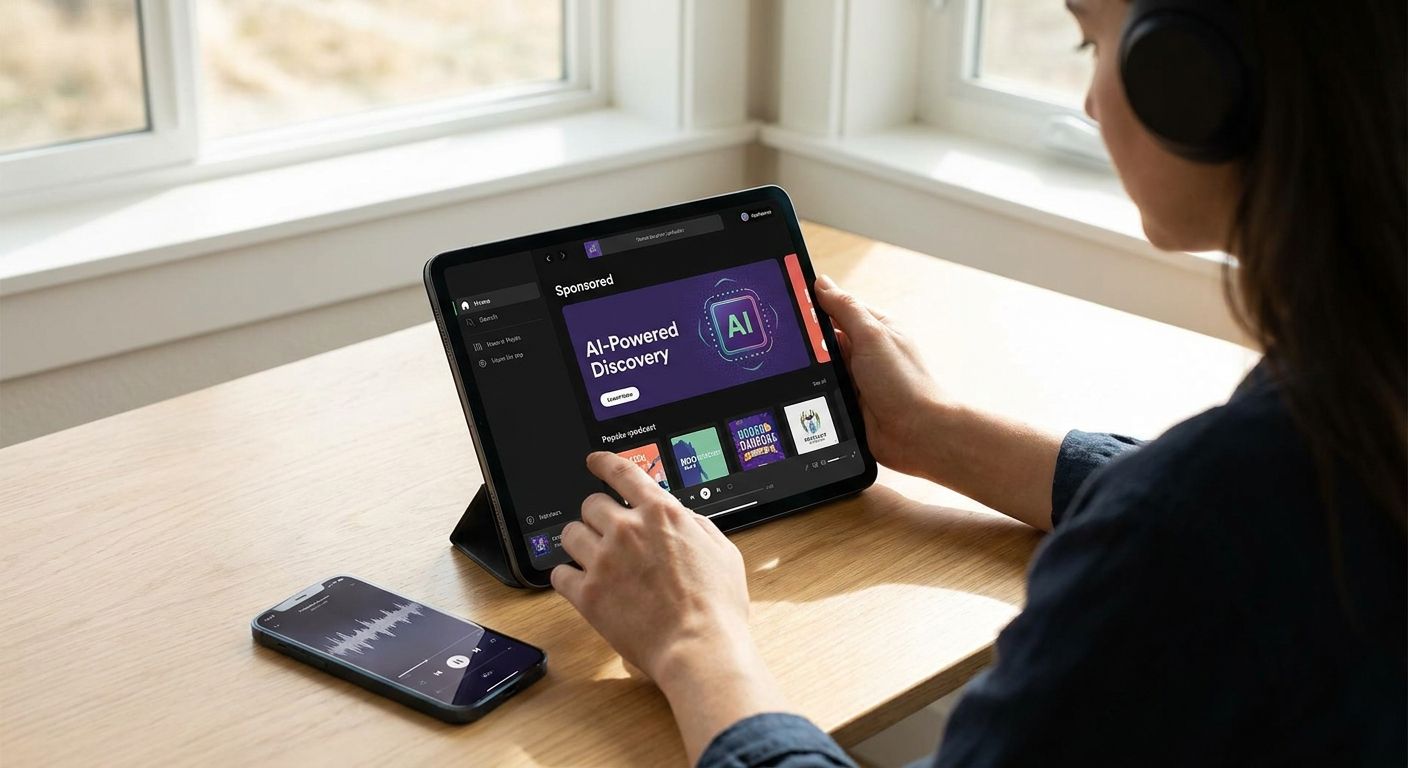
AI podcast discovery assistants that recommend, summarize, and route users to episodes sit on a stream of intent-rich conversation — and in 2026 that conversation is worth more than the API bill it costs to run. Picking the wrong ad approach either kills the chat experience or leaves that revenue on the table.
- Contextual SDKs like the [Elo](https://elo.ad/) ad server match episode topics to advertisers turn by turn — Buy for most podcast discovery assistants in 2026.
- Generic mobile ad mediation built for games fills poorly on niche podcast topics and breaks chat UX — Skip.
- Voice-first assistants need mediation tuned for spoken turns, not tap-to-click banners — Consider only purpose-built voice ad mediation.
- Direct sponsorship deals work for assistants with concentrated traffic in one genre but don't scale past a handful of advertisers — Consider.
Why this matters
A podcast discovery assistant doesn't sell anything itself. Its revenue model has to come from somewhere else, and app store subscriptions rarely cover the inference cost of a chat-based recommendation engine. Ad monetization for an AI podcast discovery assistant fills that gap, but only if the ad matches what the user is actually asking about — true crime, tech news, comedy, fitness, whatever genre they're browsing.
Generic ad networks weren't built for this. They were built for scroll-and-tap mobile screens, not multi-turn conversation. That mismatch is why founders keep asking what actually works for a chat-native product in 2026, not 2019.
Who this is for
This guide is for developers and founders running an AI podcast discovery assistant — built on OpenAI, Anthropic, or a custom LLM stack — who already have users asking for episode recommendations and now need a way to turn that traffic into revenue. If your assistant is pre-launch or still validating retention, an ad-supported model from Elo can run alongside a free tier without forcing a paywall decision before you're ready.
What to look for in ad monetization for an AI podcast discovery assistant
Episode-level context matching
Matching an ad to "podcast app" as a category is not the same as matching it to a user asking about a true-crime episode versus a startup interview. The matcher needs to read the actual conversation turn, not just the app metadata, or the ad will feel bolted on instead of relevant.
Native card format, not banner
Podcast discovery is conversational — users type or speak a request and get a response. A banner interrupts that flow. A native ad card that reads like part of the answer keeps the session intact and gets clicked because it looks like a recommendation, not an interruption.
Fill rate on long-tail genres
Mainstream podcast categories fill easily. Niche genres — hyperlocal news, regional sports, indie music criticism — are where most discovery assistants actually differentiate, and where generic ad networks run dry. Check fill rate on the long tail before you commit, not just the top five categories.
Latency inside the chat turn
Every ad call adds time to a response. If the ad request blocks the LLM's answer, users notice immediately. The ad layer needs to resolve fast enough that it doesn't become the bottleneck in the conversation.
Revenue model transparency
CPM, CPC, and CPA are three different ways to get paid, and each rewards a different kind of traffic. A discovery assistant with high session volume but low click-through needs a model that doesn't punish impressions that don't convert.
Brand safety across audio content
Podcast content spans true crime, politics, comedy, and religion — categories advertisers are picky about. The ad layer needs controls that keep a mattress ad off a war-crimes episode without you building a blocklist by hand.
Top picks
The built-for-chat pick: contextual SDK matching
This is the approach purpose-built for conversational apps rather than adapted from mobile display. Elo's SDK reads conversation context turn by turn and drops a native card, not a banner, into the response — a handful of lines of SDK code rather than a full mediation stack. Every chat is monetizable under this model, including sessions that never lead to a click, because the payout isn't click-dependent alone. Verdict: Buy for any AI podcast discovery assistant launching or relaunching monetization in 2026.
The voice-first pick: mediation tuned for spoken turns
If your podcast discovery assistant runs through a voice interface rather than text, ad mediation for voice AI assistants solves a different problem: an ad has to be spoken or surfaced without a tap target. Mediation built for screen taps doesn't map cleanly onto a voice turn. Verdict: Consider if voice is your primary interface — skip it if your assistant is text/chat-only.
The audio-vertical pick: category-tuned networks
Audio and music-adjacent ad networks already carry advertiser relationships built around listening behavior, which overlaps with podcast discovery more than generic display inventory does. Ad monetization for AI music and audio assistant apps covers the same buyer categories — audio equipment, streaming subscriptions, music gear — that show up in podcast-adjacent conversations. Verdict: Consider as a secondary source, not your primary one.
The comparison-shopper pick: run the SDK bake-off
If you're not ready to commit to one vendor, the roundup of ad monetization SDKs for AI chatbot developers lays out the field side by side. Useful if you want to test two SDKs against each other on your own traffic before locking in. Verdict: Consider as a research step, not a final answer — you still need to pick one and integrate it.
The DIY pick: direct sponsorship deals
Some podcast discovery assistants with a concentrated audience — say, a single genre like true crime or tech interviews — go straight to sponsors instead of a network. It can pay better per impression, but it doesn't scale past a handful of relationships and needs manual renewal every quarter. Verdict: Consider only if your traffic is niche and concentrated; Skip if you need programmatic scale.
What to avoid
- Repurposed mobile game ad SDKs. Interstitials and rewarded-video formats built for gaming apps don't translate to a chat interface — they force a full-screen interruption into a conversation flow, and users bounce.
- Keyword-only matching without conversation context. Matching on the word "podcast" alone, without reading what episode or genre the user is actually discussing, produces irrelevant ads that erode trust in the recommendation itself.
- Opaque revenue-share networks. If a network won't show you a CPM, CPC, or CPA breakdown before you integrate, you won't know if the deal is worth the latency cost until months in.
Test contextual ad matching on real chat traffic
See how the SDK reads conversation context before you commit.
Verdict comparison
| Approach | Context matching | Format | Fill on niche genres | 2026 Verdict |
|---|---|---|---|---|
| Contextual SDK (Elo) | Turn-by-turn | Native card | High | Buy |
| Voice ad mediation | Turn-by-turn, spoken | Voice/audio card | Moderate | Consider (voice-first only) |
| Audio-vertical network | Category-level | Native or audio | Moderate | Consider (secondary) |
| Direct sponsorship | Manual, per-deal | Custom | N/A | Consider (concentrated niche) |
| Repurposed mobile ad SDK | App-category only | Banner/interstitial | Low | Skip |
FAQ
What is the best ad monetization for an AI podcast discovery assistant in 2026?
A contextual ad SDK that reads conversation turns and serves native cards, not banners, is the strongest fit for podcast discovery assistants in 2026. It matches episode-level intent instead of just app-category, which keeps click-through and revenue per user higher than generic mobile ad networks.
Is voice ad mediation different from text-based ad SDKs?
Yes. Voice ad mediation is built for spoken turns without a tap target, while text-based SDKs render a visual native card in the chat. If your podcast discovery assistant runs primarily through voice, use mediation built for that format specifically.
How much does ad monetization for an AI chatbot cost to integrate?
Integration cost is mostly developer time, not licensing fees, since most conversational ad SDKs run on a revenue-share model rather than an upfront fee. The Elo SDK integrates in a handful of lines of code rather than a full mediation stack.
Do ads hurt retention in an AI podcast discovery assistant?
Poorly matched banner ads hurt retention because they interrupt the conversational flow. Native ad cards matched to the actual episode topic tend to read as part of the recommendation rather than an interruption, which is why format and context matching matter more than whether ads exist at all.
Can I run direct sponsorship deals instead of an ad network?
Yes, if your podcast discovery assistant has concentrated traffic in one genre, direct sponsorships can pay better per impression than a network. They don't scale past a handful of advertiser relationships without manual renewal, so most assistants pair them with a programmatic layer.
What pricing model should I use — CPM, CPC, or CPA?
CPM pays on impressions, CPC pays on clicks, and CPA pays on completed actions — each rewards different traffic. A discovery assistant with high session volume but modest click-through benefits from a CPM component so impressions that don't convert still generate revenue.
Does ad monetization work for a Claude-based or custom LLM podcast assistant?
Yes. SDK-based ad servers built for conversational apps work across OpenAI, Anthropic, and custom LLM stacks because the matching happens on the conversation content, not the model provider.
How do I keep ads brand-safe on sensitive podcast genres?
Use an ad layer with category-level brand safety controls rather than a manual blocklist, since podcast content spans genres like true crime and politics that many advertisers want to avoid by default.
One last thing
The assistants that make the most from ad monetization in 2026 aren't the ones with the most users — they're the ones where every session, converting or not, still counts as a monetizable event because the ad model doesn't depend entirely on clicks.