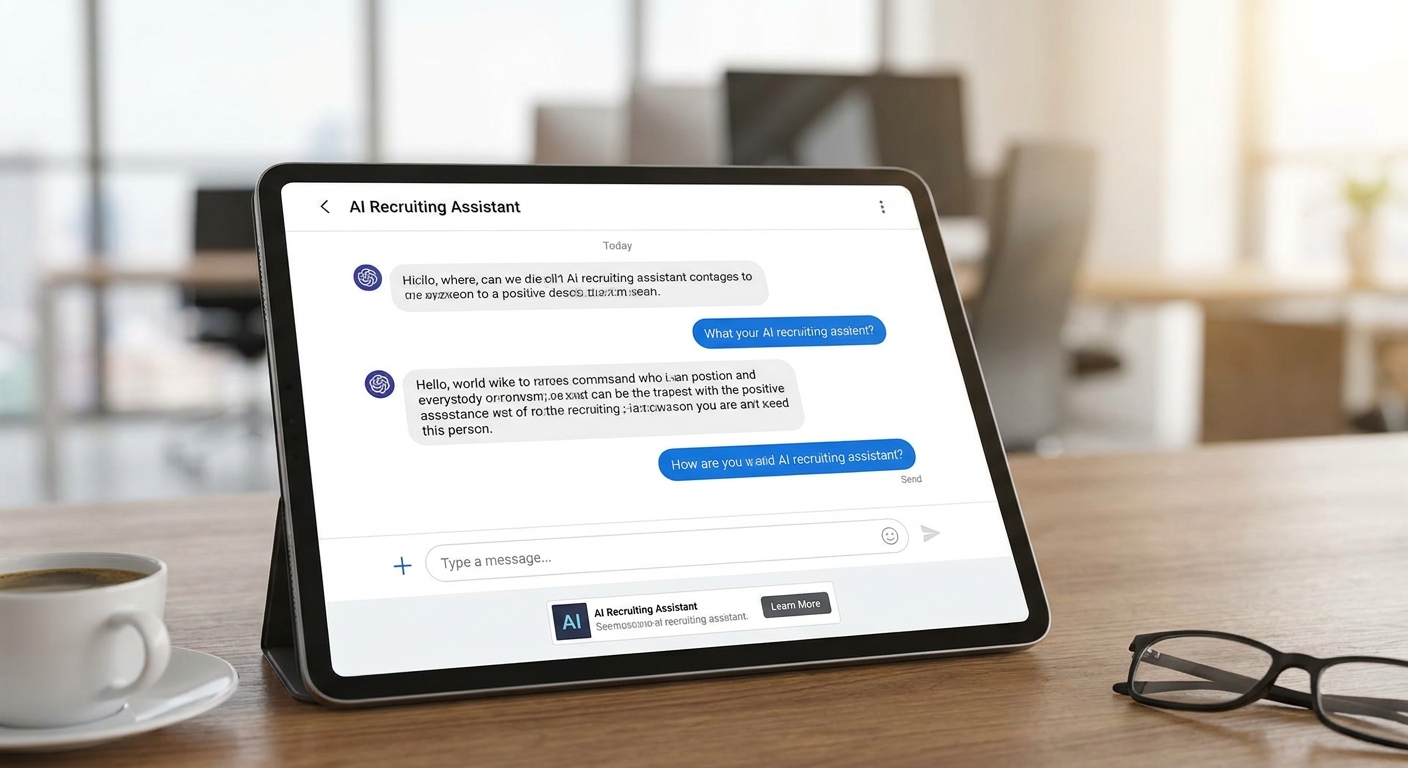
AI recruiting chatbots — candidate screening bots, interview schedulers, career-site concierges — sit on high-intent chat volume that mostly goes unmonetized in 2026. Ad monetization for AI recruiting chatbots means turning that conversational traffic into revenue without breaking the candidate experience, and the SDK you pick determines whether that works or backfires.
- Elo's SDK integrates in a day for OpenAI, Anthropic, and custom LLM recruiting bots — Buy for teams with dev bandwidth this quarter.
- Contextual matchers targeting candidate intent (upskilling, background checks, benefits) outperform generic banner ad networks in 2026.
- RAG-based recruiting bots need retrieval-aware ad placement, not post-hoc banner injection — pick the RAG-specific integration path.
- Avoid payday-loan and dating-app ad categories entirely — brand safety in recruiting chat is non-negotiable.
Why this matters
A recruiting chatbot that handles 10,000 conversations a month and monetizes none of them is leaving revenue on the table every single day in 2026. Job seekers ask about interview prep, relocation, certifications, background check timelines — all of it maps to advertiser categories that already exist. The Elo adserver treats every one of those turns as a monetizable event, whether the chat converts to a hire or not.
The catch: recruiting is a sensitive vertical. Ads that feel like banners, or ads pulled from an irrelevant category, damage candidate trust fast — and candidate trust is the entire product for an ATS or career-site bot. Ad monetization for AI recruiting chatbots only works when the ad matcher understands recruiting context specifically.
Who this is for
This guide is for engineering and product leads building or operating AI recruiting chatbots in 2026 — candidate-facing screening assistants, interview scheduling bots, career-site chat widgets, or internal mobility bots built on OpenAI's API, Anthropic's Claude, or a custom LLM stack. If your chatbot already has meaningful daily conversation volume and no revenue line attached to it, the criteria below apply directly to you.
What to look for in ad monetization for AI recruiting chatbots
Contextual relevance to candidate intent
A recruiting bot that surfaces a car insurance ad mid-interview-prep conversation reads as noise, not value. The matcher needs to read the actual conversation — resume gaps, certification questions, relocation logistics — and serve offers that fit, the same way a native card for an upskilling course lands better than a random banner.
SDK integration effort
Engineering teams shipping a recruiting bot in 2026 don't have weeks to spare on ad plumbing. Look for an SDK that drops in with minimal lines of code and doesn't require rearchitecting your chat loop — a multi-week integration kills the business case before revenue starts.
Revenue model transparency
CPM, CPC, and CPA all behave differently against recruiting chat volume, and RPM (revenue per thousand messages) is the number that actually tells you if monetization is working. Any adserver you evaluate should expose that metric in a dashboard, not bury it in a monthly invoice.
Brand safety for a professional context
Recruiting chat sits next to compliance-sensitive conversations — background checks, salary discussion, visa status. Ad categories need filtering at the vertical level so a candidate never sees a payday loan or dating app ad next to an offer letter discussion.
Latency and chat experience
An ad call that adds 400ms to every response turns a fast recruiting bot into a slow one. The ad card needs to render inline, non-intrusively, without a visible round-trip delay the candidate notices.
Architecture fit — OpenAI, Claude, custom LLM, or RAG
A bot built on retrieval-augmented generation over job descriptions and resumes needs ad placement that's retrieval-aware, not a banner bolted onto the UI layer. A bot on raw OpenAI completions has different integration needs than one on Anthropic's Claude or a fully custom model.
See the SDK in your stack
Twelve lines of code to start monetizing recruiting chat conversations.
Top picks for recruiting chatbot ad monetization
The custom-stack pick. If your recruiting bot runs on a custom LLM rather than a vendor API, contextual advertising for custom LLM chatbots is built for that architecture — the matcher reads model output directly instead of assuming an OpenAI or Anthropic response schema. Integration teams report same-week deployment in 2026 pilots. Buy if you're running a proprietary or fine-tuned model.
The RAG-specific pick. Recruiting bots that retrieve from job postings, resumes, or internal policy docs need ad placement that respects retrieval context — in-chat ads for RAG-based chatbots matches ad candidates against the retrieved chunks, not just the raw user message. This avoids the mismatch where a bot retrieves a job description about remote work and serves an ad for office furniture. Buy for any career-site bot with a document retrieval layer.
The OpenAI-native pick. Most candidate screening bots shipped in 2026 still run directly on the OpenAI API. Conversational ads for OpenAI GPT chat apps plugs into that flow with native card rendering instead of a banner overlay, keeping the chat UI consistent. Buy if you're on GPT-4 class models with no custom fine-tuning.
The adjacent-use-case comparison. Recruiting chat and post-hire onboarding support chat share a lot of structural overlap — both are high-frequency, low-transaction-value conversations. Ad monetization for AI customer support bots is worth reviewing if your recruiting bot also handles onboarding questions after an offer is accepted. Consider if your bot's scope extends past the initial candidate funnel.
What to avoid
- Generic banner ad networks retrofitted into chat. A banner injected into a chat window breaks the conversational format candidates expect in 2026 — it reads as an interruption, not a native card.
- Unfiltered ad categories. Payday loans, dating apps, and unrelated consumer verticals showing up next to a background check conversation is a brand-safety failure, not a monetization win.
- Post-hoc ad injection with no context read. If the matcher only sees the last user message and not the conversation history, expect irrelevant offers and low click-through — the RPM number will show it within the first week.
Verdict comparison
| Integration path | Best for | Verdict |
|---|---|---|
| Custom LLM contextual ads | Proprietary/fine-tuned models | Buy |
| RAG-based in-chat ads | Bots retrieving job docs/resumes | Buy |
| OpenAI GPT conversational ads | Standard GPT-4 class deployments | Buy |
| Customer support bot monetization | Bots spanning onboarding + recruiting | Consider |
| Generic banner networks | None — retrofit risk | Skip |
FAQ
What is ad monetization for AI recruiting chatbots?
It's the practice of embedding contextual, conversational ads inside a recruiting chatbot's chat flow so every conversation — hired or not — generates advertiser revenue. Elo's SDK reads the conversation context and serves native cards instead of banners.
Does adding ads slow down a recruiting chatbot?
A well-integrated SDK renders ad cards inline without a noticeable round-trip delay. Latency issues usually come from poorly optimized ad calls, not from the concept of in-chat monetization itself.
Is ad monetization safe for a candidate-facing recruiting bot?
Yes, as long as the ad matcher filters categories at the vertical level. Recruiting chat sits next to sensitive topics like background checks and salary, so ad category filtering matters more here than in general-purpose chatbots.
How much revenue can a recruiting chatbot generate from ads?
Revenue depends on conversation volume and RPM (revenue per thousand messages), which varies by ad category fill rate and candidate engagement. Dashboards that expose RPM in real time let you model this against your actual traffic in 2026.
What's the difference between CPM, CPC, and CPA for chatbot ads?
CPM pays per thousand impressions regardless of clicks, CPC pays per click, and CPA pays only when a defined action completes. Recruiting chat volume with low click intent often monetizes better under CPM than CPC.
Can a RAG-based recruiting bot use the same ad SDK as an OpenAI-only bot?
Not optimally. A RAG-based bot needs an integration that reads retrieved document chunks, while an OpenAI-only bot can work directly off the completion stream — pick the integration path matching your architecture.
How long does it take to integrate an ad SDK into a recruiting chatbot?
Teams with existing OpenAI or Claude-based bots report integration in a day to a week in 2026, depending on how much of the ad card rendering needs custom styling.
What ad categories should recruiting chatbots avoid?
Payday loans, dating apps, and any category unrelated to career development or benefits should be filtered out. Upskilling courses, certification providers, and relocation services are a better category fit.
One last thing
The recruiting bots getting the best RPM numbers in 2026 aren't the ones with the most ad slots — they're the ones matching ads to specific candidate moments, like a certification offer right after a skills-gap question, not a blanket ad on every turn. Fewer, better-matched offers beat higher ad density every time in this vertical.