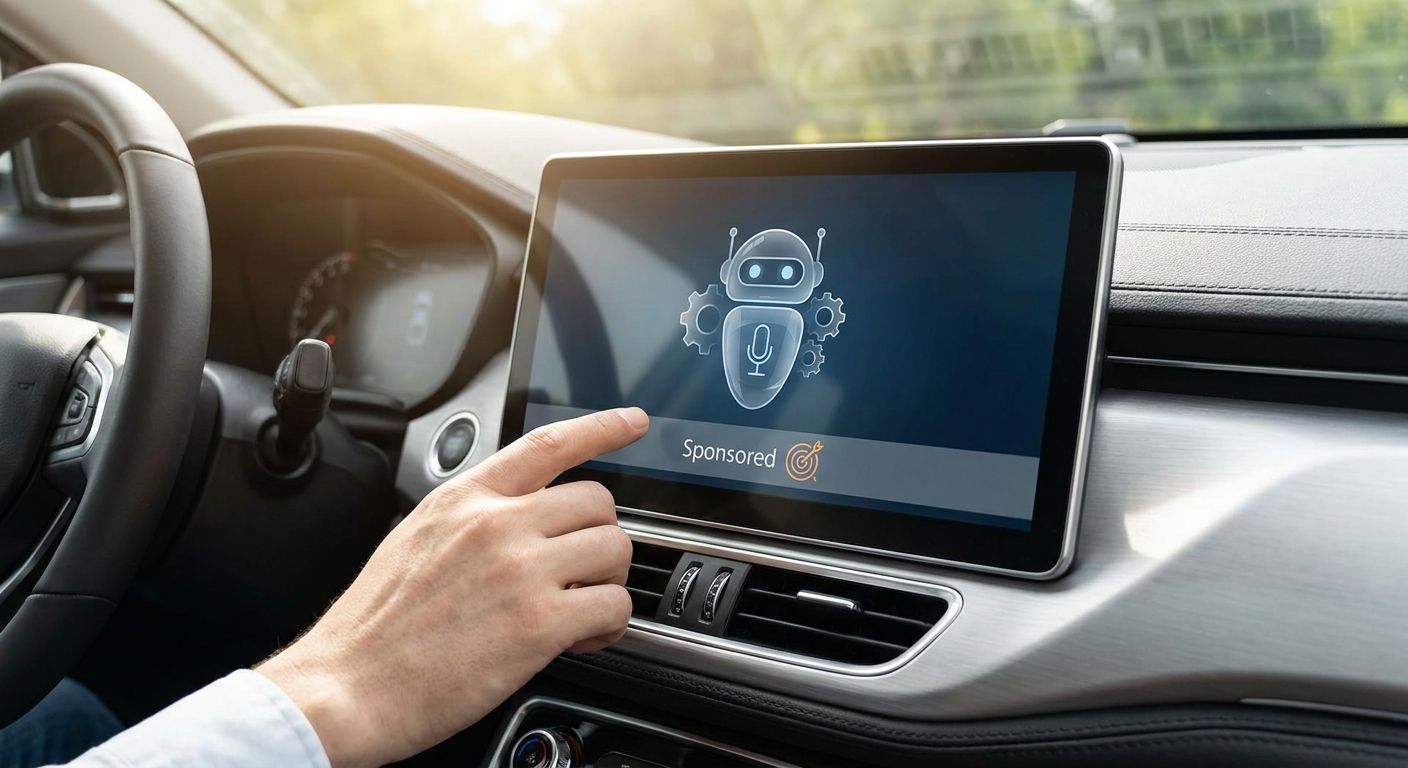
AI automotive assistant apps handle high-intent conversations about financing, parts, and service, which makes them some of the most valuable chat surfaces to monetize in 2026 if the ad layer doesn't break trust.
- Elo's contextual matcher is the safe pick for an ad sdk for ai automotive assistant apps built on OpenAI, Anthropic, or a custom LLM.
- Native in-chat cards outperform banner retrofits in a high-consideration flow like car buying or service scheduling.
- Legacy mobile ad networks bolted onto a chat window force fixed banner sizes like 300x250 and 320x50 into a UI that was never built for them: Skip.
- Revenue-per-user measurement should ship day one, not after launch, in any 2026 automotive chatbot monetization stack.
Why this matters
A car-buying assistant, a dealership service bot, or an in-car voice assistant carries conversations that are already commercial: financing terms, trade-in value, tire brands, extended warranties, roadside coverage. That's inventory an advertiser will pay for, but only if the ad fits the conversation instead of interrupting it.
Elo runs as an SDK layer that reads conversation context and serves a native ad card instead of a banner, which matters more in automotive chat than almost any other vertical because the user is mid-decision on a large purchase. A poorly timed ad here doesn't just lower click-through, it kills the assistant's credibility.
Who this is for
This guide is for developers and product teams shipping AI automotive assistant apps in 2026: dealership inventory chatbots, financing and trade-in estimators, service-scheduling assistants, roadside-support bots, and in-car voice copilots built on OpenAI, Anthropic, or a custom LLM stack. If your assistant handles more than a few thousand automotive-intent conversations a month and you're not monetizing them, you're leaving CPM revenue in conversations that already have commercial signal.
What to look for in an ad SDK for AI automotive assistant apps
Contextual match quality for automotive intent
Generic keyword matching misses the difference between someone asking about a used sedan's financing and someone asking about tire replacement, and automotive advertisers pay differently for each. A matcher that reads full conversation context, not just the last message, catches financing offers, parts ads, and insurance ads at the moment they're relevant instead of firing a generic auto-category ad. Matching ads to conversation context is the single biggest lever on RPM in this vertical.
Native card format, not a banner retrofit
A car-buying conversation is high-consideration; a 320x50 banner jammed under a chat bubble reads like spam in that context. Native cards that match the assistant's own UI keep the ad from breaking the flow of a financing or trade-in conversation, and users are more likely to tap an offer that looks like part of the assistant's response rather than an ad unit fighting for attention.
Fill rate for niche automotive queries
Automotive assistants generate long-tail queries: a specific trim level, a regional dealership promotion, an EV charging network question. An SDK with thin advertiser demand in this vertical leaves those conversations unmonetized, so fill rate on niche automotive intent, not just broad "auto" category fill, is the number to check before committing.
Low-latency rendering for voice and embedded chat
In-car voice assistants and embedded dealership widgets both have tight latency budgets; an ad call that adds visible lag breaks the conversational feel the whole product is built on. The SDK needs to resolve and render the ad card without a noticeable pause after the LLM's response.
Revenue reporting per session, not just aggregate spend
You need to see RPM and fill rate broken out by conversation type, not just a single monthly revenue number, to know whether financing-intent conversations or service-scheduling conversations are the ones actually paying. Without session-level reporting you're optimizing blind.
Top picks for monetizing an AI automotive assistant
Contextual card matching tied to conversation context — the safe pick. It reads the full conversation, not keyword triggers, and serves one native card per relevant turn instead of stacking multiple ad slots into a single response. Verdict: Buy.
Native in-chat cards over banner retrofits — the UX-safe pick. Instead of forcing IAB banner dimensions like 300x250 or 320x50 into a chat window, the card renders in the assistant's own visual language, which avoids hurting chat UX during a financing or trade-in conversation. Verdict: Buy.
Multi-network mediation for niche automotive fill — the scale pick. When a single ad network can't fill a long-tail query about a regional EV incentive, mediation across networks raises the odds a relevant offer still renders instead of leaving the turn blank. Verdict: Consider, worth it once monthly automotive-intent conversation volume justifies the added integration surface.
Set up ad mediation for your automotive bot
Route ad requests across networks so niche automotive queries still fill.
What to avoid
- Legacy mobile ad networks bolted onto a chat UI. Networks built for app install ads force fixed banner sizes — 300x250, 320x50 — into a conversational surface that was never designed to hold them. It reads as spam in a car-financing thread and tanks trust in the assistant. Skip.
- Manual affiliate links pasted into bot responses. No context matching, no reporting, no fill-rate visibility — just a static link with no way to know which conversations actually convert. Skip.
- Ad SDKs with no per-session reporting. If you can't see RPM broken out by conversation type — financing vs. service vs. parts — you can't tell which automotive use case is actually paying for the assistant. Skip.
“A banner in a car-buying conversation reads like a pop-up ad in a dealership showroom.”
Verdict comparison
| Criterion | Contextual matching | Banner retrofit | Manual affiliate links |
|---|---|---|---|
| Fits high-consideration flow | Yes | No | No |
| Fill rate on niche auto intent | High | Low | None |
| Latency for voice/in-car use | Low | Medium | N/A |
| Session-level revenue reporting | Yes | Rare | No |
| Verdict | Buy | Skip | Skip |
FAQ
What's the best ad sdk for ai automotive assistant apps?
An SDK that matches ads to full conversation context and renders native cards, not banners, fits automotive assistants best because the conversations are high-consideration. Elo's matcher reads the conversation before serving a card, which keeps financing and service-scheduling threads from feeling interrupted.
Can I add ads to a car-buying chatbot without hurting the user experience?
Yes, if the ad renders as a native card matched to the conversation rather than a banner. Users tolerate a relevant financing or trade-in offer mid-conversation far better than a fixed-size banner competing for space in the chat window.
Do contextual ads work for in-car voice assistants?
Contextual ads work for voice assistants when the SDK resolves and renders fast enough to avoid noticeable lag after the spoken response. Latency, not ad relevance, is usually the failure point in voice-first automotive apps.
Is ad mediation worth it for a niche automotive chatbot?
Mediation across multiple ad networks is worth it once your automotive assistant handles enough long-tail queries — regional dealership promotions, specific trims, EV incentives — that a single network's fill rate leaves turns unmonetized. Below that volume, one well-matched network is simpler to run.
Does an ad sdk work with Claude or a custom LLM automotive bot?
Yes, an SDK-based adserver built for AI chat apps sits alongside the model layer regardless of whether the assistant runs on OpenAI, Anthropic's Claude, or a custom LLM. The ad call happens after the model response, not inside the model itself.
How is ad revenue measured per automotive chat session?
Revenue per session is measured by tracking RPM and fill rate broken out by conversation type — financing, service scheduling, parts — rather than a single blended monthly number. That breakdown shows which automotive use case actually pays for the assistant.
What ad format fits an in-car voice assistant best?
A short native offer read back conversationally, not a visual banner, fits an in-car voice assistant because the driver isn't looking at a screen. The offer needs to resolve in the same response turn as the assistant's spoken answer.
How much does ad SDK integration slow down a chat app?
Integration overhead depends on the SDK's rendering path, but the ad call should add no perceptible delay to the assistant's response in a well-built integration. Check latency numbers during testing before launch, not after.
One last thing
The automotive assistants that monetize best in 2026 aren't the highest-traffic ones — they're the ones where the ad matches a decision the user is already mid-way through, like financing terms or a service appointment, so the offer reads as help instead of interruption.