An AI skincare or beauty assistant collects more purchase-intent signal per session than almost any other chatbot category — skin type, active ingredient sensitivities, routine steps, brand preferences — and an ad SDK for AI skincare assistant apps is what turns that context into revenue instead of letting it evaporate at the end of a free session.
- Elo's ad SDK for AI skincare assistant apps matches native cards to ingredient and routine context — Buy once you're past MVP.
- Skip legacy banner mediation networks built for mobile games; they ignore chat context and stall streaming responses.
- Affiliate shopping links work for dupe-finder bots but leave consultation-style chats unmonetized — Consider as a supplement, not a base layer.
- Brand safety filtering matters more here than in most verticals: active-ingredient claims and medical-sounding language need a filter before an ad renders.
Why this matters
Skincare and beauty assistants live or die on trust. A user typing "what's causing my breakouts" or "is retinol safe with my current routine" is not in a mood for a banner ad or a pop-up. They're in a mood to be helped — and the moment your bot interrupts that with something that looks like an ad network from 2015, you lose the session and probably the user.
The upside is real: these conversations carry buying intent that shopping and beauty brands pay for directly. Elo exists because that gap — high-intent conversation, no clean way to monetize it without wrecking UX — showed up across hundreds of AI chat products, skincare assistants included. In 2026, the developers winning this category are the ones treating ad placement as a product decision, not an afterthought bolted on before a fundraising deck.
Who this is for
This guide is for developers and founders building AI beauty or skincare products on OpenAI, Anthropic, or a custom LLM stack — routine builders, ingredient analyzers, dupe finders, virtual esthetician-style chatbots, or any assistant where a user describes their skin and expects product-level recommendations back. If your app has real session volume and no revenue line beyond a future subscription plan, this is the exact profile the ad SDK category was built for.
What to look for in an ad SDK for AI skincare assistant
Contextual matching to skin and ingredient conversation
A generic keyword matcher sees "retinol" and "vitamin C" as unrelated tokens. A matcher built for conversational context understands that a user asking about purging versus breakouts is at a different stage of the funnel than someone asking for a full routine, and serves accordingly. This is the single biggest quality differentiator between an ad SDK for AI skincare assistant apps and a repurposed mobile ad network — read more on how ad matching works against conversation context before picking a vendor.
Native card format, not banner
Skincare chat UX depends on the assistant feeling like a dermatologist's assistant, not a shopping mall. Ads rendered as native cards inside the chat thread — same font, same spacing, clearly labeled as sponsored — get engagement that banners never will in this category. Anything that injects a display unit above or below the chat window is a UX regression users notice immediately.
Brand safety for actives and medical claims
Skincare content sits close to health content. An ad SDK that can't suppress placements next to discussions of cystic acne, eczema flare-ups, or prescription-strength retinoids is a liability, not a revenue tool. Check how a vendor handles keeping conversational ads brand safe before integration, not after a complaint.
Latency that doesn't stall the streaming response
Users ask skincare questions expecting a fast, confident answer. If ad selection adds visible lag to a streamed LLM response, you've traded ad revenue for churn. Test integration under real traffic conditions, not just a local sandbox, before shipping to production.
Revenue model transparency
CPM, CPC, and CPA are three different ways an ad SDK pays out, and each rewards a different kind of assistant. A routine-builder with long sessions and low click intent monetizes differently than a dupe-finder bot where every message ends in a product link. Pick a vendor that reports RPM and event logs clearly enough that you can tell which model is actually working for your traffic.
Multi-model support
Most skincare assistant teams don't stay on a single model provider forever. An SDK locked to OpenAI's function-calling format only is a rebuild waiting to happen the day you add a Claude-based fallback or a custom fine-tune.
Ways to monetize a skincare assistant — ranked
Elo's contextual ad SDK — the safe pick. Native cards matched to skin type, ingredient mentions, and routine stage, integrated in roughly a dozen lines of code on top of an existing OpenAI or Anthropic chat flow. Every chat is monetizable under this model, even the ones that end without a purchase, because the SDK earns on impression and click events, not just conversions. Buy for any skincare or beauty assistant with production traffic in 2026.
Ad mediation across multiple networks — the hedge. Running more than one demand source through a mediation layer protects fill rate when a single network's beauty and skincare demand dips seasonally. It adds setup complexity but reduces the risk of empty inventory during low-demand weeks. Consider it once you're past a single-SDK integration and want redundancy — see ad mediation platforms for conversational AI apps for how the layer works.
Affiliate and shopping links — the supplement. Dupe-finder and product-comparison bots convert well on straight affiliate links because the user is already in buying mode. The problem: it does nothing for the larger share of sessions that are informational — routine questions, ingredient safety checks — where there's no product link to drop. Consider as an add-on revenue stream, never as the only one.
Legacy mobile ad networks repurposed for chat — the wildcard that isn't worth it. Networks built for gaming apps and mobile display inventory don't parse conversation context and were never designed to render inside a chat thread. Fill rates are inconsistent and the ad units look out of place next to a skincare consultation. Skip unless you're testing fill as a stopgap for a week, not a strategy.
Wellness-vertical ad networks with beauty demand — the niche option. Some networks built for health and wellness apps carry beauty and skincare advertiser demand already, which can shortcut the cold-start problem on advertiser supply. Worth a look if your assistant leans more toward skin health than pure cosmetics — see ad revenue tools for AI wellness apps for how that demand pool compares. Consider if your positioning sits closer to dermatology than makeup.
What to avoid
- Pop-up or modal ad formats. They interrupt the chat thread entirely and get dismissed before the user reads the offer — the opposite of a native card.
- Ad networks with no ingredient or skincare taxonomy. Without a category structure for actives, SPF, and routine steps, matching degrades to generic beauty ads that ignore what the user actually said.
- SDKs with no brand-safety controls near health-adjacent language. Skincare conversations brush up against dermatological topics constantly; an SDK with no suppression rules for medical-sounding queries will eventually place an ad somewhere it shouldn't be.
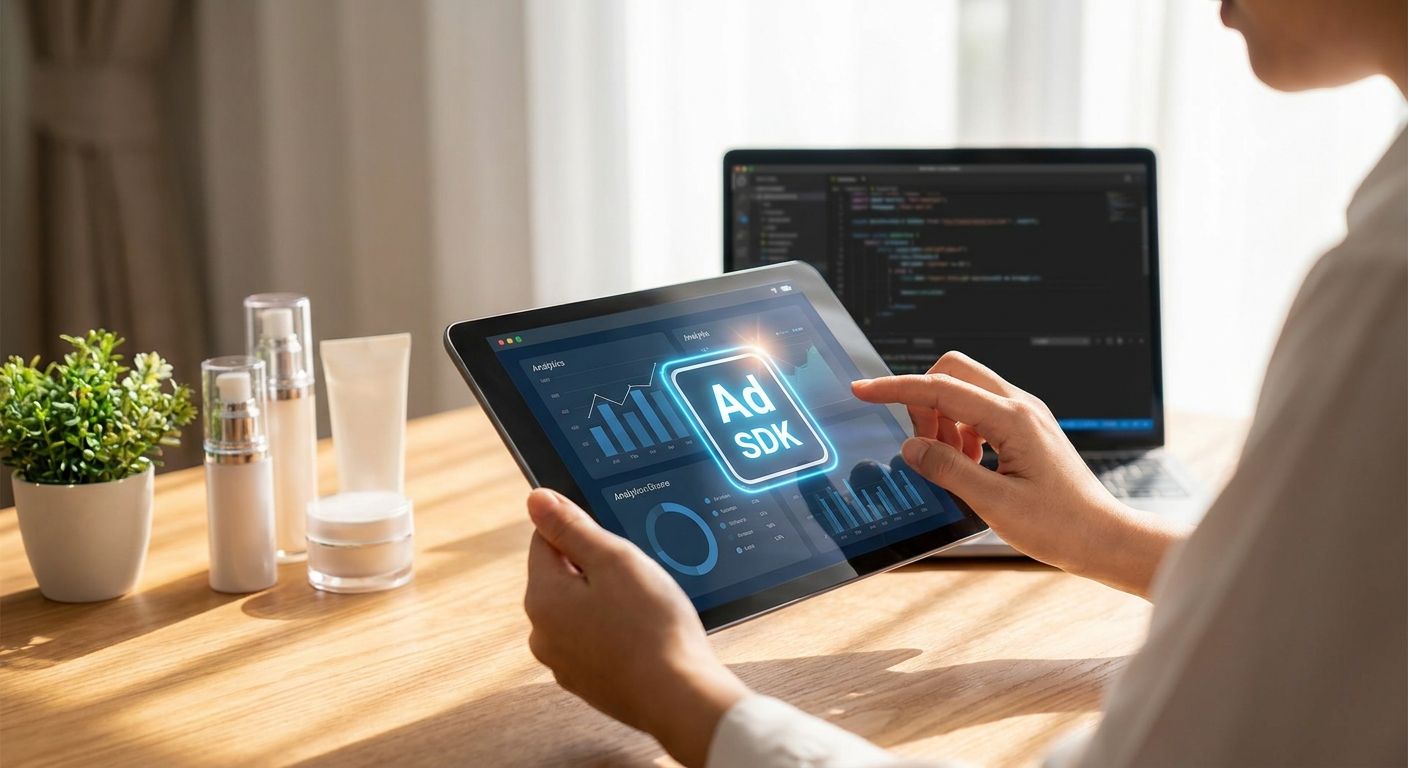
See the SDK in a skincare bot
Twelve lines of code, native cards, contextual matching built in.
Verdict comparison
| Approach | Matches conversation context | Native UX fit | Verdict |
|---|---|---|---|
| Elo contextual ad SDK | Yes — ingredient and routine aware | Native card | Buy |
| Multi-network ad mediation | Partial, depends on demand source | Native, if configured | Consider |
| Affiliate/shopping links | No — keyword only | Native, product-linked | Consider |
| Legacy mobile ad networks | No | Banner-style | Skip |
| Wellness-vertical networks | Partial | Native, varies | Consider |
FAQ
What's the best ad SDK for an AI skincare assistant?
For skincare and beauty assistants built on OpenAI or Anthropic, an SDK that matches ads to conversation context — skin type, ingredients, routine stage — outperforms generic mobile ad networks in both revenue and chat UX. Elo's SDK is built specifically for this contextual matching in 2026.
Is a native ad SDK better than affiliate links for a skincare bot?
Native ad SDKs monetize every session, including informational ones with no product intent, while affiliate links only pay when a user clicks through to buy. A skincare assistant that fields routine and ingredient questions needs both, not just affiliate links alone.
How much does an ad SDK for AI chat apps cost to integrate?
Integration cost is mostly developer time, not licensing fees, since most conversational ad SDKs run on a revenue-share model against advertiser spend. Check current terms directly with the vendor before committing engineering time.
Can ads break the chat experience in a skincare assistant?
Yes, if the ad renders as a banner or interrupts the streamed response with added latency. Native card formats placed inline, with no lag added to the LLM response, avoid this problem in 2026-era conversational ad SDKs.
Do I need brand safety controls for a skincare chatbot specifically?
Yes — skincare conversations frequently touch medical-adjacent topics like acne, eczema, and prescription actives, and an ad SDK without suppression rules near that language risks placing an ad in the wrong context.
Does an ad SDK work with a custom LLM, not just OpenAI or Anthropic?
A well-built ad SDK for AI skincare assistant apps should support custom LLM stacks as well as OpenAI and Anthropic, since many teams switch or add model providers after launch.
How is ad revenue measured in a skincare AI chatbot?
Revenue is typically tracked through CPM, CPC, or CPA models with RPM (revenue per thousand sessions) reported on a dashboard, letting developers see which conversation types actually monetize.
What's the difference between ad mediation and a single ad SDK?
Ad mediation runs multiple demand sources through one layer to protect fill rate, while a single SDK integration is simpler to set up but depends entirely on one network's advertiser demand.
One last thing
The skincare and beauty category has a structural advantage most verticals don't: users volunteer detailed personal context — skin type, allergies, budget, brand loyalty — without being asked twice, because it's how the assistant gives a good answer. That's exactly the signal an ad SDK for AI skincare assistant apps needs to match relevant ads instead of generic ones, and it's why this category tends to monetize better per session than assistants where users give up almost nothing about themselves.