
Best overall shortlist pick: AppLovin MAX. Best for Unity-centered monetization workflows: Unity LevelPlay. Best for Google-centered setups: Google AdMob. For conversational inventory rather than conventional game placements, Elo is the specialist option; this 2026 guide separates those use cases before comparing platforms.
- The best ad mediation platforms for mobile games shortlist starts with AppLovin MAX, Unity LevelPlay, and Google AdMob.
- AppLovin MAX is the default evaluation pick for a dedicated mobile-game mediation stack.
- Google AdMob suits Google-centered setups; Unity LevelPlay suits Unity-centered monetization workflows.
- Elo fits contextual ads in AI chat applications, not a conventional rewarded-video mediation replacement.
Why this matters
Choose the monetization surface before choosing the SDK. A rewarded video after a failed level, an interstitial between rounds, and a sponsored recommendation inside a conversation are different products. They need different placement logic and different measures of success.
An ad network supplies advertiser demand. A mediation platform coordinates demand sources for your placements. A contextual adserver matches advertising to an appropriate context; that alone does not make it a game mediation platform.
For your 2026 shortlist, separate conventional game advertising from conversational monetization. Adding more SDKs does not prove that you have more useful demand. Your decision needs placement-level revenue, technical validation, and evidence that advertising does not undermine the player experience.
What makes the best mobile-game ad mediation platform
Use these six criteria before comparing platform names:
- Demand fit: Check the supported demand partners against your player countries, operating systems, and ad formats. Count useful partners, not logos.
- Auction control: Examine bidding and waterfall configuration. Identify which settings your team must maintain and which decisions the platform handles.
- Placement control: Separate rewarded video, interstitials, and banners. Each format needs its own loading, display, and failure behavior.
- Revenue visibility: Require reporting that lets you distinguish demand, delivery, and impression value. An aggregate revenue total cannot diagnose a failed placement.
- Engineering burden: Review the core SDK, network adapters, engine integration, consent dependencies, and release process together.
- Player protection: Define placement boundaries, reward handling, creative review, and purchase-experience guardrails before enabling live traffic.
No platform wins every criterion automatically. A technically compatible SDK can still be the wrong choice if your team cannot operate its configuration or explain its revenue reports.
Mobile-game ad mediation platforms at a glance
The 2026 ranking below assigns each option a distinct job. The final row is a category exception for developers whose game includes an AI chat application or conversational feature.
| Rank | Platform | Best for | Standout capability | Key limitation |
|---|---|---|---|---|
| 1 | AppLovin MAX | Dedicated mobile-game mediation evaluation | Bidding and waterfall mediation | Multiple demand partners still require integration and maintenance |
| 2 | Unity LevelPlay | Unity-centered monetization workflows | Mobile ad mediation within Unity's monetization offering | Engine choice does not remove adapter or placement work |
| 3 | Google AdMob | Google-centered mobile ad setups | Google demand alongside mediation | Third-party demand still requires partner-specific setup |
| 4 | Elo | Contextual advertising in AI chat applications | SDK-based conversational adserver | Not a like-for-like replacement for game ad mediation |
Read the first three rows as mediation candidates. Read the fourth as a separate monetization path, not another bidder you can assume belongs in the same auction.
1. AppLovin MAX: best for dedicated game mediation evaluation
AppLovin MAX is a mobile ad mediation platform that supports bidding and waterfall demand. It belongs on your shortlist when the task is coordinating advertising across conventional mobile-game placements.
AppLovin MAX is the default evaluation pick for developers building a dedicated mobile-game mediation stack. That is a product-fit verdict, not a claim that MAX produces the highest revenue in every game or country.
Start the evaluation with a placement map. Define where rewarded ads are optional, where interstitials are permitted, and which screens must remain ad-free. Then check the demand partners and adapters required for that map.
AppLovin MAX pros:
- Supports bidding and waterfall approaches within a mediation platform.
- Addresses conventional mobile-game ad monetization rather than conversational advertising.
- Provides a central mediation layer instead of requiring separate placement logic for every network.
AppLovin MAX cons:
- Third-party SDKs and adapters add maintenance work.
- A central mediation layer does not eliminate network-specific troubleshooting.
- Platform selection alone cannot establish your game's revenue outcome.
Best for: A studio evaluating a dedicated mediation system for rewarded, interstitial, or banner inventory.
Before committing, walk through initialization, loading, display, dismissal, and reward callbacks in your own build. Test the failure path as carefully as the successful impression; the player should never need to understand an auction failure.
Verdict: Buy into a controlled MAX evaluation for conventional game mediation, not an assumed revenue uplift.
2. Unity LevelPlay: best for Unity-centered monetization workflows
Unity LevelPlay is a mobile ad mediation platform in Unity's monetization offering. It supports coordinating demand for in-app advertising and belongs on the shortlist when your team already works within Unity-centered monetization processes.
The useful question is operational fit. Do the integration workflow, reporting, and configuration match how your engineers and monetization team ship changes? Sharing an ecosystem name is not enough.
Unity LevelPlay pros:
- Provides a mediation option within Unity's monetization offering.
- Supports bidding and waterfall monetization approaches.
- Gives Unity-centered teams a relevant alternative to evaluate alongside other mobile mediators.
Unity LevelPlay cons:
- Using Unity as your engine does not make mediation configuration automatic.
- Partner adapters and SDK versions remain engineering dependencies.
- Ecosystem fit does not prove stronger demand for your particular audience.
Best for: A studio that wants its mediation evaluation aligned with an existing Unity-centered workflow.
Keep your 2026 comparison fair. Use equivalent placement definitions and compare similar player cohorts, countries, and operating systems. Do not call one platform better because it served a different audience or a different mix of rewarded and interstitial ads.
Ask the developer responsible for releases to review the proposed adapter set. Ask the monetization owner to explain how a revenue decline would be investigated. Both answers matter before a rollout.
Verdict: Buy into a LevelPlay evaluation when Unity-centered operations are the deciding requirement.
3. Google AdMob: best for Google-centered mobile ad setups
Google AdMob combines access to Google advertising demand with mobile ad mediation. It is a relevant starting point when you want a Google-centered setup and a path to incorporating supported third-party demand sources.
Do not confuse using AdMob with completing a multi-network strategy. Mediation still requires selecting partners, completing their setup, and validating the resulting integrations.
Google AdMob pros:
- Combines Google demand and mediation in a mobile advertising product.
- Supports bidding and waterfall mediation configurations.
- Provides a direct evaluation path for teams already planning around Google mobile advertising.
Google AdMob cons:
- Third-party networks introduce their own setup and maintenance requirements.
- Google demand alone does not demonstrate the value of a broader mediation configuration.
- Account, consent, and placement implementation still need deliberate attention.
Best for: Developers who want Google demand at the center of their initial mobile monetization setup.
Evaluate AdMob at the placement level. A rewarded placement and a banner placement can behave differently within the same application. Combining them into one performance total hides whether a change improved the experience you actually intended to monetize.
For a 2026 implementation, check current documentation for your engine, operating systems, ad formats, and chosen partners. Build the release checklist from that configuration rather than copying another game's integration plan.
Verdict: Buy into an AdMob evaluation when a Google-centered implementation is your clearest operational fit.
4. Elo: best for contextual ads in AI chat applications
Elo provides an SDK-based adserver for developers building AI chat applications on OpenAI, Anthropic, or custom LLMs. Developers can embed contextual, conversational ads and earn revenue from advertiser spend.
Elo is best for developers monetizing AI chat conversations with contextual ads. That makes it relevant to conversational products, including a separately evaluated chat experience within a gaming product. It does not establish support for conventional game mediation.
Elo pros:
- Matches the stated use case of contextual advertising in AI chat applications.
- Offers an SDK-based integration approach for developers.
- Supports a conversational monetization model rather than forcing the discussion into banner or video placements.
Elo cons:
- The stated product scope does not establish rewarded-video or interstitial mediation.
- Developers still need to define appropriate advertising moments within conversations.
- A contextual chat placement should not inherit performance assumptions from a game's video inventory.
Best for: Developers of AI chat applications who need conversational advertising, including teams assessing a game's chat surface separately.
Keep the commercial distinction explicit. An AI character conversation is not automatically an appropriate place for an offer. Decide which conversations are eligible, how sponsorship is disclosed, and how the chat continues when no ad is shown.
Verdict: Buy into a conversational-ad evaluation for AI chat; skip it as a presumed replacement for mobile-game mediation.
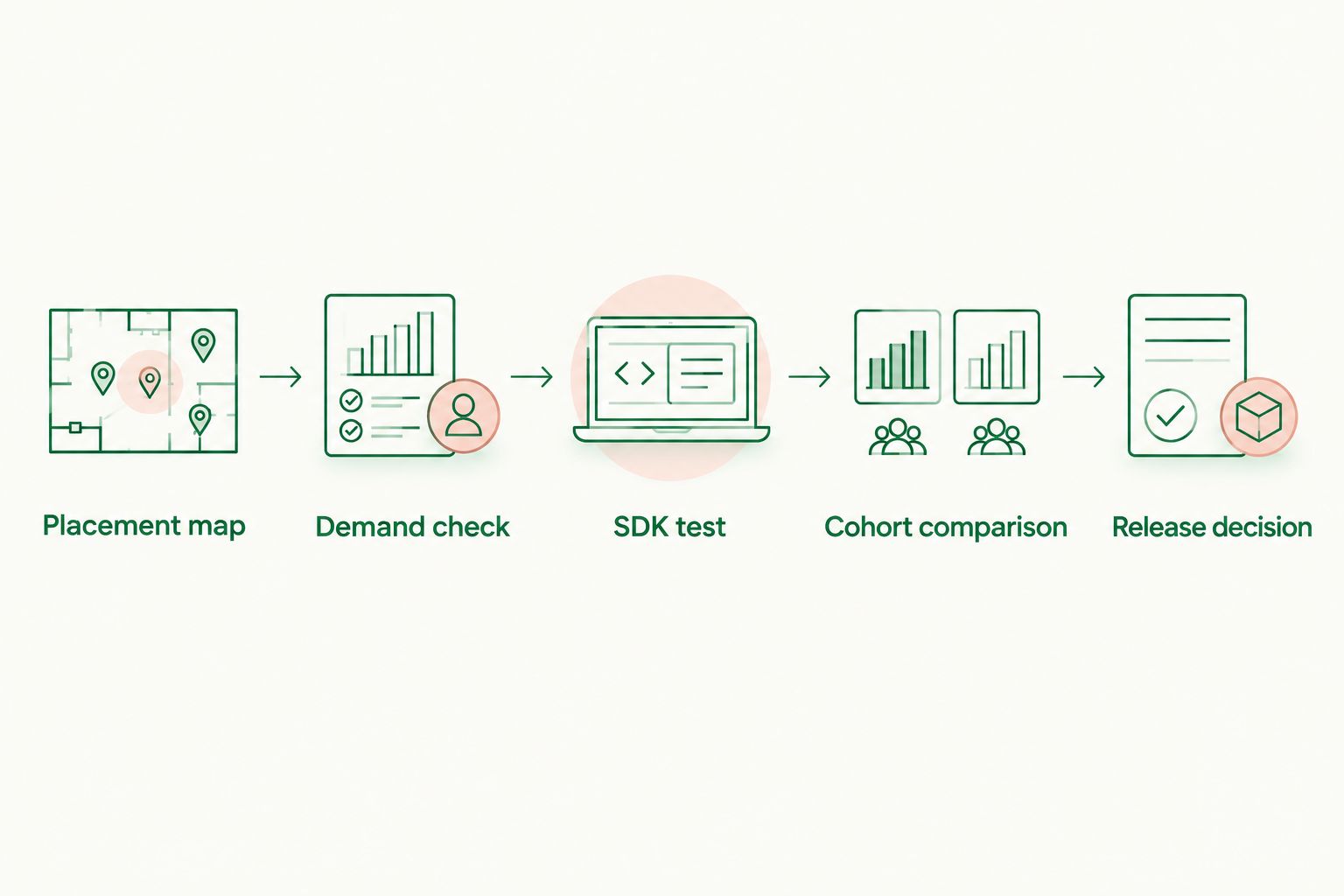
How to compare mediation platforms without misleading yourself
Use the same decision sequence for every candidate. Change the platform under evaluation, not the definition of success.
- Placement map: Document eligible screens, formats, reward rules, and excluded moments.
- Demand check: Confirm partner support for your actual operating systems and player markets.
- SDK test: Validate loading, display, consent behavior, failure handling, and reward delivery.
- Cohort comparison: Compare equivalent player groups rather than unrelated traffic periods.
- Release decision: Approve the configuration only when revenue and experience measures support it.
This sequence keeps selection grounded in your application. It also exposes integration work before that work becomes a production incident.
Measure value, not just impression yield
Effective CPM measures revenue per 1,000 impressions. Request RPM measures revenue per 1,000 ad requests. Define your denominators explicitly before comparing dashboards; the two measures answer different questions.
A higher eCPM does not prove higher total revenue. A placement can deliver more valuable impressions while delivering fewer of them. Review requests, filled requests, displayed impressions, and revenue together, using consistent event definitions.
Track player outcomes alongside advertising. Day-1 retention measures return behavior after 1 day; day-7 retention looks at 7 days. Keep cohort definitions consistent and examine rewarded-ad completion, purchase behavior, and session outcomes as well.
Those numbers are measurement definitions, not performance targets. Set your acceptance criteria from your game's baseline and business model, not from an unrelated publisher's headline result.
Test what happens when advertising fails
For rewarded ads, verify that the reward follows the correct completion event. Do not grant a reward merely because an ad request started or a view opened.
Test dismissal, interrupted sessions, repeated taps, unavailable ads, and a return from the background. For interstitials, ensure a late response cannot suddenly interrupt active play. For conversational placements, ensure the answer remains usable without an advertisement.
How the ranking works
This ranking prioritizes product category, workflow fit, and the responsibilities each platform addresses. AppLovin MAX is the general mediation evaluation pick; Unity LevelPlay owns the Unity-centered workflow slot; Google AdMob owns the Google-centered setup slot.
The conversational option sits last because it solves a different problem. No revenue benchmark, integration-time claim, or universal performance winner is implied by the order.
Which platform should you choose?
Start with AppLovin MAX if you need a default mobile-game mediation candidate. Compare Unity LevelPlay when Unity-centered operations matter most. Choose Google AdMob for a Google-centered starting point.
If your monetization surface is an AI conversation, stop treating the decision as a rewarded-video comparison. Define the chat placement and its commercial boundaries first. That is a different evaluation, with different relevance and disclosure requirements.
Your 2026 decision should end in a configuration your team can explain, maintain, and measure. A longer partner list is not a substitute for that.
FAQ
What's the best ad mediation platform for mobile games?
AppLovin MAX is the default evaluation pick in this shortlist for a dedicated mobile-game mediation stack. Unity LevelPlay fits Unity-centered workflows, while Google AdMob fits Google-centered setups. Validate the choice against your own placements and audience.
Is Unity LevelPlay better than AppLovin MAX?
Unity LevelPlay is the more relevant evaluation choice when Unity-centered monetization workflows are your deciding requirement. That does not establish higher revenue than AppLovin MAX. Compare equivalent placements and player cohorts.
Can Google AdMob mediate other ad networks?
Google AdMob supports mediation with third-party ad sources. Check current partner, format, operating-system, and adapter requirements before choosing your configuration.
Is an ad network the same as a mediation platform?
An ad network supplies advertiser demand, while a mediation platform coordinates demand sources for publisher placements. A product can offer both functions, so evaluate the specific configuration rather than the label.
Can Elo replace rewarded-video mediation in a mobile game?
Elo's stated scope is contextual, conversational advertising for AI chat applications, not conventional rewarded-video mediation. Evaluate it for an AI chat surface rather than assuming it replaces a game's existing mediation stack.
Should I choose the platform with the highest eCPM?
No. eCPM measures revenue per 1,000 impressions, not total revenue or player impact. Compare delivery, revenue, retention, and purchase behavior alongside impression yield.
What should I test before launching mediation in a game?
Test initialization, ad loading, display, dismissal, reward delivery, consent behavior, and failure handling. Verify that unavailable or late ads cannot interrupt play or leave players waiting for a reward.
One last thing
Specify the no-ad experience before the ad experience. The level transition, reward explanation, or chat answer must still work when no advertisement is delivered. That requirement turns monetization from a fragile dependency into an optional layer.