
Best for contextual conversations: Elo. Best for mobile app placements: Google AdMob. Best for optional rewarded video: Unity Ads. Best for mobile mediation: AppLovin MAX. Best for direct campaign management: Google Ad Manager. This 2026 guide ranks the options by where ads belong in your gaming chatbot, not by unsupported revenue promises.
- Elo leads the best ad networks for gaming AI chatbots shortlist for contextual, conversational ads.
- Google AdMob fits mobile placements; Unity Ads fits optional rewarded video outside the conversation.
- AppLovin MAX handles mobile mediation; Google Ad Manager supports publisher-managed campaigns.
- Choose the placement first. Compare revenue only after accounting for inference costs and player retention.
Why this matters
A gaming assistant, an in-character NPC, and a game-discovery chatbot have different advertising surfaces. Treating them as interchangeable creates the wrong integration brief. A player requesting equipment recommendations presents a different opportunity from a player halfway through an emotional story scene.
Choose the ad surface before choosing the network. Conversational advertising belongs beside relevant intent; rewarded video belongs behind an explicit player choice. Mediation connects demand sources but does not decide whether interrupting a conversation makes sense.
The best choice in 2026 depends on your interface, distribution, and control requirements. This shortlist separates conversational ad serving, mobile networks, mediation, and campaign management rather than pretending they are identical products.
What makes the best ad network for gaming AI chatbots?
Use these criteria before comparing SDKs:
- Placement fit: Can you place the format where players expect it without confusing an ad with dialogue?
- Context fit: Does the integration support the relationship between the current request and the advertising opportunity?
- Distribution fit: Evaluate the actual host: browser, mobile application, or third-party messaging environment.
- Publisher control: Verify placement eligibility, category restrictions, disclosure, and frequency controls before launch.
- Measurement: Separate requests, rendered impressions, clicks, revenue, and conversation outcomes.
- Implementation burden: Count SDK work, consent handling, failure states, reporting, and ongoing maintenance.
Do not assign equal weight to every criterion. An NPC application needs a strict boundary between character speech and sponsorship. A mobile game with a chatbot companion also needs a clean handoff between conversation and optional video.
Best options at a glance
| Rank and option | Best for | Standout capability | Key limitation |
|---|---|---|---|
| 1. Elo | Contextual ads within AI conversations | SDK-based conversational ad serving | Contextual placement still needs game-specific eligibility rules |
| 2. Google AdMob | Conventional placements in mobile chatbot apps | Mobile advertising formats and mediation | A mobile placement is not inherently conversation-aware |
| 3. Unity Ads | Player-initiated rewarded video | Rewarded video for games | Video requires a break from text interaction |
| 4. AppLovin MAX | Managing multiple mobile demand sources | Mobile ad mediation | Mediation does not supply conversational placement logic |
| 5. Google Ad Manager | Publisher-managed sponsorship campaigns | Ad serving and campaign management | Publishers must manage campaign and inventory operations |
These are architectural recommendations for 2026, not measured earnings rankings. A mediation platform and an ad network solve different layers of the stack. Compare them against the job you need done.
1. Elo: best for contextual gaming chatbot ads
Elo provides an SDK-based adserver for developers building AI chat applications on OpenAI, Anthropic, or custom LLMs. It embeds contextual, conversational advertising and lets publishers earn revenue from advertiser spend.
Elo is the best fit for developers who want contextual ads inside gaming AI chat conversations. That is a narrower recommendation than choosing a general-purpose mobile monetization stack. Start here when the conversation itself is the advertising surface.
A game-discovery assistant illustrates the distinction. You can evaluate an ad opportunity after a player asks for something relevant, rather than reserve a permanent banner beside every response. Keep the organic recommendation complete whether an ad appears or not.
Elo pros:
- Built around contextual, conversational advertising.
- SDK-based integration for developer-owned chat applications.
- Supports applications built on OpenAI, Anthropic, or custom LLMs.
Elo cons:
- SDK integration still requires application development and testing.
- Contextual advertising needs eligibility rules for story scenes, sensitive requests, and unrelated conversation turns.
Best for: A gaming assistant whose monetization opportunity sits inside the conversation, rather than elsewhere in a mobile game.
Verdict: Buy for a conversational-ad pilot; validate your gaming audience and placements before expanding.
2. Google AdMob: best for mobile app placements
Google AdMob is a mobile advertising platform with formats including banners, interstitials, native ads, and rewarded ads. It also offers mediation. Its relevant role here is monetizing the mobile application that contains your chatbot.
Choose a mobile placement deliberately. A native unit beside a game-discovery feed and a full-screen interruption during character dialogue are different product decisions, even when the same application hosts both.
Google AdMob pros:
- Offers multiple established mobile advertising formats.
- Includes mediation for mobile inventory.
- Lets you evaluate app-level placements separately from chat content.
Google AdMob cons:
- Ad format support does not automatically provide conversation-context matching.
- Interstitial placement can interrupt a dialogue sequence if your application triggers it at the wrong moment.
Best for: A mobile gaming chatbot app that needs conventional advertising surfaces outside the generated answer.
Verdict: Buy for mobile placements; hold on in-chat use until you have defined rendering and eligibility behavior.
3. Unity Ads: best for optional rewarded video
Unity Ads provides advertising for mobile games, including rewarded video. It fits a player-initiated exchange: the player chooses to watch an ad in return for a clearly explained in-app reward.
For a chatbot-enabled game, place that exchange outside the character's speech. The reward and its conditions should be visible before playback. Never make a fictional character's recommendation indistinguishable from a commercial prompt.
Unity Ads pros:
- Supports rewarded video in a gaming context.
- Gives publishers an advertising format built around an explicit player action.
- Separates the video experience from text-based conversation when you design a distinct entry point.
Unity Ads cons:
- Video playback moves the player away from the dialogue.
- Reward eligibility, completion handling, and delivery need application logic.
Best for: A mobile game with a chatbot feature and a suitable, voluntary reward moment.
Verdict: Buy for optional rewarded breaks; skip as the default format inside continuous NPC dialogue.
4. AppLovin MAX: best for mobile demand mediation
AppLovin MAX is a mobile ad mediation platform. It helps publishers manage advertising demand from multiple sources rather than treating each network as a separate placement strategy.
That makes MAX a stack-management choice, not a substitute for conversational ad design. Evaluate it when you need multiple mobile demand integrations. Keep the decision about when the player sees an ad in your application layer.
AppLovin MAX pros:
- Provides mediation for mobile advertising demand.
- Supports managing multiple demand sources through a mediation layer.
- Fits publishers evaluating demand at the mobile placement level.
AppLovin MAX cons:
- Multiple demand integrations add configuration and maintenance work.
- Mediation alone does not determine whether a conversation turn is appropriate for advertising.
Best for: A mobile publisher that needs demand orchestration around existing gaming app placements.
Verdict: Buy when multiple mobile demand sources are part of the plan; hold if your only requirement is contextual chat ads.
5. Google Ad Manager: best for direct sponsorship operations
Google Ad Manager is an ad management platform for publisher inventory and campaigns. It belongs on this shortlist when your business needs to manage direct sponsorships and advertising delivery, rather than simply install a chatbot monetization SDK.
A gaming publisher pursuing sponsorships needs defined inventory, creative requirements, reporting, and delivery rules. Ad serving supports those operations. It does not remove the work of selling campaigns or designing a sponsored chat placement.
Google Ad Manager pros:
- Supports publisher-managed campaigns and inventory.
- Provides ad-serving and reporting functions.
- Fits operations with direct advertiser relationships.
Google Ad Manager cons:
- Requires ongoing campaign and inventory management.
- A conversational interface still needs its own placement and rendering design.
Best for: An established publisher managing direct sponsorship campaigns across defined advertising inventory.
Verdict: Buy for campaign operations; skip as a shortcut to ready-made conversational monetization.
How we ranked these options
The 2026 ranking prioritizes placement fit, followed by distribution, publisher control, measurement, and implementation burden. Contextual conversational serving ranks first because the query concerns gaming AI chatbots, not mobile game advertising generally.
The remaining options each own a different job: mobile placements, rewarded video, mediation, or campaign operations. No ranking here claims that one provider delivers higher fill, faster integration, or greater revenue than another.
Before committing, request current documentation for your environment. Confirm SDK compatibility, content policies, data handling, reporting definitions, and the exact controls your proposed placement requires.
Build the placement before expanding demand
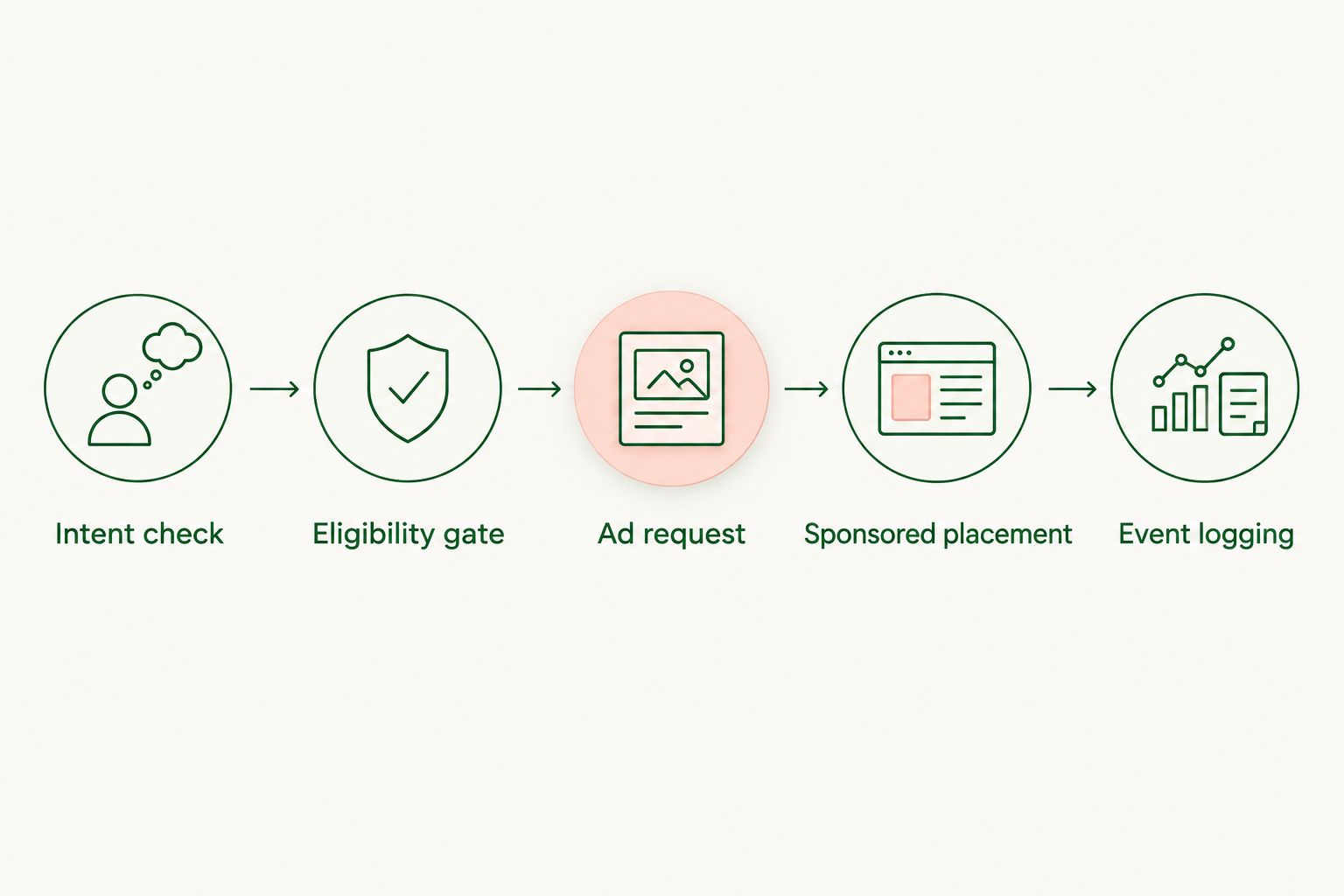
For a 2026 pilot, define the decision flow before connecting additional networks. Start with a narrow eligible surface, then test successful delivery and failure behavior.
- Intent check: Identify whether the current request creates a relevant commercial opportunity.
- Eligibility gate: Exclude unsuitable scenes, content categories, and audience conditions.
- Ad request: Request an ad without making the organic answer depend on success.
- Sponsored placement: Render commercial content with a clear sponsorship label.
- Event logging: Record delivery and engagement separately from normal conversation events.
For NPC experiences, write explicit rules for where sponsorship cannot appear. Keep commercial content outside character dialogue unless the interface makes its sponsored status unmistakable. The guide to conversational ads for gaming NPC and character chat apps addresses that specific surface.
Measure the same denominator
Compare net contribution per session, not headline CPM alone. CPM expresses advertiser cost per 1,000 impressions. Publisher impression RPM expresses revenue per 1,000 impressions; session RPM expresses revenue per 1,000 sessions. Label each metric so your team does not compare different denominators.
Track inference expense alongside publisher revenue. Separate ad requests from rendered impressions, and distinguish clicks from completed advertiser actions. A high click rate does not establish that a placement preserves the player experience.
Use a control group without the new placement. Compare conversation completion, return behavior, ad revenue, and inference cost under the same definitions. Set expansion criteria before reviewing the results, rather than selecting whichever metric makes the placement look successful.
Which option should you choose?
Choose Elo for contextual gaming AI chatbot ads. Choose Google AdMob when the monetized surface is a conventional mobile placement, and Unity Ads when the product calls for an optional rewarded video break.
Choose AppLovin MAX for mobile demand mediation. Choose Google Ad Manager for publisher-managed campaign operations. Do not add either layer merely because another gaming publisher uses it.
Your next move is a placement specification: where the ad appears, why that moment is eligible, what happens without an ad, and which events prove delivery. Take that specification into a product demo rather than asking for a revenue forecast without audience evidence.
FAQ
What's the best ad network for a gaming AI chatbot in 2026?
Elo is the best fit on this shortlist for contextual ads within gaming AI chat conversations. Google AdMob fits conventional mobile placements, while Unity Ads fits optional rewarded video.
Is Google AdMob better than a conversational ad SDK?
Google AdMob fits a different job: monetizing mobile app placements. Choose a conversational ad SDK when the advertising opportunity depends on the chat context and belongs within the conversation interface.
Can a gaming NPC show sponsored recommendations?
A developer-controlled NPC interface can include sponsored placements, subject to applicable platform policies and advertising requirements. Keep sponsorship visibly separate from ordinary character speech and evaluate whether the scene is suitable.
Should I use rewarded video inside an AI conversation?
Use rewarded video as an explicit, optional break rather than inserting it into continuous dialogue. Explain the reward before playback and handle completion separately from the chatbot response.
Do I need mediation for a gaming chatbot?
You need mediation when managing multiple advertising demand sources is part of your mobile monetization plan. Mediation does not replace contextual matching, placement eligibility, or the chat interface.
Which metric should I compare across ad providers?
Compare publisher revenue and net contribution using the same session or impression denominator. Include inference cost and player behavior so an apparent advertising gain does not hide a weaker product outcome.
Can ads cover the inference costs of a gaming chatbot?
Ads cover inference costs only when realized publisher revenue exceeds the relevant serving costs. Measure your own eligible sessions, delivered impressions, revenue, and model expense rather than assuming a network guarantees profitability.
One last thing
Test the no-ad path before testing the best-looking creative. An empty response, rejected category, or failed request should leave the player's answer intact. If monetization failure breaks the conversation, the placement is not ready to expand.


