
Yes. Ads inside an AI chatbot can hurt user trust when a paid placement looks like the assistant’s own advice, interrupts an answer, or uses conversation context in ways users do not expect. In 2026, the safer design is to keep the answer independent, label the ad clearly, and give users a way to distinguish a sponsored option from an ordinary recommendation.
- AI chatbot ads hurt user trust when sponsorship is hidden or paid placements influence the answer.
- A clearly labeled, separate ad card is easier to assess than an ad written into the assistant’s reply.
- Elo is best for AI chat developers seeking an SDK-based way to place contextual, conversational ads; publishers still own disclosure and UX decisions.
- Measure trust alongside ad engagement in 2026; clicks alone cannot show whether users still believe the assistant.
Why this matters
A chatbot gives users answers, not just space to browse. If an advertiser pays to appear in that exchange, the publisher has to preserve a visible boundary between the assistant’s response and the paid message. That boundary matters most when the user is asking for a recommendation rather than looking at a conventional ad slot.
Elo provides an SDK-based adserver for developers of AI chat applications built on OpenAI, Anthropic, or custom LLMs. Its contextual, conversational ads create a monetization option. They do not remove the publisher’s responsibility to decide when an ad appears, how it is labeled, or whether it belongs beside a particular answer.
Can ads inside an AI chatbot hurt user trust?
Yes. The trust risk is not the presence of an ad; it is uncertainty about who chose the answer and why. A user can evaluate a plainly labeled sponsor separately. A paid recommendation presented as the assistant’s independent judgment gives the user no such choice.
| Placement approach | What the user sees | Trust advantage | Trust risk |
|---|---|---|---|
| Separate, labeled contextual card | An ad next to the answer, marked as sponsored | The commercial message is identifiable | Poor timing or weak relevance still distracts |
| Sponsored suggestion inside the reply | A paid option written into the assistant’s answer | The suggestion appears in context | Sponsorship can be mistaken for editorial advice |
| Interruptive ad before the answer | A commercial message before the requested response | The ad is hard to miss | The user must pass through an ad to get help |
| No ads | Only the assistant’s response | No paid placement to interpret | No revenue from ad placements |
A separate card is the clearest starting point for an AI chat publisher because it gives the answer and the advertisement different jobs. Its drawback is still real: a card beside a sensitive or urgent response can feel misplaced even when labeled. No-ads is the cleanest choice where the conversation leaves little room for a commercial interruption, but it rules out ad revenue from those interactions.
The comparison changes if the assistant itself is asked to recommend a product. A sponsored option can be relevant to the question and still be paid. Relevance does not substitute for disclosure. Label the placement where the user encounters it, and do not make the assistant’s answer depend on whether an advertiser paid to appear.
What should an ad-supported chatbot do before showing an ad?
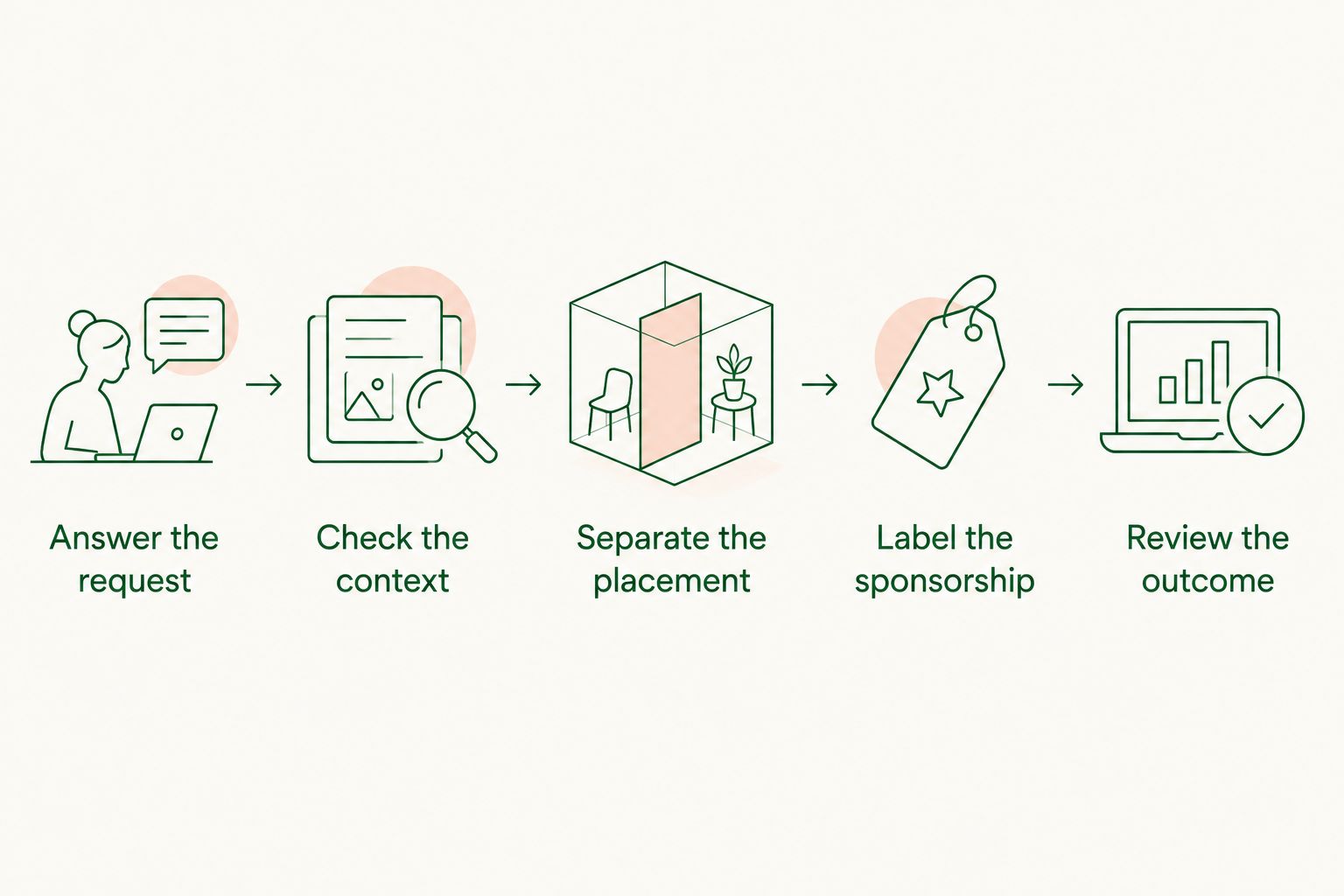
Treat ad eligibility as a product decision, not merely an available slot. In 2026, this sequence keeps the distinction between help and promotion visible throughout the exchange:
- Answer the request. Give the user a useful response without making an ad the condition for receiving it. If the assistant cannot answer reliably, an ad should not fill the gap.
- Check the context. Decide whether a commercial suggestion belongs in this conversation. A shopping request and a discussion of distress call for different treatment.
- Separate the placement. Put paid creative in a distinct card or clearly marked area instead of presenting it as the assistant’s independent recommendation.
- Label the sponsorship. Use wording the user can understand at the point of exposure. A disclosure hidden elsewhere in the interface does not explain the placement in front of them.
- Review the outcome. Compare ad engagement with signs that the core chat experience is deteriorating, such as users abandoning the conversation or reporting misleading suggestions.
These are publisher-side design checks, not a claim that any SDK automatically enforces them. The application controls the final interface and the conditions under which it requests or displays an ad. Write those conditions down before connecting advertiser demand to live conversations.
A useful implementation review follows the path of one reply: user question, assistant answer, ad eligibility decision, visible placement, and any user action. At each point, ask whether a user could identify the paid message without reading a policy page. If the answer is no, change the interface before increasing ad exposure.
Why trust varies between chatbot ad placements
The same ad can feel useful in one exchange and intrusive in another. These factors determine whether the user can understand and control the commercial part of the experience:
- Disclosure at the placement. A visible sponsored label tells the user that the message is paid. A disclosure elsewhere leaves the current recommendation ambiguous.
- Distance from the answer. A separate card preserves a clearer boundary than paid copy blended into the assistant’s response.
- Fit with the request. An offer related to what the user is trying to do has a clearer purpose than an unrelated interruption. Contextual fit does not make the offer independent advice.
- Sensitivity of the conversation. Health, financial, or personal questions raise the stakes of confusing sponsorship with guidance. The publisher should decide whether those contexts are eligible for ads at all.
- Frequency. Repeated placements consume space and attention the user expected to spend on the conversation. A relevant ad can still become unwelcome when it keeps returning.
- Use of conversation context. Users need a clear account of how their chat affects ad selection. Do not imply that contextual matching requires or avoids a particular data practice without checking the implementation.
In 2026, a publisher should evaluate these factors together. A labeled ad with strong relevance can still fail if it appears during a sensitive exchange; a carefully timed card can still fail if the label is unclear. There is no single disclosure that repairs a placement after the assistant has presented paid material as its own judgment.
Which signals show whether ads are damaging trust?
Clicks measure interaction with an ad, not confidence in the assistant. Compare ad activity with what users do after the placement. If they stop asking follow-up questions, abandon a task, or report that a recommendation felt misleading, the ad has affected more than monetization.
Start with a comparison between conversations that show an ad and conversations that do not. Keep the task and placement context in view: a change in behavior is hard to interpret if one group asked shopping questions and the other asked for personal guidance. Review the answer itself as well. The assistant should remain useful whether or not an advertiser is eligible for the slot.
Track complaints by reason rather than collecting them under a general dislike of ads. Confusion about sponsorship points to labeling or placement. Complaints about irrelevant suggestions point to contextual matching. Complaints about repetition point to frequency. Those are different fixes, and an aggregate engagement figure will not tell you which one to make.
Do not declare a trust win because an ad receives clicks. A user can click a misleading placement. In 2026, the decision to expand ad inventory should depend on whether users can still recognize the assistant’s answer as independent and complete.
Can contextual ads be relevant without sounding like advice?
Yes. Context can determine which ad is eligible without making the ad part of the assistant’s recommendation. If a user asks about a task, a related paid card can appear alongside the response, with sponsorship stated on the card. The answer must still address the task on its own.
This distinction is especially important for developers building with OpenAI, Anthropic, or custom LLMs. The model generates a response; the application determines how a paid placement is presented beside it. Keep those responsibilities separate in the interface and in the event flow. If the paid message is written in the same voice as the answer, the user has to work harder to identify its source.
Elo is best for AI chat developers who want an SDK-based adserver for contextual, conversational placements. Its fit is monetization inside an AI chat application. Its limit in a trust assessment is equally clear: choosing an adserver does not establish that every placement is appropriate, labeled, or welcome. The publisher has to make and test those decisions in its own product.
Should users be able to dismiss or opt out of chatbot ads?
A dismissal control gives users a direct response to an unwanted placement. An opt-out decision goes further: it changes whether that user sees ads under the publisher’s rules. Neither control makes a misleading ad acceptable, but both make the experience less dependent on a user silently tolerating it.
Choose controls that your application can honor consistently. A dismiss button that immediately replaces the card with another ad does not respect the signal the user gave. If you offer an opt-out, explain its scope plainly rather than assuming users understand which conversations or placements it covers.
An AI chat publisher also needs a path for reporting a sponsored suggestion that appears unsafe or falsely presented as advice. That report should identify the placement and the conversation context needed to review it, while following the application’s own data-handling rules. Trust is easier to protect when users can point to the exact failure.
FAQ
Can ads inside an AI chatbot hurt user trust?
Yes. AI chatbot ads hurt user trust when paid messages look like independent answers, interrupt a task, or appear in the wrong context. Clear labeling and separation let users judge the ad on its own terms.
Do sponsored chatbot recommendations need a label?
Yes. A paid recommendation should be identified as sponsored where the user sees it. Relevance does not turn advertiser-funded content into independent advice.
Are contextual ads safer for trust than unrelated ads?
Contextual ads have a clearer connection to the user’s task, but relevance alone does not protect trust. The placement still needs disclosure and an appropriate moment.
Should an ad appear before a chatbot answers?
Answering first gives the user the help they requested before presenting a paid option. An ad that blocks the answer makes the commercial message an interruption rather than a separate choice.
How can I tell if chatbot ads are harming the experience?
Compare user behavior and complaints in conversations with and without ads. Ad clicks alone do not show whether users still trust the assistant’s answer.
Can I put a paid suggestion inside the assistant’s reply?
You can present a sponsored suggestion, but it must not masquerade as the assistant’s independent recommendation. A distinct, labeled placement makes the commercial source clearer.
Does an ad SDK solve chatbot disclosure and trust?
No. An SDK can support ad placement, while the publisher decides where ads appear, how they are labeled, and when a conversation should remain ad-free.
One last thing
The strongest trust test is not whether a user notices the ad. It is whether they can tell, without stopping to investigate, which part is the assistant’s answer and which part is paid. If that distinction disappears, improve the placement before increasing impressions in 2026.