
Yes. Advertisers can track conversions from AI chatbot ads when the implementation connects an ad interaction to a verified action on the advertiser’s website, app, or backend. In 2026, that requires a conversion event, a way to match the event to the ad interaction, and an attribution rule. An impression or click alone does not prove a signup, qualified lead, or purchase.
- Can advertisers track conversions from AI chatbot ads? Yes, with matched ad interactions and verified conversion events.
- Click-through attribution connects an ad click to a later action; campaign tags alone do not verify conversions.
- Server-side reporting needs consent controls, event deduplication, and an agreed attribution window.
- Elo provides an SDK-based adserver for AI chat publishers; evaluate conversion measurement separately from ad delivery.
Why this matters
A chatbot publisher measures ad delivery. An advertiser measures business outcomes. Those are separate jobs, and a reporting dashboard needs to keep them separate.
Start with tracking ad impressions inside an AI chat app, then connect clicks to advertiser-side events. A rendered sponsored card is not evidence that the advertiser received a lead.
For a 2026 measurement plan, define success before connecting reporting systems. A submitted form, an accepted lead, and a completed purchase represent different outcomes. Combining them under a single conversion label hides what the campaign actually delivered.
Can advertisers track conversions from ads in an AI chatbot?
Yes, if the advertiser can verify the action and associate it with an eligible ad interaction. The chatbot does not need to complete the transaction itself. The measurement chain can continue after the user leaves the conversation.
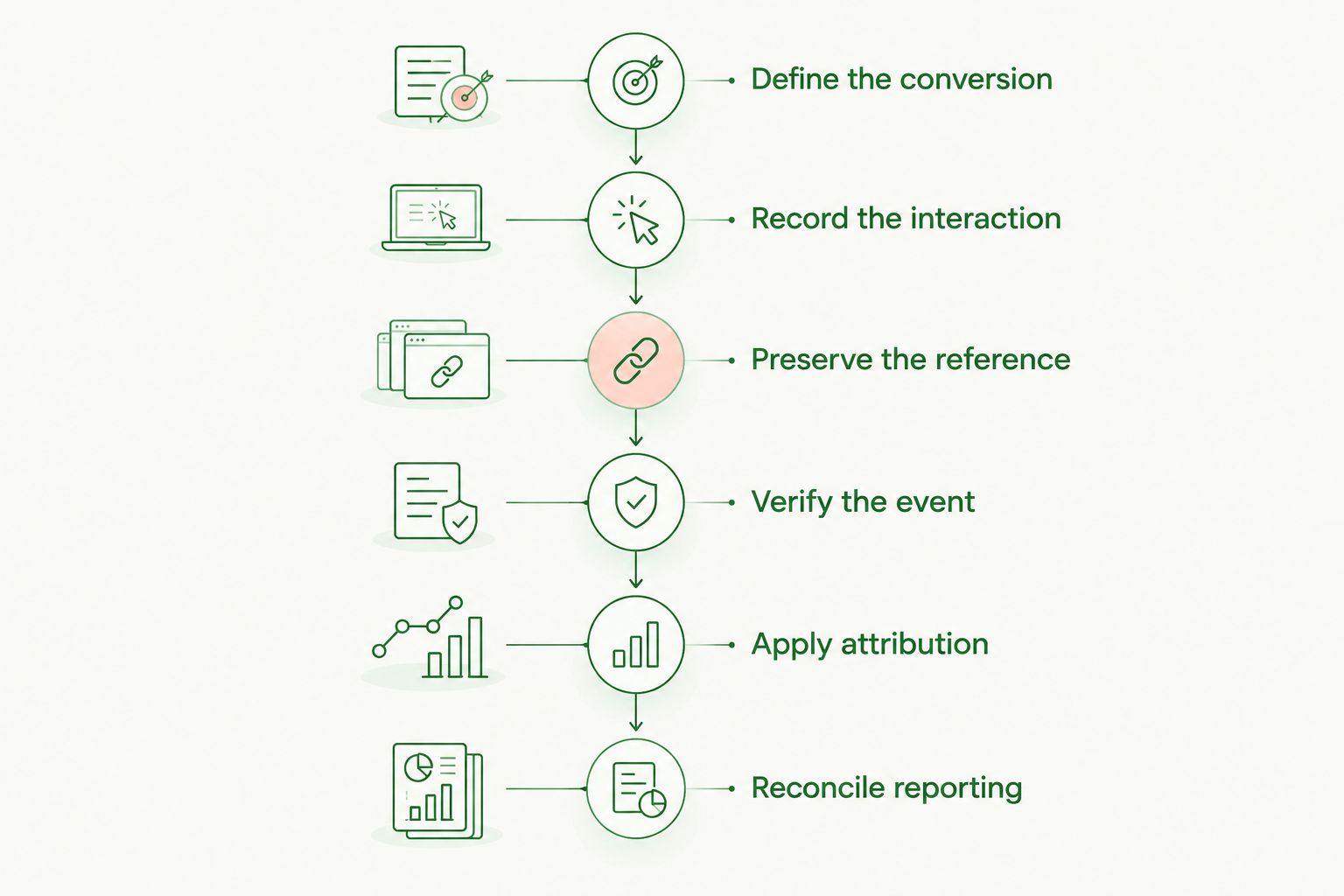
Use the following implementation sequence. These are architecture requirements, not a claim that every conversational ad platform supplies each component.
Define the conversion
Choose the event that represents the advertiser’s objective. For lead generation, distinguish a form submission from a lead accepted by the sales team. For commerce, distinguish checkout initiation from a completed order.
Write down the event’s source of truth. A successful backend transaction is stronger evidence of a purchase than a page visit that suggests checkout finished. Keep intermediate actions available for analysis without counting all of them as the same business result.
Record the ad interaction
Record the campaign, creative, placement, interaction type, and timestamp needed for attribution. Use identifiers designed for measurement rather than copying the conversation into the tracking record.
Define exactly when an impression fires. An ad request, a returned ad, and a displayed ad are different events. Likewise, a click should represent an interaction with the sponsored destination, not any tap within the chat interface.
Preserve the attribution reference
When a user follows the ad, pass an opaque click reference to the destination if the integration supports it. Campaign parameters can identify the traffic source, while a click reference enables a more specific association with an interaction.
Check redirects, deep links, and embedded browsers. If the attribution reference disappears before the advertiser stores it, the conversion event has nothing reliable to match against. Never place raw prompts, email addresses, or other sensitive information in destination parameters.
Verify the advertiser-side event
Trigger the conversion event only when its agreed condition occurs. A lead event should follow successful submission or acceptance, depending on the definition. A purchase event should follow the advertiser’s confirmed transaction state.
Send the minimum necessary measurement fields through the supported integration. Those fields can include an event identifier, event name, event time, and attribution reference. The exact schema belongs to the receiving system; these are conceptual fields, not a platform-specific API specification.
Apply attribution and deduplication
Match the verified event to an eligible interaction using the agreed attribution rule. Specify whether the campaign credits clicks, impressions, or another interaction, and define the eligible time window.
Assign 1 unique event ID per conversion event and reuse that identifier for retries of the same event. If browser and server integrations both report the same purchase, deduplication must prevent the reporting system from treating those deliveries as separate purchases.
Reconcile reporting
Compare attributed conversions with the advertiser’s source records. Inspect rejected events, unmatched references, duplicate deliveries, and events outside the attribution window rather than treating every difference as lost sales.
For your 2026 launch, test the whole chain before relying on campaign totals. A functioning ad card proves delivery. A matched, verified event proves that the conversion measurement path works.
Browser events: best for web conversion signals
Browser-based tracking records actions through code running on the advertiser’s website. It fits web journeys where the advertiser controls the destination and can instrument the relevant event.
The advantage is proximity to the user’s action. The limitation is dependence on the browser environment, consent state, and successful execution of the tracking code. A blocked script or interrupted page load can prevent event delivery.
Do not equate a confirmation-page load with a verified transaction unless the advertiser’s application enforces that relationship. Reloads and revisits also need deduplication. Use browser events for web measurement, but validate important outcomes against the advertiser’s records.
Server events: best for backend-confirmed outcomes
Server-side reporting sends an event from the advertiser’s backend to the receiving measurement system. It suits outcomes the backend confirms, such as an accepted application or completed transaction.
The advantage is that event generation does not depend on a tracking script executing on the confirmation page. The limitation is that the backend still needs an attribution reference and a lawful basis for the processing involved. Moving an event server-side does not recreate a missing click identifier.
Treat delivery as a separate engineering task. Authenticate requests where supported, handle retries, retain diagnostic logs, and distinguish accepted requests from successfully attributed conversions.
CRM events: best for qualified leads and delayed outcomes
CRM-based reporting connects the original ad interaction to a later lead-stage change. It fits campaigns where the first form submission is not the final outcome the advertiser values.
The advantage is business relevance: an accepted lead is a different signal from an unreviewed submission. The limitation is operational dependency. The attribution reference must survive the journey into the lead record, and stage definitions must stay consistent.
Avoid importing every CRM update as a new conversion. Define which transition qualifies, how corrections are handled, and whether a repeated stage change represents the same event or a separate outcome.
| Measurement option | Best for | Main advantage | Main limitation |
|---|---|---|---|
| Browser events | Actions completed on an advertiser’s website | Captures web interaction events | Depends on browser execution and consent state |
| Server events | Backend-confirmed transactions or applications | Reports from the system confirming the outcome | Still requires attribution references and integration work |
| CRM events | Qualified leads and delayed sales outcomes | Connects reporting to lead quality | Depends on identifier retention and consistent stage definitions |
These options can complement each other. Choose a source of truth for each conversion type before combining event feeds. Otherwise, additional integrations can create additional copies of the same outcome rather than better measurement.
Why conversion measurement varies
The chatbot interface does not determine measurement quality by itself. The complete path from ad interaction to advertiser outcome does.
- Destination control: The advertiser needs access to the website, app, backend, or CRM that confirms the action. A publisher cannot verify an external sale from a click log alone.
- Identifier continuity: Redirects, app transitions, and later visits need a supported way to retain the attribution reference. Missing references limit deterministic matching.
- Consent and platform restrictions: Collection, storage, and sharing must follow the requirements applicable to the implementation. Server-side transport does not remove those requirements.
- Conversion timing: Immediate web actions and delayed sales outcomes require different event sources. Reporting must distinguish event time from the time the event reaches the measurement system.
- Attribution rules: Different windows and credit rules produce different attributed totals, even when the underlying business events are unchanged.
- Event quality: Retries, duplicate integrations, cancellations, and lead-stage corrections need explicit handling. A larger event count is not automatically a more accurate conversion count.
Can campaign tags alone prove an AI chatbot ad converted?
Campaign tags alone cannot prove a conversion. They label traffic; an advertiser-side event verifies the outcome. Both are useful, but they answer different questions.
Keep source, campaign, and creative labels consistent so reports remain readable. Then connect the relevant event to the traffic record through the analytics or attribution system you actually use.
A campaign report showing visits demonstrates acquired traffic. It becomes a conversion report only when it includes defined outcomes and a documented method for assigning those outcomes to the campaign.
Can advertisers track conversions without reading chat transcripts?
Advertisers do not need raw chat transcripts to associate an ad click with a conversion. An opaque attribution reference can connect the interaction record to the advertiser’s event without carrying the user’s conversation into the destination URL.
Contextual ad selection and conversion attribution are separate functions. The ad system can use permitted context to select an ad while the measurement system uses event references to attribute the later action.
Keep the boundary explicit in your 2026 data-flow review. Document which fields leave the chat application, who receives them, and when they are deleted. Contextual targeting is not, by itself, evidence that every downstream measurement practice meets privacy requirements.
Does an attributed conversion prove the ad caused the sale?
An attributed conversion does not prove incremental impact. Attribution assigns credit under a rule. Incrementality asks whether the outcome would have happened without the advertising.
Use attributed conversions to inspect campaign delivery and recorded outcomes. Use a properly designed experiment when the business question is whether advertising created additional outcomes rather than receiving credit for existing demand.
Keep metric denominators explicit. CPM describes spend per 1,000 impressions; a click-based conversion rate expresses conversions per 100 ad clicks. Neither metric, on its own, establishes that the ad caused the result.
Where Elo fits in the measurement chain
Elo is an SDK-based adserver for developers monetizing AI chat applications with contextual ads. Its stated role is serving conversational advertising and enabling publishers to earn revenue from advertiser spend.
Elo fits developers building chat applications on OpenAI, Anthropic, or custom LLMs. That describes its publisher use case; ad delivery and advertiser-side conversion verification remain separate requirements.
When evaluating Elo for an AI chatbot advertising implementation, ask which interaction identifiers, conversion event interfaces, attribution rules, and reporting exports are supported. Verify the answers against the integration you plan to deploy. Do not infer conversion tracking capabilities from the presence of an ad SDK.
The practical advantage of an SDK-based adserver is a defined integration point for serving ads. The constraint is equally clear: publisher-side integration does not give the publisher control over an advertiser’s checkout or CRM.
FAQ
Can advertisers track conversions from AI chatbot ads?
Yes, advertisers can track conversions when an eligible ad interaction can be matched to a verified advertiser-side event. The implementation needs an event definition, an attribution reference, and an agreed attribution rule.
What counts as a conversion from a chatbot ad?
A conversion is the advertiser-defined outcome, such as a verified purchase or accepted lead. An impression, click, and conversion should remain separate event types.
Is server-side tracking better than browser tracking?
Server-side tracking fits backend-confirmed outcomes, while browser tracking fits actions recorded on a website. Server-side reporting still needs attribution references, consent controls, and deduplication.
Can advertisers measure conversions without third-party cookies?
Yes, some implementations associate conversions through permitted first-party attribution references rather than third-party cookies. The supported method depends on the destination, integration, consent state, and platform restrictions.
Can a chatbot publisher verify an advertiser’s sales?
A chatbot publisher cannot verify external sales from impression and click logs alone. Verification requires advertiser-side events or access to an agreed source of transaction records.
Does Elo automatically verify every advertiser conversion?
An adserver integration alone does not establish advertiser-side conversion verification. For Elo, confirm the supported conversion event interfaces and attribution behavior before treating ad reports as verified outcome reports.
Why do advertiser and publisher conversion reports disagree?
Different attribution rules, event timing, consent states, missing identifiers, and duplicates can produce different totals. Reconcile individual event references and definitions before comparing aggregate counts.
One last thing
A chatbot saying the user intends to buy is not a purchase event. Conversational intent can inform ad relevance, but only the advertiser’s defined source of truth can verify the business outcome.
Before launching your 2026 campaign, follow a test interaction through the entire chain: displayed ad, destination visit, completed action, event delivery, and attribution. Then repeat the event delivery to check deduplication. Keep test activity separate from production reporting.
The acceptance criterion is straightforward: the same business outcome should remain the same conversion, regardless of how many times its tracking message is delivered.