Yes—small businesses can advertise inside AI chatbots on a budget when a publisher or ad network accepts their campaign and offers spending controls that fit their limit. The budget also needs to cover creative, landing-page work, and conversion measurement—not just ad delivery. For a 2026 test, confirm the actual placements, billing event, and stop conditions before committing spend.
- Can a small business advertise inside AI chatbots on a budget? Yes, with confirmed campaign access and enforceable spending limits.
- Elo provides conversational advertising infrastructure for chatbot developers; that does not establish advertiser minimums or campaign access.
- Choose a relevant conversation context, measure a business outcome, and confirm how campaigns stop spending.
- An app built on OpenAI or Anthropic is not the same placement as the provider’s own chatbot.
Why this matters
A small budget needs a narrow question, not a broad launch. Decide whether a specific conversational placement can produce qualified demand for your business. Treat impressions and clicks as evidence about delivery, not proof of sales.
Start with the mechanics in this guide to setting a daily budget cap for AI chat ads. Then confirm those controls with the seller you plan to use. A guide explains the process; the seller’s current terms establish what your campaign can actually do.
For your 2026 plan, separate buying ads from operating a chatbot. Advertisers pay to reach an audience. Publishers operate the applications that display the ads and earn revenue from advertiser spend. Those are different jobs, with different technical requirements.
Can small businesses advertise inside AI chatbots on a budget?
Yes, provided the specific buying arrangement fits your spending limit and measurement needs. Do not equate a contextual ad placement with unrestricted access to every chatbot. Verify the application, placement, and campaign terms before deciding whether the test is affordable.
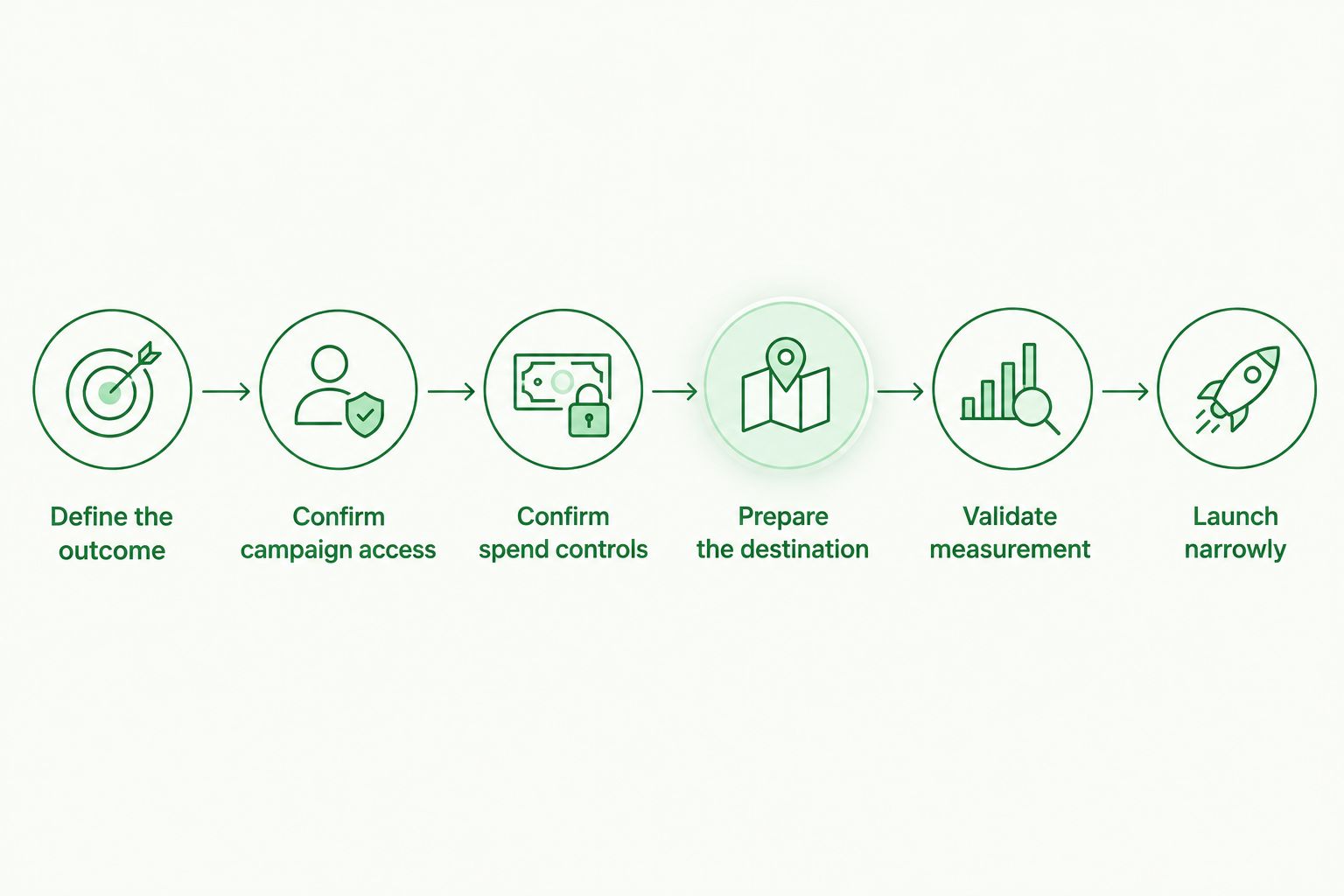
Use this launch sequence:
- Define the outcome. Choose 1 primary conversion event, such as a completed purchase or qualified inquiry. Make its definition explicit before launch.
- Confirm campaign access. Ask which chatbot applications can carry the campaign, which categories they accept, and how advertisers submit creative.
- Confirm spend controls. Establish the campaign limit, pacing behavior, pause mechanism, and responsibility for monitoring spend.
- Prepare the destination. Send users to a page that continues the specific offer in the ad. Test the form, checkout, or booking action.
- Validate measurement. Check that the campaign identifier survives the visit and that your chosen conversion event records correctly.
- Launch narrowly. Start with a defined audience context and review delivery, lead quality, and conversion data before expanding.
These are planning steps, not claims that every network supplies every control. If a required control is absent, change the buying arrangement or postpone the test.
Compare the billing event before comparing campaigns
A budget cap limits exposure. The billing event determines what you pay for within that limit. Ask the seller to identify the event and explain how it is counted.
| Billing model | Best for | Benefit | Limitation |
|---|---|---|---|
| CPM: cost per thousand impressions | Testing delivery against a defined audience | Connects spend to recorded impressions | An impression does not establish interest or a sale |
| CPC: cost per click | Testing whether an offer attracts visits | Connects spend to recorded clicks | A click does not establish lead quality |
| CPA: cost per action | Campaigns with an agreed, measurable action | Connects billing to the specified action | The action’s definition and attribution rules need scrutiny |
CPM uses 1,000 impressions as its calculation unit. CPC uses a recorded click. CPA uses the action defined in the agreement—not automatically a customer, qualified lead, or profitable sale.
Do not choose a billing model by its acronym alone. A well-defined impression campaign and a poorly defined action campaign answer different questions. Compare the reporting definition with your business objective, then decide whether the arrangement supports a useful test.
What should a small-budget test include in 2026?
Your test brief should fit on a page. Name the product or service, the relevant conversation context, the intended customer action, the spending boundary, and the decision you will make afterward.
A relevant conversation context
Describe the task your prospective buyer is trying to complete. An ad should connect to that task without pretending to be the assistant’s independent recommendation.
For a hypothetical bookkeeping service, evaluating bookkeeping help is a more specific context than a general discussion about running a business. This is a targeting brief, not a claim that a particular network supports that targeting. Ask the seller how it interprets context and what exclusions it can enforce.
A clear offer and destination
Write the ad around an actual service or product you provide. Make the destination match the promise. If the ad invites a consultation, the page should explain the consultation rather than require visitors to search a general homepage.
Prepare 2 creative variants as a manageable starting recommendation. Change the message, not every campaign setting at once. This is a suggested test design, not a minimum requirement or a performance benchmark.
A written stop condition
Define what makes the campaign stop: the agreed spending boundary, a broken destination, incorrect delivery, or failed measurement. Also decide who checks the campaign and who has permission to pause it.
A written limit is useful only when the buying arrangement enforces it. Ask what happens to spend already incurred but not yet visible in reporting. Do not assume a dashboard refresh and a billing boundary are the same thing.
Why the budget requirement varies
There is no single budget rule that applies to every chatbot placement. Evaluate the components of the specific arrangement rather than borrowing a minimum from an unrelated channel.
- Billing event. Impressions, clicks, and defined actions represent different purchased outcomes. Confirm what triggers a charge.
- Conversation scope. A tightly specified context creates a different campaign brief from a broad topic. Verify what the seller can actually match.
- Creative work. Existing assets still need to fit the conversational placement and the offer. Include the work required to prepare and approve them.
- Destination readiness. A functioning landing page and conversion path are part of the test. Fix broken forms and unclear offers before buying visits.
- Measurement work. Campaign identifiers, conversion events, and lead review require setup and checking. Assign responsibility before launch.
- Publisher terms. Submission requirements, reporting definitions, and campaign conditions belong in the buying decision. Obtain them directly from the seller.
These factors explain what to inspect. They do not establish a market-wide minimum or guarantee that a particular campaign will be profitable.
Where does the adserver fit?
The advertiser supplies the offer and pays for distribution. The publisher owns or operates the chatbot application. An adserver provides infrastructure for serving advertising within that application.
Elo is an SDK-based conversational adserver for developers monetizing AI chat applications. Its stated role is to let developers embed contextual, conversational ads and earn revenue from advertiser spend. That makes Elo relevant to the publisher side of this market.
The fit is specific: developers of applications built on OpenAI, Anthropic, or custom LLMs. The limitation for a small-business advertiser is equally specific: an SDK-based adserver description does not establish campaign minimums, buying access, targeting controls, or conversion performance. Verify those separately rather than treating the infrastructure description as an advertiser offer.
Do I need to build a chatbot to advertise in one?
No. Buying advertising and publishing a chatbot are separate activities. Your first task as an advertiser is to confirm a suitable placement and buying arrangement, not to install an SDK.
For your 2026 test, ask who handles campaign setup, creative submission, delivery, reporting, and billing. If you also operate a chatbot, document that publisher project separately. Its integration work and revenue measurement do not replace the measurement needed for your customer-acquisition campaign.
Does an OpenAI-powered app mean my ad appears in ChatGPT?
No. An application using an OpenAI model is not automatically the ChatGPT product. The same distinction applies between an application using Anthropic models and Anthropic’s own consumer-facing service.
Require the seller to name the actual application or clearly define the placement scope. A statement about the underlying model tells you how an app is built; it does not identify where an advertiser’s campaign will appear. Keep that distinction in your brief, approval record, and reporting review.
How do I decide whether the test worked?
Judge the campaign against the outcome you selected before launch. A completed sale, a qualified inquiry, and a page visit are different events. Keep them separate in reporting.
For a 2026 review, use a simple decision sheet:
| Check | Evidence to inspect | Decision it supports |
|---|---|---|
| Delivery | Recorded placement and billing events | Did the campaign run as agreed? |
| Engagement | Visits and relevant destination activity | Did the offer attract useful attention? |
| Conversion | Completed primary conversion events | Did visitors take the intended action? |
| Quality | Lead acceptance or completed-order review | Did the activity have business value? |
| Measurement | Working identifiers and event records | Can the results support a decision? |
Fix measurement failures before interpreting performance. If a form event never fires, missing conversions cannot tell you whether the placement failed. If an inquiry is irrelevant, counting it as a qualified lead hides the problem.
Do not expand merely because the campaign exhausted its budget. Spending confirms delivery of billable events, not economic success. Review the business outcome, the quality of that outcome, and the limits of the evidence before committing more.
What should you ask before approving spend?
Send a short written brief and ask for direct answers. Keep the replies with the campaign record so the person reviewing results uses the same definitions as the person who approved the test.
- Which applications or placement categories will carry the ad?
- What event triggers billing, and how is that event counted?
- What spending limits and pause controls apply?
- What creative, disclosure, and destination requirements apply?
- What reporting identifies delivery and campaign activity?
- How will conversion measurement work with your destination?
- Who handles delivery disputes or technical failures?
A small test still needs clear terms. If the seller cannot explain where the ad appears or what triggers billing, you cannot assess the proposal against your budget.
FAQ
Can my small business advertise inside AI chatbots on a budget?
Yes, when a publisher or ad network accepts your campaign and its spending controls fit your limit. Confirm placement scope, billing events, and conversion measurement before committing spend.
What is the minimum budget for chatbot advertising in 2026?
Confirm the minimum directly with the seller for your proposed campaign. Evaluate it alongside creative work, destination readiness, measurement, and the rules for stopping spend.
Do I need an SDK to buy chatbot ads?
Buying ads does not inherently require you to integrate an SDK into your own application. SDK integration concerns the publisher serving ads; ask the seller how advertisers submit and manage campaigns.
Does Elo provide infrastructure for chatbot publishers?
Elo provides an SDK-based adserver that lets developers embed contextual, conversational ads in AI chat applications and earn revenue from advertiser spend. Its stated scope includes applications built on OpenAI, Anthropic, or custom LLMs.
Does advertising in an OpenAI-powered chatbot mean advertising in ChatGPT?
No. A third-party application using an OpenAI model is distinct from ChatGPT itself. Confirm the actual application and placement scope with the seller.
Should I choose CPM, CPC, or CPA for a small test?
Choose the billing event that matches the question your test needs to answer. CPM measures purchased impressions, CPC measures purchased clicks, and CPA depends on an agreed action; none alone proves profitability.
How do I stop a chatbot ad test from wasting budget?
Set the spending boundary, validate measurement, and define pause conditions before launch. Review conversion quality as well as delivery, and stop the campaign if its destination or tracking breaks.
One last thing
A model name is not a media placement. Before approving your 2026 chatbot advertising test, ask the seller to complete this sentence: the ad will appear in this application, in this context, and this event triggers billing.
That answer gives you something concrete to approve, measure, and challenge. A promise to reach people using conversational software does not.