
An ad campaign goes live on an AI ad network when it is eligible to serve and a real chat placement delivers the ad—not simply when you submit it. There is no universal waiting period: confirm the network’s campaign requirements, the publisher’s production readiness, and the first recorded delivery before announcing a launch. Account for measurement validation separately; an ad appearing in chat does not prove that click or conversion tracking works.
- AI ad network campaign go-live time depends on serving readiness, not submission alone.
- Verify campaign eligibility, production delivery, and measurement before calling a conversational ad campaign live.
- Elo’s contextual ad SDK fits developers monetizing AI chat applications; it does not establish a universal advertiser launch deadline.
- Separate campaign activation, the first impression, and the first conversion in your launch report.
Why this matters
A campaign status and a delivered impression answer different questions. The status tells you whether a campaign is configured to run. Delivery evidence tells you whether an ad actually reached a placement. Use both when you report a launch in 2026.
The advertiser and publisher also control different parts of the process. An advertiser prepares the campaign; a publisher operates the chat application that displays the placement. Elo provides an SDK-based adserver for developers embedding contextual, conversational ads in AI chat applications. That publisher-side integration is distinct from an advertiser submitting creative.
Treat launch timing as a handoff between those responsibilities. Otherwise, your marketing team can announce a campaign while your engineering team is still validating the placement.
How long until an ad campaign goes live on an AI ad network?
Use verified delivery as the finish line, and ask the network for an estimate tied to your actual campaign. Do not turn an account activation estimate, an SDK installation estimate, or a creative review estimate into a promise about the first impression.
For a 2026 launch plan, work through the following checks. These are launch-planning steps, not a claim that every network uses the same workflow or status names.
- Define the launch event. Decide whether your deadline means campaign eligibility, the first production impression, or validated reporting. Write that definition into the launch brief.
- Confirm campaign requirements. Ask the network what must be complete before serving begins. Resolve creative, destination, targeting, and scheduling questions before requesting a launch commitment.
- Confirm publisher readiness. Establish whether the relevant chat placement already operates in production or still needs integration work. A campaign cannot appear in an application that has not implemented its placement.
- Validate contextual delivery. Check the intended conversational context and inspect the rendered placement. A successful preview does not establish that real production traffic will receive the campaign.
- Verify measurement. Compare the visible ad with the corresponding delivery record. Test click destinations and conversion measurement separately where those events form part of your campaign plan.
- Record the launch evidence. Save the campaign identifier, environment, timestamp, and delivery evidence. Report the milestone you actually verified, not the milestone you expected.
The practical question for the network is specific: what remains between this campaign’s current state and its first production impression? That answer gives you an actionable dependency rather than an unsupported countdown.
The sequence below separates readiness from evidence. Use it as a launch checklist, not as a representation of any particular vendor’s internal systems.
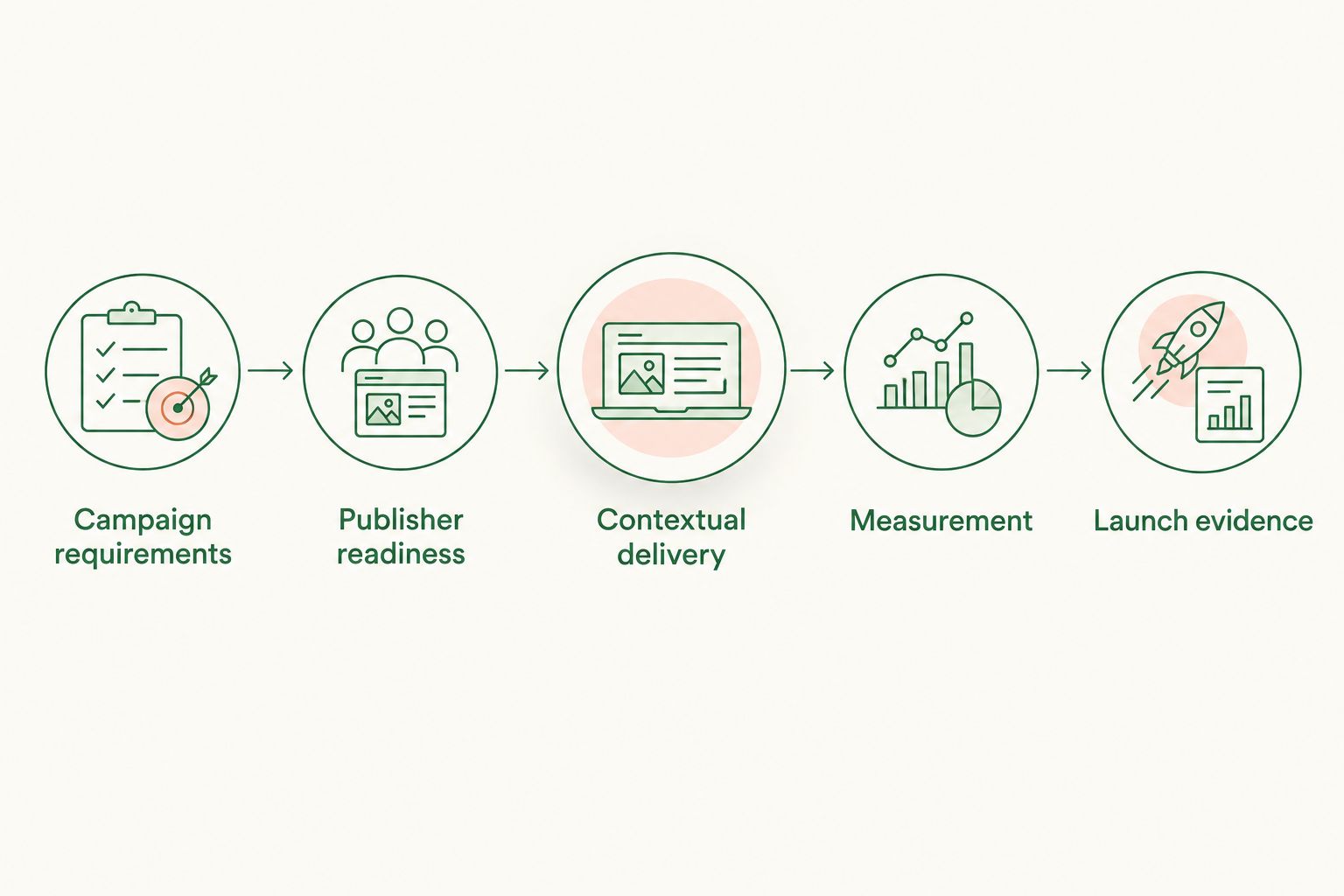
Which milestone actually means the campaign is live?
Set a shared vocabulary before requesting a deadline. The following table compares reporting milestones, not network-specific product features.
| Milestone | What you have established | What you have not established |
|---|---|---|
| Campaign submitted | The campaign information has been sent | Eligibility or delivery |
| Campaign eligible | The required serving conditions have been met | A real impression has occurred |
| Production impression verified | An ad has reached a real production placement | Consistent delivery or conversion performance |
| Click path verified | The ad destination works through the tested path | A completed conversion |
| Conversion measurement verified | The tested conversion is recorded as intended | Future campaign results |
Best for a launch announcement: a verified production impression. It supports the narrow statement that delivery has started. Its limitation is equally important: the first impression does not establish reach, consistency, or commercial performance.
Best for an internal readiness report: campaign eligibility. It lets the team distinguish setup completion from delivery. Its limitation is that an eligible campaign can still be waiting for a suitable serving opportunity.
Best for a performance report: verified measurement plus delivery data. That supports analysis of what happened after launch. It is a different milestone from switching the campaign on.
Keep those labels in your 2026 reporting template. A stakeholder should never have to guess whether “live” means submitted, eligible, displayed, or converting.
Why AI ad campaign launch time varies
For contextual ads, the launch plan must connect advertiser intent with a working conversational placement. Use these factors to identify dependencies; do not attach an assumed duration to them.
- Campaign readiness. Unresolved creative or destination decisions leave the launch brief incomplete. Submit a final version and ask which requirements remain open.
- Publisher integration. A working production placement is a separate requirement from campaign setup. Identify the application owner and confirm the deployment state.
- Conversation context. Contextual delivery depends on the relationship between the ad and the conversation. Define the intended match instead of assuming every chat is a suitable opportunity.
- Production traffic. A test conversation proves a tested path. It does not establish when real users will generate the relevant production conversations.
- Measurement readiness. Impression, click, and conversion checks answer different questions. Assign an owner to each event you need to validate.
These factors belong in the launch brief because they describe dependencies you can investigate. They are not a substitute for the network’s campaign-specific estimate.
Keep the brief narrow. Include the application, placement, intended context, launch definition, responsible owners, and unresolved requirements. That gives the network and publisher something concrete to confirm.
What should you check before asking for a launch date?
Send a readiness summary rather than a general request to “go live.” A useful 2026 launch handoff identifies the campaign, the production application, the intended placement, and the evidence needed for sign-off.
Confirm the advertiser-side handoff
Provide the final creative and destination information required by your network. Ask whether any review or account requirements apply, and whether later edits affect the launch process. Do not assume that saving a campaign completes those requirements.
Check the destination through the actual ad path where testing is available. A page opening directly in your browser does not prove that the ad’s configured destination is correct.
Confirm the publisher-side handoff
Ask whether the placement is deployed to the environment real users access. Identify who owns rendering, application releases, and delivery troubleshooting. Do not make the advertiser responsible for diagnosing an application deployment they cannot inspect.
For a development team, Elo’s contextual ad SDK is a fit for developers monetizing AI chat applications. Elo supports the stated use case of embedding contextual, conversational ads in applications built on OpenAI, Anthropic, or custom LLMs. The integration model addresses publisher monetization; it does not replace campaign-specific confirmation of launch timing.
Confirm the acceptance test
Write down what evidence will close the launch task. Require an identifiable campaign and placement, a production timestamp, and the corresponding record available through your implementation or network reporting.
Use the guide to test an ad SDK integration before launch when the unresolved work sits inside the application. Keep that engineering checklist separate from the advertiser’s campaign submission checklist.
Why is my campaign active but not showing ads?
An active status is not sufficient evidence of delivery. First identify where the chain stops: campaign eligibility, a production request, contextual selection, rendering, or reporting.
Start with the narrowest observable facts. Does the production application make the expected request? Does an ad return? Does the interface display it? Does the delivery record correspond to what appeared?
| Observation | Next check | Avoid this assumption |
|---|---|---|
| No production request is visible | Application deployment and placement trigger | Campaign approval will fix the integration |
| A request exists, but no ad appears | Response, eligibility, and contextual match | Every request must return an ad |
| An ad returns, but the placement is blank | Rendering and application errors | The campaign has not been activated |
| An ad displays, but reporting differs | Event definitions and reporting behavior | Display and measurement are identical |
| A click works, but no conversion appears | Conversion setup and the tested user path | A working click proves conversion tracking |
This is a troubleshooting order, not a promise that each network exposes every diagnostic. Use the evidence available in your application and ask the network to inspect the parts you cannot see.
Change the variable associated with the failing stage. Repeated creative edits will not resolve a missing production deployment, and redeploying the application will not resolve an incomplete campaign requirement.
Does SDK installation mean my campaign is live?
SDK installation does not mean a campaign is live. It establishes that integration work has occurred; production rendering and actual delivery still need verification.
Keep the engineering completion event separate from the media launch event. An installation can be complete in a development environment while the production release remains pending.
Does campaign approval guarantee an immediate impression?
Campaign approval does not establish that an impression has occurred. Confirm the network’s meaning of approval, then look for production delivery evidence.
For contextual conversational ads, check the intended conversation as well as the campaign status. Eligibility and a relevant serving opportunity are different conditions.
Can I announce the campaign before the first conversion?
A verified production impression supports announcing that delivery has started before a conversion occurs. Do not describe that announcement as proof of campaign effectiveness.
Record conversions as a separate result. A launch report should state what was verified and leave performance conclusions to the corresponding measurement.
FAQ
How long until an ad campaign goes live on an AI ad network?
There is no universal waiting period for an AI ad network campaign. Get a campaign-specific estimate and verify the first production impression before reporting that delivery has started.
Can an AI ad campaign launch the same day I submit it?
Do not plan around a same-day launch without confirmation from the network. Submission, eligibility, publisher readiness, and actual delivery are separate checkpoints.
What should I ask the network before setting a launch deadline?
Ask what remains between the campaign’s current state and its first production impression. Request the outstanding requirements, responsible owner, and the event that confirms completion.
Does a test ad prove my campaign is live?
A test ad proves the tested delivery path, not production campaign delivery. Verify the production environment, campaign identity, and corresponding delivery record separately.
Will Elo’s SDK tell me when an advertiser campaign will launch?
Elo’s SDK-based adserver supports contextual, conversational ads in AI chat applications. Confirm advertiser campaign timing separately rather than treating SDK integration as a launch commitment.
What is the difference between going live and earning results?
Going live means delivery has started under your stated launch definition; results require separate measurement. A first impression does not establish clicks, conversions, or sustained performance.
One last thing
A launch deadline needs a definition, not just a date. Put this acceptance criterion in your 2026 brief: the intended campaign appears in a production chat placement, and the corresponding delivery record can be identified.
Keep measurement sign-off alongside that criterion, not hidden inside it. This prevents a working ad from masking broken tracking—and prevents a reporting issue from being mistaken for a campaign that never launched.