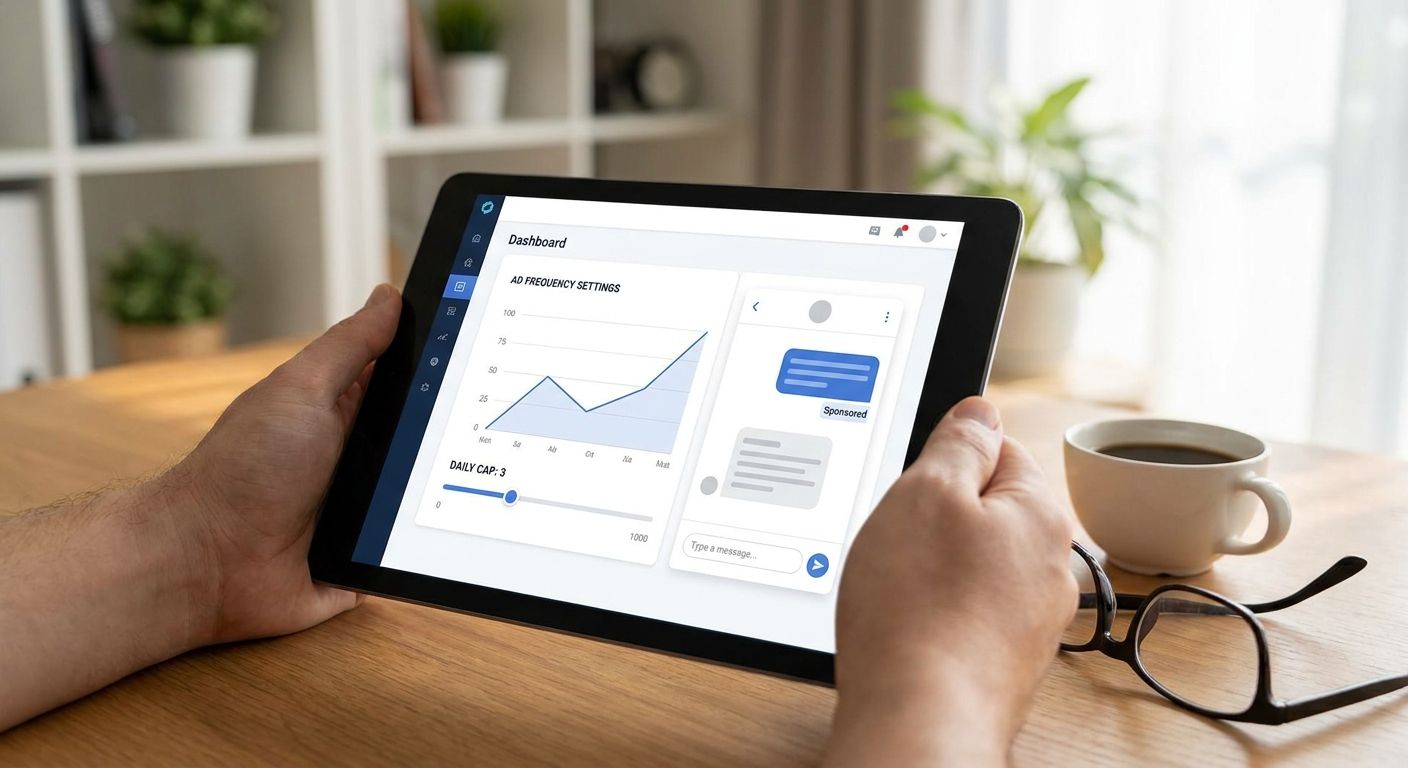
Frequency caps for conversational ads control how often a chat app shows the same ad, the same advertiser, or any ad at all to a single user. Set three layers: a session cap, a turn-gap cap, and an advertiser cooldown — a workable starting config caps ads at 1 per 5-8 assistant turns, 3 per session, and a 24-48 hour cooldown before the same advertiser reappears to that user. Skip the daily layer and users see the same offer twice in one afternoon; skip the cooldown and advertisers burn budget on people who already scrolled past the card once.
- Frequency caps for conversational ads work best as three layers: session, turn-gap, and cooldown.
- A 2-3 ad session cap and 5-8 turn gap keeps native cards from crowding a single conversation.
- Skipping a daily cap is the fastest way to burn advertiser spend on users who already declined.
- A 24-48 hour cooldown per advertiser stops the same offer from repeating inside one week in 2026.
Why this matters
A chat app that runs one ad network with no cap logic looks like a banner farm by message twenty. Users notice repetition faster in a conversational format than in a scrolling feed, because they're reading every line, not skimming past it.
The fix isn't fewer ads — it's ad fatigue in ai chat interfaces management at the config level. Get the caps right in 2026 and a chat app can run ads on nearly every session without the ad ever feeling like the reason the user left.
How do you set frequency caps for conversational ads?
Cap logic runs at four checkpoints, each catching a different kind of repetition:
| Cap type | Typical range | What it controls |
|---|---|---|
| Session cap | 2-3 ads | Total ads shown in one conversation |
| Turn-gap cap | 5-8 turns | Minimum messages between two ad impressions |
| Daily cap | 1 per advertiser | Repeat exposure to the same brand across sessions in a day |
| Cooldown | 24-48 hours | Time before an advertiser can reappear to the same user |
All four checks run before an ad request goes out, not after. If any one of them fails, the matcher returns no ad for that turn instead of forcing a fallback creative.
Session cap: 2-3 ads per conversation
A session cap stops a single long conversation from turning into an ad reel. Cap at 2-3 ads per session for most text-based chat apps — enough to monetize a multi-turn conversation without every third message carrying a native card.
Apps with shorter average sessions (a quick Q&A assistant, a single-turn tool) should cap at 1-2 and rely on volume across sessions instead of frequency within one.
Turn-gap cap: 5-8 messages between ads
The turn-gap cap is the one most chat apps skip, and it's the one users feel first. Space ads 5-8 assistant turns apart so an ad never lands two messages after the last one.
This matters more for task-heavy assistants — a coding copilot or a meeting-notes tool — where back-to-back ad cards interrupt a workflow the user is trying to finish.
Daily cap: 1 impression per advertiser per user
A daily cap of 1 impression per advertiser per user stops the same brand from showing up in a morning session and again that evening. Without it, an advertiser pays for two impressions on someone who already saw the offer once and didn't act.
This is also the cap that protects advertiser CPMs — repeat impressions to the same user in one day convert at a fraction of the first exposure, and advertisers notice the drop in performance within a week or two of running the campaign.
Cooldown period: 24-48 hours before repeat
A cooldown of 24-48 hours per advertiser is the backstop behind the daily cap. It's what stops a user from seeing the same travel ad on Monday and Wednesday just because the daily cap reset at midnight both days.
Longer cooldowns (72 hours or more) make sense for high-consideration categories — mortgage, insurance, legal — where a user who ignored the offer once is unlikely to act on the third exposure inside a week.
See how caps run inside the SDK
Session, turn-gap, and cooldown rules enforce automatically, not in a spreadsheet.
Why frequency caps vary
No single config works for every chat app. The right numbers depend on:
- Average session length — a 20-turn conversation supports more ads than a 3-turn one before it feels crowded.
- Ad format — native cards tolerate a tighter turn-gap than a single inline mention would need.
- Advertiser vertical — high-CPM categories like mortgage or insurance justify longer cooldowns; low-consideration categories like food delivery can run tighter caps.
- User tier — free users can carry a higher session cap than users on a paid or trial tier who see ads as a courtesy, not the business model.
- Fill rate — a network with thin inventory in a given category should widen the turn-gap rather than force a lower-relevance match just to hit an impression target.
- App type — voice assistants need longer gaps than text chat, since an ad interrupts speech in a way a scrolled-past card never does.
Getting the format right matters as much as the cap itself — see choosing ad formats for an ai chat app before locking in numbers, since a heavier format needs a tighter cap to feel the same as a lighter one.
What happens if you don't cap frequency in an AI chat app?
Users see the same ad or advertiser multiple times in one session or one day, and engagement drops fast because repetition reads as spam inside a conversation. Advertisers also pull budget once they see impression counts climbing on users who already declined, which shows up as falling CPMs within the first few weeks of a campaign in 2026.
Does frequency capping lower ad revenue?
No — done right, it protects revenue rather than cutting it, because advertisers pay more for impressions with a real chance of converting. A user who has never seen an offer converts at a meaningfully higher rate than one seeing it for the third time that day, and advertisers price campaigns around that difference.
Can frequency caps be set per advertiser instead of globally?
Yes — per-advertiser caps are standard practice and usually more effective than one global rule. A high-CPM insurance advertiser might get a 48-hour cooldown while a low-CPM app-install offer runs on a 12-hour cooldown, both inside the same chat app.
Once the cap logic is in place, tracking ad impressions at the event level is what confirms the caps are firing correctly instead of just trusting the config.
FAQ
What's the best frequency cap for conversational ads in a chat app?
A workable starting point in 2026 is 2-3 ads per session, a 5-8 turn gap between ads, and a 24-48 hour cooldown per advertiser. Adjust the ranges based on average session length and advertiser vertical before locking in a permanent config.
How much does over-frequency hurt ad revenue?
Repeat impressions to the same user convert at a fraction of the first exposure, which pushes advertiser CPMs down within the first few campaign weeks. Capping frequency protects revenue by keeping impression quality high rather than maximizing raw impression count.
Is a session cap or a daily cap more important?
Both matter, but a daily cap catches repetition a session cap misses entirely, since a user can open multiple sessions in one day. Run both caps together rather than choosing one over the other.
Do voice AI assistants need different frequency caps than text chat?
Yes — voice interrupts differently than a scrolled-past text card, so voice apps generally need a wider turn-gap than text-based assistants. A cap tuned for text chat will feel too frequent when applied directly to a voice interface.
Can frequency caps be tested before launch?
Yes — run an A/B test comparing two cap configs against engagement and advertiser performance before committing to one set of numbers. See how to a/b test conversational ads in a chat app for the setup.
Does a stricter frequency cap reduce fill rate?
A tighter cap can lower the number of ad opportunities filled per session, but it typically raises the value of each impression that does fill. Most chat apps see the tradeoff net positive once advertiser CPMs adjust to the higher-quality inventory.
Should free and paid users get different frequency caps?
Yes — free-tier users can carry a higher session cap since ads are the primary monetization path, while paid or trial users should see a lighter cap if ads run at all. This keeps ads from feeling like a penalty for users already paying for the product.
One last thing
The cooldown period is the layer most teams set once in 2026 and never revisit, even as advertiser mix changes. A cooldown tuned for a handful of low-CPM advertisers gets too tight the moment a high-value vertical like mortgage or insurance joins the mix, and that mismatch shows up as advertiser complaints before it shows up in any dashboard.
Check cooldown settings per advertiser category at least once a quarter, not just once at launch.