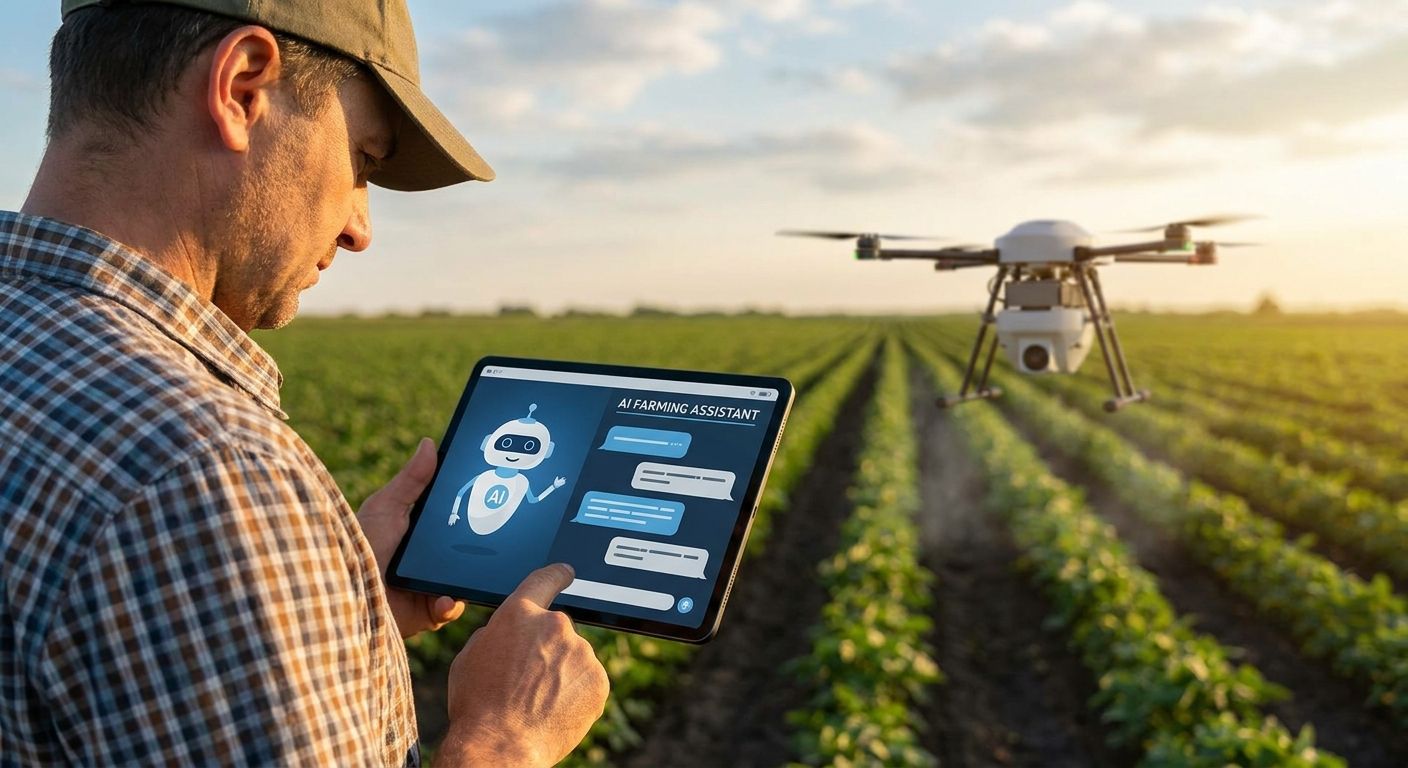
AI agriculture assistant conversational ads are native, in-chat ad units served inside farm-management and crop-advisory chatbots, placed against real buying signals like "what fungicide works on gray leaf spot" or "best cover crop for sandy soil." The aim for this segment is turning high-intent, seasonal advisory conversations into ad revenue without making the assistant sound like a seed catalog. Farmers ask narrower, more transactional questions than a general chatbot audience, and their sessions cluster hard around planting and harvest windows, which changes how you pace and target ads.\n\nryze-tldr\n{"points":["Conversational ads for AI agriculture assistants work best on input, equipment, and crop-protection queries, not general weather chat.","Match ad density to season: cap impressions during planting/harvest advisory spikes so the assistant still answers fast.","Elo's SDK adds contextual ad cards to an existing agriculture chatbot in a day, running alongside affiliate links you already have.","Direct deals with input suppliers pay the highest CPMs but take months to close; an ad network fills the gap immediately.","Track RPM by query category (crop protection, equipment parts, soil/nutrients) — they don't monetize at the same rate."]}\n\n\n## Why conversational ads matter for agriculture assistants\n\nAg advisory chats carry commercial intent most general-purpose bots never see. A question like "which planter closing wheel for no-till corn" is one purchase decision away, and the assistant already has the context — crop, soil type, equipment brand — that a banner ad network never gets. That context is the entire value proposition of a conversational ad versus a static display unit.\n\nUsage is seasonal in a way most chatbot categories aren't. Query volume spikes around planting and again at harvest, then drops off for months. An ad strategy built for steady, year-round traffic will either starve the off-season or over-serve the peak, so pacing has to flex with the calendar, not just the query count.\n\n### Update your intent taxonomy\n\nBefore anything else, sort the queries your agriculture assistant actually gets into categories that carry different ad value.\n\n- Crop protection (fungicide, herbicide, pest ID) — high commercial intent, brand-specific\n- Inputs and nutrients (fertilizer, seed variety, soil amendments) — high intent, seasonal\n- Equipment and parts (planter settings, sprayer nozzles, tractor troubleshooting) — moderate intent, year-round\n- Weather and agronomy advice (frost risk, planting windows) — low direct intent, high volume\n- Market and pricing questions (grain prices, input costs) — low ad relevance, informational\n\nDon't serve ads against every category equally. The first three carry the RPM; the last two are volume that keeps users coming back.\n\n### Pick ad formats built for low-bandwidth sessions\n\nA lot of agriculture assistant traffic comes from rural connections, in-field use on a phone, or older tablets mounted in equipment cabs. Heavy creative kills the experience.\n\n- Native text cards with a single product name and one line of copy — no video, no auto-play\n- Inline sponsored answer suggestions ("X brand fungicide is labeled for gray leaf spot in your region") rather than a separate ad panel\n- Lightweight image cards only for equipment/parts categories where a photo actually helps\n- Skip pop-ups or interstitials entirely — they break trust fast in an advisory context\n\n### Match ads to season and crop stage\n\nA fertilizer ad in October, after harvest, is wasted spend. Tie ad eligibility to the point in the season the query implies.\n\n- Pre-plant window: seed, soil test, and equipment prep ads\n- In-season: crop protection and irrigation ads tied to growth stage mentions\n- Harvest window: storage, grain handling, and equipment parts ads\n- Off-season: input pre-buy and planning-tool ads, at lower frequency\n\nBuild this manually first with a simple date/crop-stage rule set before automating it — you'll learn which windows actually convert before you lock in logic.\n\n### Set frequency caps around advisory sessions\n\nFarmers come back to the same assistant across a growing season, sometimes daily during a disease outbreak or spray window. Showing the same ad five times in one week reads as spam, not sponsorship.\n\n- Cap unique ad impressions per user per week, not per session\n- Suppress ads entirely on urgent queries ("my corn is dying, what is this") until the diagnostic answer is delivered\n- Rotate advertisers within a category so the same fungicide brand isn't the only one shown all season\n- Log frequency data so you can adjust caps before the next planting window, not after\n\n### Choose a monetization path\n\nMost agriculture assistants start with a couple of affiliate links to seed or input retailers, which works but caps out fast because it depends on manual link maintenance and a handful of partners. The faster path once you have real session volume is a contextual ad SDK that matches ad inventory to the query itself, rather than a static affiliate URL. Elo's ad SDK for AI chat applications reads conversation context and serves a card only when the query supports it, which is closer to how contextual advertising for custom LLM chatbots should work in a domain this specific.\n\n- Manual affiliate links: zero setup cost, but limited to whatever partners you've manually signed\n- Ad network header bidding: broader fill, but generic creative rarely fits agronomic queries\n- Contextual ad SDK: matches ads to the actual crop/equipment/input mentioned in the chat\n- Direct advertiser deals: highest CPMs, but takes months of sales cycle before the first dollar lands\n\n### Test placement without breaking advisory trust\n\nThe biggest risk in this segment isn't low fill rate, it's a farmer losing trust in the diagnostic advice because an ad card showed up where a diagnosis should have.\n\n- Never place an ad inside the diagnostic answer itself — after it, clearly separated\n- Label sponsored cards plainly ("Sponsored") rather than styling them to blend in\n- A/B test one ad placement at a time against session length, not just click-through\n- Pull ads from any query flagged as urgent or health/safety related (chemical exposure, equipment injury)\n\n### Measure RPM by query category\n\nAggregate RPM hides which part of the assistant is actually paying for itself.\n\n- Track RPM separately for crop protection, inputs, equipment, and general advice queries\n- Compare RPM against session length — a longer diagnostic session with one well-placed ad often beats three short sessions with three ads\n- Re-check category RPM monthly during the growing season, since input pricing and advertiser budgets shift with commodity prices\n\n## Monetization options compared\n\n| Option | Best for | Key limitation |\n|---|---|---|\n| Manual affiliate links | Early-stage assistants with a handful of retail partners | Doesn't scale past a few dozen products, no contextual matching |\n| Generic ad network | Assistants that need any fill fast | Creative rarely matches agronomic queries, hurts trust |\n| Contextual ad SDK (Elo) | Assistants with steady query volume across crop, input, and equipment categories | Requires enough traffic to attract category advertisers |\n| Direct advertiser deals | Platforms with an established user base and sales capacity | Long sales cycles, not viable for a new assistant in 2026 |\n\nryze-cta\n{"heading":"Add contextual ads to your ag chatbot","description":"See how the SDK matches ad cards to crop, input, and equipment queries.","buttons":[{"label":"See the ad SDK","url":"https://elo.ad/"},{"label":"Read the monetization guide","url":"https://elo.byryze.com/how-to-monetize-an-ai-chatbot-with-conversational-ads"}]}\n\n\n## Common mistakes agriculture assistants make\n\n- Running the same ad density year-round. Off-season traffic doesn't need the same frequency caps as a planting-window spike, and applying peak-season rules in December just annoys the users still checking in.\n- Serving generic ag ads instead of category-specific ones. A blanket "farm supply" ad performs worse than one tied to the exact crop protection or input category the query named.\n- Placing ads inside diagnostic answers. Mixing a sponsored card into a pest-ID or disease diagnosis erodes the trust the assistant depends on for return visits.\n- Ignoring device constraints. Heavy image or video creative loads poorly on the phones and cab-mounted tablets a lot of field users rely on.\n- Treating all query categories as equal RPM. Crop protection and input queries carry commercial intent that weather or market-price questions simply don't; averaging RPM across all of them hides where the revenue actually comes from.\n\n## FAQ\n\nryze-faq\n{"items":[{"q":"What are conversational ads for AI agriculture assistants?","a":"They are native ad cards shown inside a farming chatbot's replies, matched to the crop, input, or equipment mentioned in the conversation rather than served as a static banner. They work because the assistant already has the agronomic context a generic ad network lacks."},{"q":"Is it better to use affiliate links or an ad SDK for a farming chatbot?","a":"Affiliate links work at low volume with a handful of partners, but a contextual ad SDK scales better once query volume grows because it matches ads to the specific crop-stage or input query instead of a fixed link list."},{"q":"How much does adding conversational ads to an agriculture assistant cost?","a":"Cost depends on the monetization path chosen; check current SDK and platform terms directly rather than assuming a fixed rate, since ad network and direct-deal terms vary by advertiser volume."},{"q":"Do conversational ads hurt trust in an AI crop advisory tool?","a":"Only if they're placed inside the diagnostic answer itself. Labeled, clearly separated sponsored cards placed after the advisory answer generally preserve trust."},{"q":"Which query types monetize best in an agriculture chatbot?","a":"Crop protection, input/nutrient, and equipment/parts queries carry the highest commercial intent in 2026 ag chatbot traffic, while weather and market-price questions carry volume but little direct ad relevance."},{"q":"Should ad density change with the growing season?","a":"Yes. Planting and harvest windows see the highest query volume and the highest-intent questions, so frequency caps and category targeting should tighten or loosen with the calendar rather than staying fixed year-round."},{"q":"Can a self-hosted or custom LLM farming assistant run conversational ads?","a":"Yes, an SDK-based adserver integrates at the application layer regardless of whether the underlying model is OpenAI, Anthropic, or a custom LLM, so a self-hosted agriculture assistant isn't excluded."},{"q":"What's the fastest way to start monetizing an ag advisory chatbot in 2026?","a":"Start with a simple intent taxonomy separating high-intent categories (crop protection, inputs, equipment) from low-intent ones, then add a contextual ad SDK once query volume is steady enough to attract category advertisers."}]}\n\n\n## One last thing\n\nThe assistants that get this segment right treat weather and market-price queries as the retention layer, not the revenue layer — they're the reason a farmer opens the app in the off-season, while crop protection and input queries during the growing season carry almost all the ad revenue. Building frequency caps and targeting logic around that split, rather than an average RPM across every query type, is the single change that moves the needle most in 2026.\n\n## Related guides\n\n- Contextual advertising for custom LLM chatbots\n- How to monetize an AI chatbot with conversational ads\n- Best ad monetization SDKs for AI chatbot developers\n- Conversational ads for AI field service and construction assistants\n- Conversational ads for AI logistics and supply chain assistants
Conversational ads for AI agriculture and farming assistants
How conversational ads for AI agriculture assistants work in 2026: intent mapping, seasonal pacing, ad formats, and monetization options compared.
ELContent TeamSep 1, 2026 — 8 min read