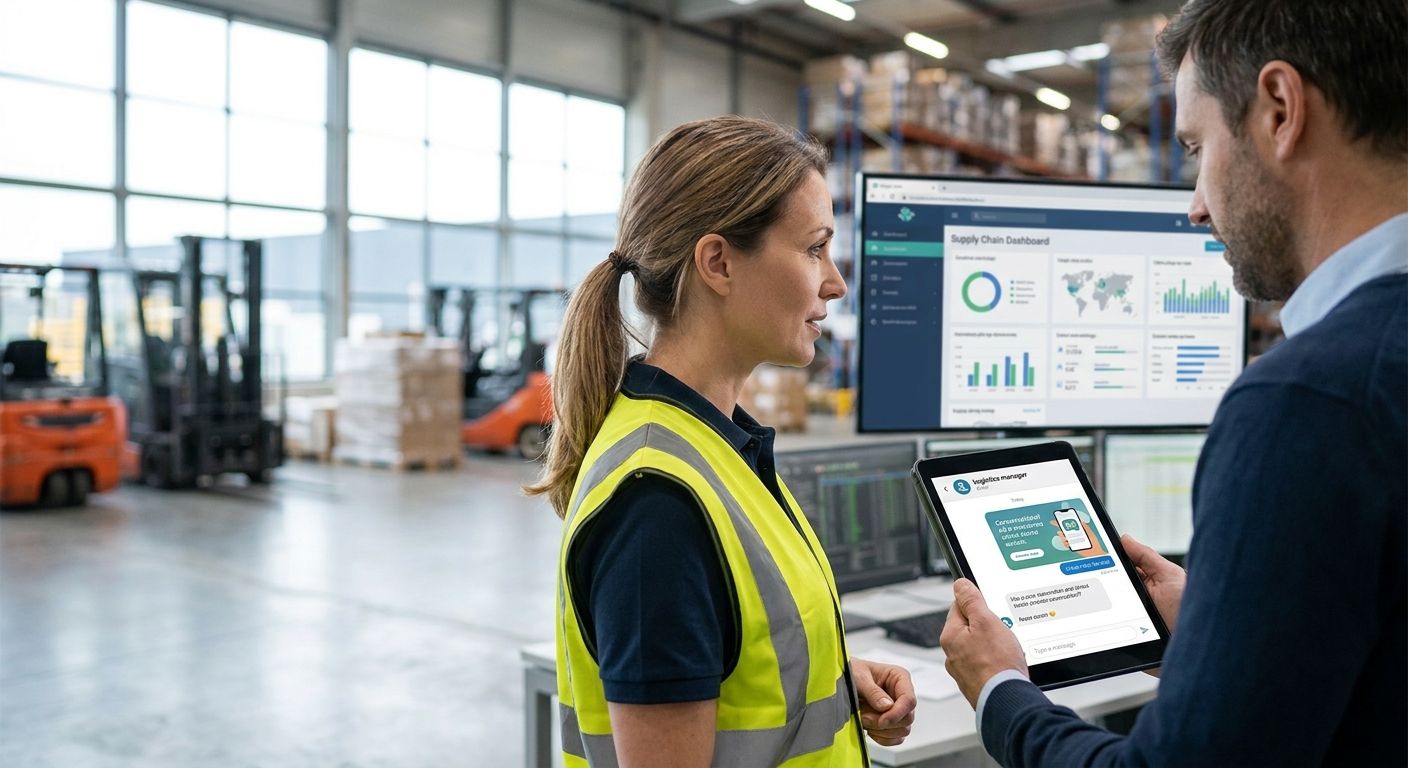
Freight quoting bots, fleet dispatch copilots, and warehouse inventory assistants all share one problem: they generate real usage and zero revenue. Conversational ads fix that without turning a dispatch tool into a banner farm.
- Elo's SDK adds conversational ads for logistics assistant apps without banner placements — native cards only.
- B2B SaaS AI copilots is the default integration path for freight, fleet, and warehouse chatbots in 2026.
- Custom LLM stacks and multi-model apps each need a different mediation approach — pick the wrong one and fill rate suffers.
- Generic contextual ad networks without logistics or B2B advertiser demand are a Skip for dispatch and freight tools.
- Twelve lines of code is roughly what SDK integration takes across OpenAI, Anthropic, or custom LLM builds.
Why this matters
A logistics assistant that answers 40,000 carrier-rate questions a month and monetizes none of them is leaving revenue on the table that a support widget or a Zendesk bot would never leave. Conversational ads for logistics assistant apps work differently than search ads: the ad shows up as a native card inside the answer, tied to what the user just asked, not as an interruption before it.
The difference matters more in logistics than in most categories. A dispatcher comparing fuel surcharges or a warehouse manager asking about pallet racking isn't browsing — they're mid-task. An ad that surfaces a relevant fuel card offer or a freight insurance quote at that exact moment reads as a helpful answer. A generic banner reads as noise, and B2B users tolerate noise for exactly zero seconds before they churn to a competitor's tool. Elo builds the matching layer specifically to avoid that failure mode.
Who this is for
This is for developers and founders building AI logistics or supply chain assistants — freight rate comparison bots, fleet maintenance copilots, customs document assistants, dispatch chatbots, inventory forecasting tools — on OpenAI, Anthropic, or a custom LLM stack, who want ad revenue without degrading the chat experience for professional B2B users. If your assistant serves brokers, dispatchers, warehouse operators, or procurement teams, the bar for ad relevance and brand safety is higher than a consumer chatbot, and the picks below are ranked with that in mind.
What to look for in conversational ads for a logistics assistant
Contextual matching tuned to freight and supply chain intent
Generic contextual matchers built for retail or entertainment chat don't know the difference between a "carrier" question and a "fuel card" question. A matcher trained on logistics-adjacent categories — freight, fleet, warehousing, customs, insurance — returns ads that fit the actual conversation instead of forcing a loose keyword match.
Native card format, not display banners
Dispatch and freight tools are used inside a work session, often on a shared screen or a mobile device in a warehouse. A native card that renders inline with the chat answer keeps the interface usable; a banner or interstitial breaks the flow and gets reported as broken UI.
Support for whichever model stack you already run
Logistics assistants get built on all three common LLM stacks — OpenAI, Anthropic, or a custom in-house model — and an ad SDK that only supports one of them forces a rebuild later. Confirm the SDK works across your stack before you integrate, not after.
Brand-safety controls for a professional B2B audience
A freight broker or warehouse manager sees an irrelevant or low-quality ad exactly once before they stop trusting the tool. Category exclusions and advertiser vetting matter more here than in a consumer app, where users have a higher tolerance for misses.
Revenue reporting you can act on
A dashboard that shows impressions without RPM, fill rate, or per-conversation revenue tells you nothing about whether the integration is working. You need numbers you can compare week over week, not a vanity impression count.
Latency that doesn't stall a dispatch or quote reply
A freight quote or ETA answer that takes an extra two seconds because an ad call is blocking the response loses users fast. The ad layer has to run without adding perceptible delay to the core answer.
Top picks for logistics and supply chain assistants
The default path — B2B SaaS AI copilots
Most logistics assistants are, structurally, B2B SaaS copilots wearing a freight or fleet skin. The B2B SaaS AI copilots integration path is built for exactly that shape of product — a professional user asking task-specific questions inside a paid or freemium tool. Integration runs roughly twelve lines of code on top of your existing chat loop. Buy — this is the starting point for nearly every freight, fleet, or warehouse assistant.
The custom-stack pick — contextual advertising for custom LLM chatbots
If your logistics assistant runs on a fine-tuned or in-house model rather than a stock OpenAI or Anthropic API, the contextual advertising for custom LLM chatbots path handles the matching layer without requiring you to expose model internals to a third party. It works off the conversation text itself, not the model architecture behind it. Buy if your stack is custom; Consider if you're still on a stock API and might switch later.
The multi-model pick — ad mediation for multi-model LLM apps
Some logistics platforms route different assistant tasks — quoting, tracking, documentation — through different models to balance cost and accuracy. The ad mediation for multi-model LLM apps setup lets one ad layer sit on top of all of them instead of running separate integrations per model. Consider — worth the extra setup only if you're actually running more than one model in production.
The retrieval-heavy pick — in-chat ads for RAG-based chatbots
A logistics assistant built on retrieval-augmented generation — pulling from carrier rate sheets, customs regulations, or internal SOPs — needs ad matching that reads the retrieved context, not just the user's raw question, to avoid serving an ad based on a document snippet instead of actual intent. Treat this as a Consider if your assistant is RAG-heavy, and confirm the matcher reads retrieved context before committing.
What to avoid
- Display banners bolted onto a chat UI. They look like a retrofit because they are one, and B2B users notice.
- Ad networks with no logistics or B2B advertiser demand. A network built for gaming or consumer apps will fill your inventory with irrelevant offers, which trains users to ignore the ad slot entirely.
- Contextual matchers that ignore compliance language. Freight, customs, and insurance conversations touch regulated topics — a matcher that doesn't account for that will eventually serve an ad that shouldn't run next to that conversation.
Add ads to your logistics assistant
See the SDK docs and revenue dashboard before you integrate.
Verdict comparison
| Pick | Best for | Model stack | Verdict |
|---|---|---|---|
| B2B SaaS AI copilots | Most freight/fleet/warehouse assistants | OpenAI, Anthropic, custom | Buy |
| Custom LLM contextual ads | In-house or fine-tuned models | Custom | Buy |
| Multi-model mediation | Apps routing across several models | Mixed | Consider |
| RAG-based in-chat ads | Retrieval-heavy logistics assistants | Any, with RAG | Consider |
FAQ
What are conversational ads for a logistics assistant?
They're native ad cards shown inside an AI logistics or freight chatbot's answer, matched to the topic the user just asked about rather than shown as a separate banner. In 2026 this format is standard on assistants that field freight, fleet, or warehouse questions at volume.
Do conversational ads hurt the chat experience in a dispatch tool?
Not when they use native cards instead of banners and match the actual conversation topic. A poorly matched or intrusive ad does hurt retention, which is why matching accuracy and card format matter more than raw fill rate.
Is conversational ad monetization better than a subscription for a logistics assistant?
They're not mutually exclusive — many logistics tools run a freemium tier monetized by ads alongside a paid tier without them. Ads let you monetize the free or lower-tier users who would never convert to a paid plan anyway.
Which LLM stacks support conversational ad SDKs in 2026?
Coverage generally spans OpenAI, Anthropic, and custom or fine-tuned LLM stacks, since logistics assistants get built on all three. Confirm SDK support for your specific stack before integrating, since coverage varies by vendor.
How hard is it to integrate an ad SDK into a logistics chatbot?
Integration effort runs roughly a dozen lines of code on top of an existing chat loop for a standard SDK setup. The bulk of the setup time goes into category and brand-safety configuration, not the code itself.
Are conversational ads GDPR compliant for logistics assistants used in Europe?
Compliance depends on how the SDK handles consent and data processing, not on the ad format itself. Check the specific compliance documentation for whatever SDK you integrate before launching to EU users.
What's the biggest mistake logistics assistant builders make with ads?
Using a generic contextual ad network with no freight, fleet, or B2B advertiser demand, which fills the ad slot with irrelevant consumer offers. That trains professional users to ignore or distrust the ad slot within a few sessions.
One last thing
The logistics assistants that monetize best aren't the ones with the most traffic — they're the ones where every question implies a purchase decision already in motion. A user asking about carrier rates, fuel surcharges, or freight insurance is closer to a buying moment than a user asking a general customer support question, which is exactly why a well-matched conversational ad in this category tends to outperform the same format in a generic chatbot.