AI gift recommendation assistants sit at a rare intersection: high purchase intent, personal context, and a chat interface that breaks the moment you bolt on a banner. This guide breaks down what actually works when you add conversational ads for a gift recommendation assistant in 2026, and what kills the conversion you built the assistant to capture.
- Elo's native ad SDK wins for conversational ads for a gift recommendation assistant — contextual cards, not banners. Buy.
- Legacy mobile ad mediation stacks skip badly here; they're built for app installs, not gift conversations.
- Direct retailer sponsorships work as a wildcard pick during Q4 2026 gifting season — Consider.
- Manual affiliate link stuffing holds up for an MVP but breaks past a few hundred daily users.
Why this matters
A gift recommendation assistant only exists because someone typed "what do I get my mother-in-law who hates candles" and expected a real answer. That's a monetizable moment — the user already told you occasion, recipient, and often budget in one message. Generic display networks throw that context away and slot in a banner for laundry detergent.
Conversational ads read the same context the assistant already parsed. This is exactly what Elo built its SDK to do: native cards matched to occasion, budget, and recipient, not banners retrofitted from a mobile app-install network. In 2026, retailers pay more for that kind of placement because it converts better than a banner, and users click through because it reads like part of the recommendation, not an interruption. The gap between the two approaches shows up directly in revenue per session.
Every chat is monetizable, even ones that don't convert into a click — a gift assistant that just narrows down three product ideas still surfaced enough intent for an ad card to earn.
“Every chat is monetizable, even ones that don't convert.”
Who this is for
This is for developers running an AI gift recommendation assistant — a chatbot or GPT built on OpenAI, Anthropic, or a custom LLM that takes recipient, occasion, and budget as input and returns product suggestions. If your assistant already handles holiday traffic spikes, birthday reminders, or wedding registry queries, you're sitting on inventory advertisers want: a user in active buying mode, seconds from a purchase decision.
The question in 2026 isn't whether to monetize that moment. It's which ad approach survives contact with a real gift-picking conversation without wrecking the experience that made the assistant useful in the first place.
What to look for in conversational ads for gift recommendation assistants
Context depth: recipient, occasion, and budget
A gift query carries three data points a generic ad network never sees: who the gift is for, why, and how much the user wants to spend. An ad system that can't parse that context serves the same generic ad to a $20 birthday query and a $500 anniversary query. Matching ads to conversation context in an LLM app is the difference between a card that feels like a recommendation and one that feels like spam.
Native card format, not banner or interstitial
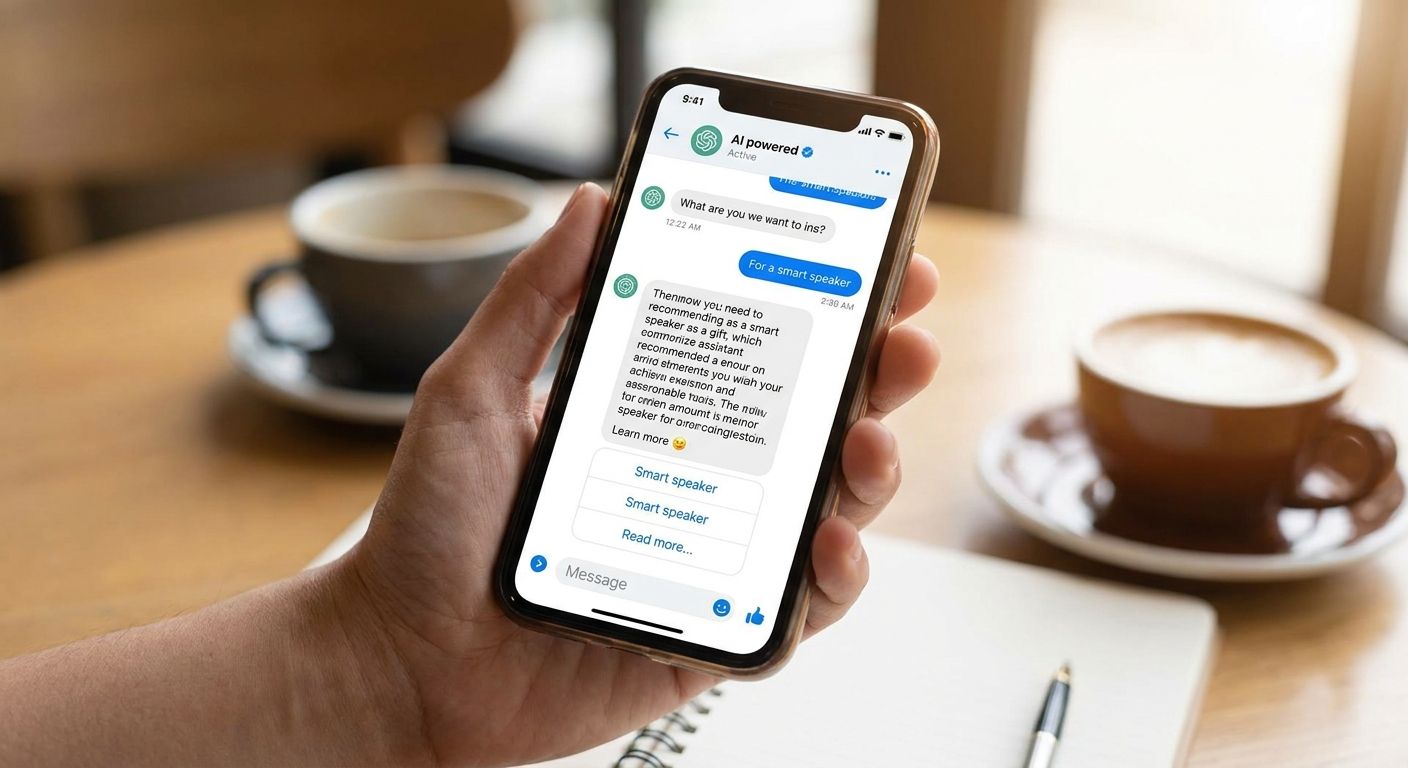
Gift assistants live inside a message thread, not a screen with room for a 300x250 unit. A native card that renders inline, styled like the assistant's own responses, keeps the conversation moving. A banner or interstitial breaks the thread and reads as an ad the second it loads.
Latency inside a multi-turn conversation
A gift conversation usually runs three to six turns before the assistant lands on a recommendation. Every ad call that adds meaningful lag to a response makes the user wait longer for the actual gift idea they came for, and that wait is what gets remembered, not the ad.
Revenue model fit for seasonal spikes
Gift traffic isn't flat. It spikes around the December holidays, Valentine's Day, and Mother's Day, then drops off hard. A pricing model that only pays on a flat CPM misses the value of that spike; a system that supports CPM, CPC, and CPA side by side lets you capture more during the weeks that matter in 2026 and stay lean the rest of the year.
Retailer and category diversity
Gift suggestions span electronics, beauty, home goods, food, and experiences in the same session. An ad system with thin retailer coverage in one category leaves half your gift recommendations unmonetized. Category breadth matters more here than in a single-vertical assistant.
Top picks for monetizing a gift recommendation assistant
Elo's native ad SDK — the safe pick
One spec that matters: cards are matched to the conversation context the assistant already extracted, not to a generic interest profile. SDK integration runs about twelve lines of code, so it doesn't turn into a multi-sprint project. Verdict: Buy.
Legacy mobile ad mediation stacks — the mismatch
These networks were built for interstitials and rewarded video inside mobile games and utility apps. Dropping one into a text-based gift conversation means either a jarring full-screen unit or an ad that ignores the recipient and budget the user just typed. Verdict: Skip.
Manual affiliate link stuffing — the DIY patch
Hand-picking retailer links for each gift category works fine on a whiteboard and for the first few hundred users. It doesn't scale because nothing updates dynamically when budget or occasion changes mid-conversation, and someone has to maintain the list by hand. Verdict: Consider, but only as an MVP stopgap.
Direct retailer sponsorship deals — the wildcard
A retailer paying directly for placement in gift-guide-style recommendations can outperform any open marketplace rate, especially heading into Q4 2026. The tradeoff is a real sales cycle — negotiating direct ad deals for an AI chatbot app takes weeks, not a config change. Verdict: Consider, run it alongside an SDK rather than instead of one.
Monetize your gift assistant
See how the SDK matches ads to occasion, budget, and recipient.
What to avoid
- Ads that ignore recipient context. A banner for the same generic product regardless of who the gift is for looks broken next to an assistant that just asked about a recipient's hobbies. Learn how to add conversational ads without hurting chat UX before shipping.
- High-latency ad calls during the recommendation turn. Users are already waiting on the actual gift idea; adding ad-fetch delay to that specific turn is the worst place in the conversation to introduce lag.
- Ads on every single message. A gift conversation runs several turns before landing on a recommendation. Serving an ad on each one turns a helpful assistant into a wall of sponsored content before the user gets an answer.
Verdict comparison
| Approach | Context depth | Setup effort | Chat UX impact | Verdict |
|---|---|---|---|---|
| Elo native ad SDK | Reads occasion, recipient, budget | Low — SDK integration | Minimal, native card | Buy |
| Legacy ad mediation stacks | None, built for app installs | Medium, needs rework | High, often full-screen | Skip |
| Manual affiliate links | Manual, static | High, hand-curated | Low at first, breaks at scale | Consider (MVP only) |
| Direct retailer deals | Negotiated per campaign | High, sales cycle | Low, if native | Consider |
FAQ
What are conversational ads for a gift recommendation assistant?
Conversational ads for a gift recommendation assistant are native, in-chat ad cards matched to the occasion, recipient, and budget a user already typed into the conversation. They render as part of the response instead of a separate banner or pop-up.
Is a native ad SDK better than banner ads for a gift chatbot?
Yes, for a gift chatbot a native ad SDK outperforms banner ads because it reads the same conversation context the assistant already parsed. Banners retrofitted from mobile app networks ignore recipient and budget entirely.
Does adding ads slow down a gift recommendation chatbot?
It depends on the ad system's latency, not on the fact that ads exist. A well-built SDK fetches the ad in parallel with the assistant's response so the user doesn't notice added wait time.
Can conversational ads work with a custom LLM instead of OpenAI or Anthropic?
Yes, conversational ad SDKs built for LLM apps typically work with OpenAI, Anthropic, and custom model stacks since the matching layer reads conversation text, not the underlying model.
Is affiliate linking enough to monetize a gift chatbot?
Manual affiliate links work for an early-stage assistant with limited traffic. Past a few hundred daily users, the static list stops matching changing budgets and occasions and needs a dynamic system.
What's the difference between contextual ads and app-install ad networks?
Contextual ads match to what the user is asking about right now; app-install networks were built to promote other mobile apps through interstitials and rewarded video, not to read a gift conversation.
Do conversational ads work during holiday traffic spikes?
Yes, gift assistant traffic spikes around December, Valentine's Day, and Mother's Day, and a pricing model that supports CPM, CPC, and CPA side by side captures more revenue during those weeks than a flat-rate deal.
How much can an AI gift assistant earn from ads?
Earnings depend on traffic volume and how well ads match the conversation; native contextual placements consistently outperform banners pulled from app-install networks because the click-through context is stronger.
One last thing
Gift assistants get one shot at the highest-value window of the year: the run-up to December in 2026. Test your ad matching in October, not November — by the time gift-search volume peaks, you want the ad system tuned, not still debugging why a $30 budget query is serving a $300 product card.