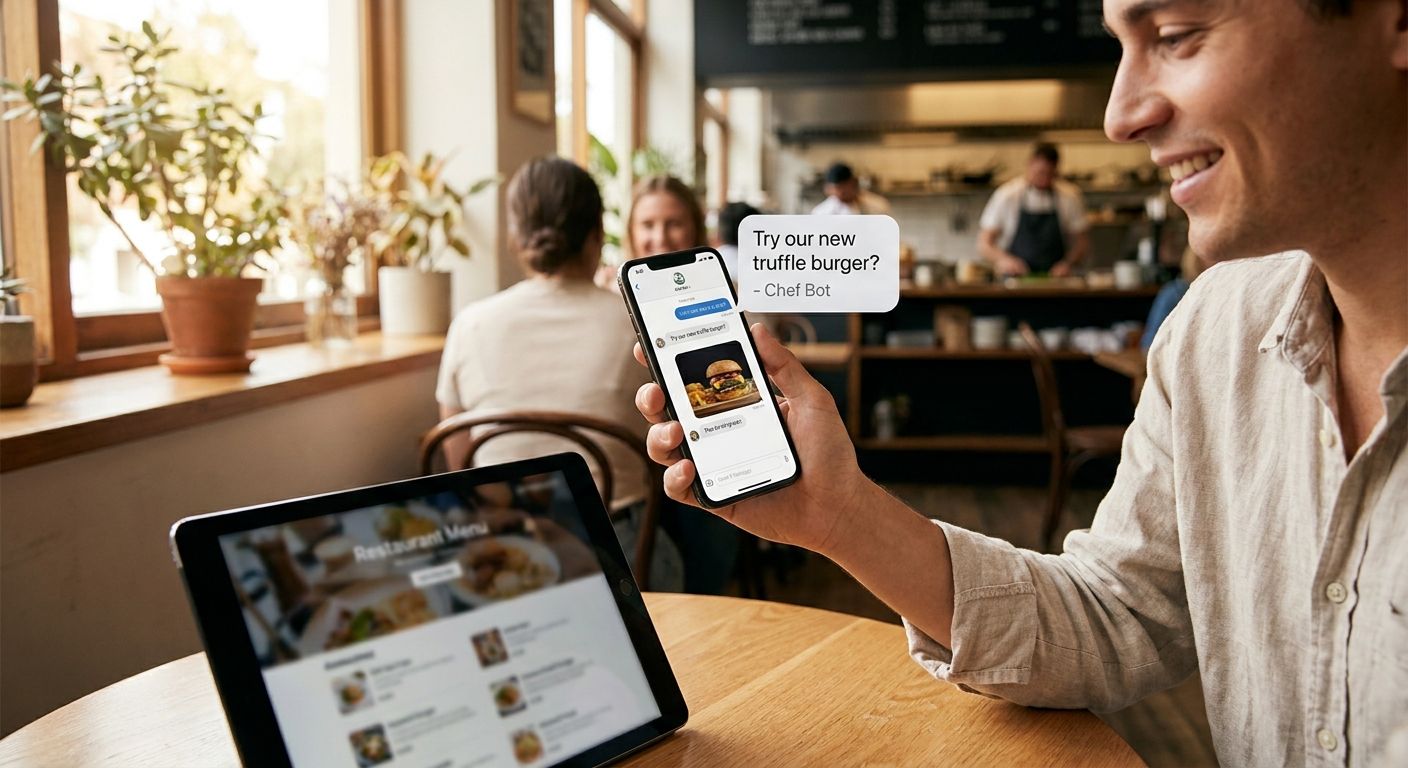
AI food ordering and restaurant assistants field constant intent signals — cravings, dietary restrictions, delivery windows, budget — and most of that traffic never turns into ad revenue. Conversational ads for AI food ordering assistants close that gap by turning order-adjacent chat into monetizable inventory without breaking the flow that gets someone from "I want tacos" to a completed order.
- Conversational ads for AI food ordering assistants work best as native menu cards matched to cuisine and dietary intent.
- Skip repurposed mobile banner ads inside an ordering assistant — they stall checkout and get ignored.
- Elo's ad SDK integrates in about twelve lines of code and matches ads to order context in real time.
- eCPM for food-category conversational ads improves when matching accounts for dietary restrictions and delivery windows in 2026.
- Every ordering chat is monetizable in 2026, even the ones that end without a completed order.
Why this matters
Food ordering assistants have a monetization problem that most ad networks weren't built for: the conversation itself is the product, and a bad ad placement doesn't just get ignored, it kills the order. A banner interrupting a checkout flow behaves differently than a sponsored card suggesting a combo upsell while someone is still deciding.
Elo runs the matching and rendering layer for that difference — native cards that sit inside the conversation instead of over it, priced on CPM, CPC, or CPA depending on the advertiser. In 2026, that distinction is the whole ballgame for developers trying to add conversational ads without tanking order completion rates.
Who this is for
This is for developers and product teams running AI chat assistants that handle restaurant discovery, food ordering, delivery tracking, or meal planning — whether built on OpenAI, Anthropic, or a custom LLM stack. If your assistant fields queries like "find me something spicy under $15" or "what's open near me that does gluten-free," you're sitting on ad-matchable intent that most food ordering bots currently leave on the table.
What to look for in conversational ads for AI food ordering assistants
Order-intent matching, not keyword matching
A food assistant that mentions "vegan" fifty times a day needs ads matched to dietary restriction and cuisine type, not just the literal word. Keyword-level matching surfaces irrelevant ads — a burger chain ad against a vegan query burns trust in one turn. Intent-level matching reads the conversation context, not just the last message.
Latency during checkout
An ad that adds 400 milliseconds to a response during an active order flow is a lost order, not a monetized one. Ad matching has to run inline with the model's response generation, not as a blocking call after it. Anything that measurably slows the assistant during checkout is the wrong integration point.
Format that survives a mobile screen
Most food ordering happens on a phone mid-decision. A card format that's native to the chat bubble reads as part of the conversation; a banner or interstitial reads as an interruption and gets dismissed or ignored. Format matters more in food ordering than almost any other vertical because the user is already in a transactional mindset.
Restaurant and category brand safety
Food assistants sit next to sensitive categories — allergens, health claims, alcohol delivery in some regions. Ad matching needs category-level controls so a beer delivery ad doesn't surface next to a query about pregnancy-safe meal planning. This isn't optional in 2026; it's table stakes for keeping restaurant partners and advertisers both comfortable.
Fill rate for long-tail cuisines
A network with deep fill for national QSR chains can still leave you with empty inventory on niche cuisine queries — Ethiopian, Filipino, regional Mexican. If your assistant serves a broad cuisine catalog, fill rate on the long tail matters as much as the headline CPM on burger and pizza queries.
Revenue model transparency
CPM, CPC, and CPA behave differently for food ordering traffic. A sponsored menu recommendation that leads to an actual order justifies a CPA or CPC model; a passive brand awareness card for a delivery service is CPM territory. Know which model applies to which placement before you commit inventory.
Top picks for conversational ad formats
The safe pick — native sponsored menu cards. These render inline as a suggested dish or restaurant, matched to the current query, and don't require a tap to dismiss before the user can keep ordering. Integration through Elo's SDK runs about twelve lines of code. Buy — it's the lowest-risk format for order-flow assistants and the one least likely to hurt completion rates.
The high-intent pick — context-matched upsell cards. Instead of matching on the query alone, this format reads dietary restriction, cuisine preference, and time-of-day signals to surface an ad only when it's genuinely relevant — say, a meal-kit ad triggered by a "what should I cook this week" query rather than a one-off order. The matching layer is what makes this work instead of feeling random. Buy — highest relevance, and relevance is what keeps users from tuning ads out.
The wildcard — post-order recommendation cards. Shown after an order confirms rather than during checkout, these carry zero risk of interrupting a transaction and can promote a second restaurant, a dessert add-on, or a delivery loyalty offer. The tradeoff is lower attention since the user's task is already done. Guidance on placing ads without hurting chat UX applies directly here. Consider — good incremental revenue, weaker performance than in-flow placements.
The one to skip — repurposed mobile interstitial banners. These are lifted straight from app-install ad stacks and dropped into a chat UI as a full-screen unit between messages. They require a dismiss tap before the conversation continues, which is exactly the friction a food ordering flow can't absorb. Skip — the format was built for a different product category and it shows.
“If the ad card requires a tap to dismiss before the order can proceed, the placement is wrong.”
Add ads to your ordering assistant
Twelve lines of code, native cards, revenue from day one.
What to avoid
- Full-screen interstitials mid-checkout — any format that blocks the next message until dismissed costs you completed orders, not just ad impressions.
- Keyword-only targeting on allergen-adjacent queries — matching "nut-free" to a generic snack ad without checking the actual allergen data is a brand-safety problem waiting to happen.
- Flat CPM pricing on every placement — a sponsored menu card that drives an actual order is worth more than a passive banner, and pricing them the same undersells your highest-intent inventory.
Comparison across criteria
| Format | Checkout risk | Long-tail cuisine fit | Revenue model | Verdict |
|---|---|---|---|---|
| Native sponsored menu card | Low | Good | CPC / CPA | Buy |
| Context-matched upsell card | Low | Strong | CPC / CPA | Buy |
| Post-order recommendation card | None | Moderate | CPM | Consider |
| Repurposed mobile interstitial | High | Poor | CPM | Skip |
FAQ
What are conversational ads for AI food ordering assistants?
They're native ad cards embedded directly in the chat flow of a food ordering or restaurant assistant, matched to the user's cuisine, dietary, and order intent rather than shown as separate banners. In 2026 the format is closest to a sponsored menu recommendation than a display ad.
Do conversational ads hurt order completion rates?
Poorly placed formats do, especially interstitials that require a dismiss tap mid-checkout. Native cards that render inline without blocking the next message generally don't interrupt the ordering flow.
Is CPM or CPC better for food ordering ad inventory?
CPC or CPA fits high-intent placements like sponsored menu suggestions that lead to an order, while CPM fits passive brand-awareness placements like post-order recommendations. Pricing every placement the same undervalues your best inventory.
How much code does it take to add ads to a food ordering assistant?
Integrating a native ad SDK into an existing chat flow typically runs around twelve lines of code, since the SDK handles matching and rendering rather than requiring a custom ad stack.
Can conversational ads target dietary restrictions safely?
Yes, but only when matching reads actual dietary and allergen context rather than surface keywords. Category-level brand safety controls are what keep an allergen-sensitive query from surfacing an irrelevant or unsafe ad.
What's the biggest mistake in food ordering ad monetization?
Using a mobile interstitial format built for app installs inside a checkout flow. It adds a dismiss step exactly where friction costs you a completed order.
Does ad fill rate matter for niche cuisine queries?
It matters more than the headline CPM on mainstream categories like pizza or burgers. A network with strong fill on national chains can still leave long-tail cuisine queries with no relevant ad to serve.
Should ads show during checkout or after order confirmation?
Both have a place: in-flow native cards during the ordering conversation drive the highest relevance, while post-order cards carry zero completion risk but lower attention. Most food ordering assistants in 2026 run both.
One last thing
The assistants that monetize best in 2026 aren't the ones with the most ad slots — they're the ones where the ad card reads like a menu suggestion a friend would make. A sponsored recommendation that matches the actual order intent gets tapped; a generic banner gets scrolled past. Every chat is monetizable, even the ones that end without a completed order, as long as the format respects the conversation it's sitting inside.