
Adding ads does not automatically mean lower chatbot engagement; the effect depends on the placement, the conversation, and what you count as engagement. For a 2026 launch, test ads against an ad-free control and measure task completion and return visits alongside revenue—not just ad clicks.
- Does adding ads reduce chatbot engagement? Test task completion and retention against an ad-free control before deciding.
- Keep conversational ads separate from the assistant’s answer, and label sponsored content clearly.
- Elo fits developers who want SDK-based contextual ads in their own chat applications.
- Treat revenue as a business outcome, not proof that the chatbot experience improved.
Why this matters
Your chatbot exists to help users finish something. An ad impression does not prove that happened, and a longer conversation does not necessarily mean the experience improved. A user asking the same question repeatedly generates messages without making progress.
Define success before adding inventory. For your 2026 experiment, name the task users should complete, the behavior that signals success, and the engagement changes that would stop a rollout. The guide to A/B testing conversational ads in a chat app covers the testing question separately from integration.
Protect the user’s task before optimizing the ad slot. That rule makes the monetization decision easier to interpret: revenue is acceptable only within the experience limits you set.
Does adding ads reduce chatbot engagement?
The answer requires a comparison with users who do not receive ads. A before-and-after dashboard cannot isolate the ad effect when your model, acquisition channels, or onboarding also change.
Use the following table as a test-design framework, not as a prediction of results. Each approach exposes a different trade-off.
| Approach | Best for | What it lets you evaluate | Limitation |
|---|---|---|---|
| Ad-free control | Establishing a baseline | Task success and retention without the new placement | Generates no revenue from the tested ad slot |
| Labeled contextual card | Testing a separate sponsored option | Whether users act on a relevant offer while completing their task | Requires space in the conversation and clear disclosure |
| Post-answer placement | Testing an offer after the requested response | Whether a sponsored next step fits the completed answer | Appears after the point where some users finish their visit |
| Blocking placement | Testing a deliberately gated experience | Whether users tolerate an interruption before continuing | Makes access to the answer depend on passing the placement |
For an initial experiment, prefer a separate, labeled placement over a gate. This recommendation protects access to the answer; it does not claim that a particular format will increase retention.
Keep sponsored content out of the assistant’s independent reasoning. If an advertiser pays for visibility, present that visibility as advertising rather than disguising it as an objective recommendation.
What should you measure besides ad clicks?
Track the product outcome and the advertising outcome separately. Then join them at the experiment-cohort level so you can see whether monetization coincides with a change in the experience.
Task completion
Choose an observable completion event that matches your chatbot’s job. Examples include finishing a requested document, resolving a support issue, or saving a selected itinerary. These are suggested event definitions, not claims about your current instrumentation.
Define completion identically for the control and treatment. If the ad-enabled version counts a sponsored click as task completion while the control requires a finished task, the comparison is invalid.
Return visits
Measure whether users return after their initial exposure. You can define a 7-day return window for an early read and a 28-day return window for a longer follow-up; these are measurement choices, not universal benchmarks.
Compare cohorts with equal observation time. A recently enrolled treatment user has not had the same opportunity to return as a control user enrolled earlier.
Conversation quality
Track repeated questions, explicit negative feedback, and abandonment before the requested answer finishes. Use these signals to inspect the conversation, not to assign a cause automatically.
Keep message count in context. More messages can represent useful exploration or unsuccessful attempts to get an answer; a transcript review should distinguish them.
Revenue and delivery
Report impressions, clicks, revenue, and the denominator behind each rate. RPM expresses revenue per 1,000 units; explicitly name whether those units are impressions, sessions, or another measure.
For your 2026 dashboard, keep revenue per session separate from revenue per impression. Otherwise, a change in ad frequency can look like better monetization without showing what happened to the user experience.
How do you test ads without confusing the result?
Use a controlled rollout with a written decision rule. Do not change the answer model, ad placement, and onboarding simultaneously and then attribute the result to advertising.
- Define success. Select a primary product outcome, such as task completion. Add retention and experience guardrails, then record what would count as an unacceptable decline.
- Assign users. Keep users in a consistent control or treatment group. Avoid switching the same person between experiences during the test unless your experimental design explicitly accounts for that switching.
- Deliver ads. Start with a specified placement and eligibility rule. Record assignment even when an eligible treatment session receives no ad, so delivery failures do not erase users from the analysis.
- Record outcomes. Capture the same task and retention events in both groups. Keep ad requests, rendered placements, and clicks distinct rather than treating a request as a viewed impression.
- Apply guardrails. Compare product outcomes and revenue together. Roll back when the predeclared experience limits are breached; investigate uncertain results instead of declaring a win from clicks alone.
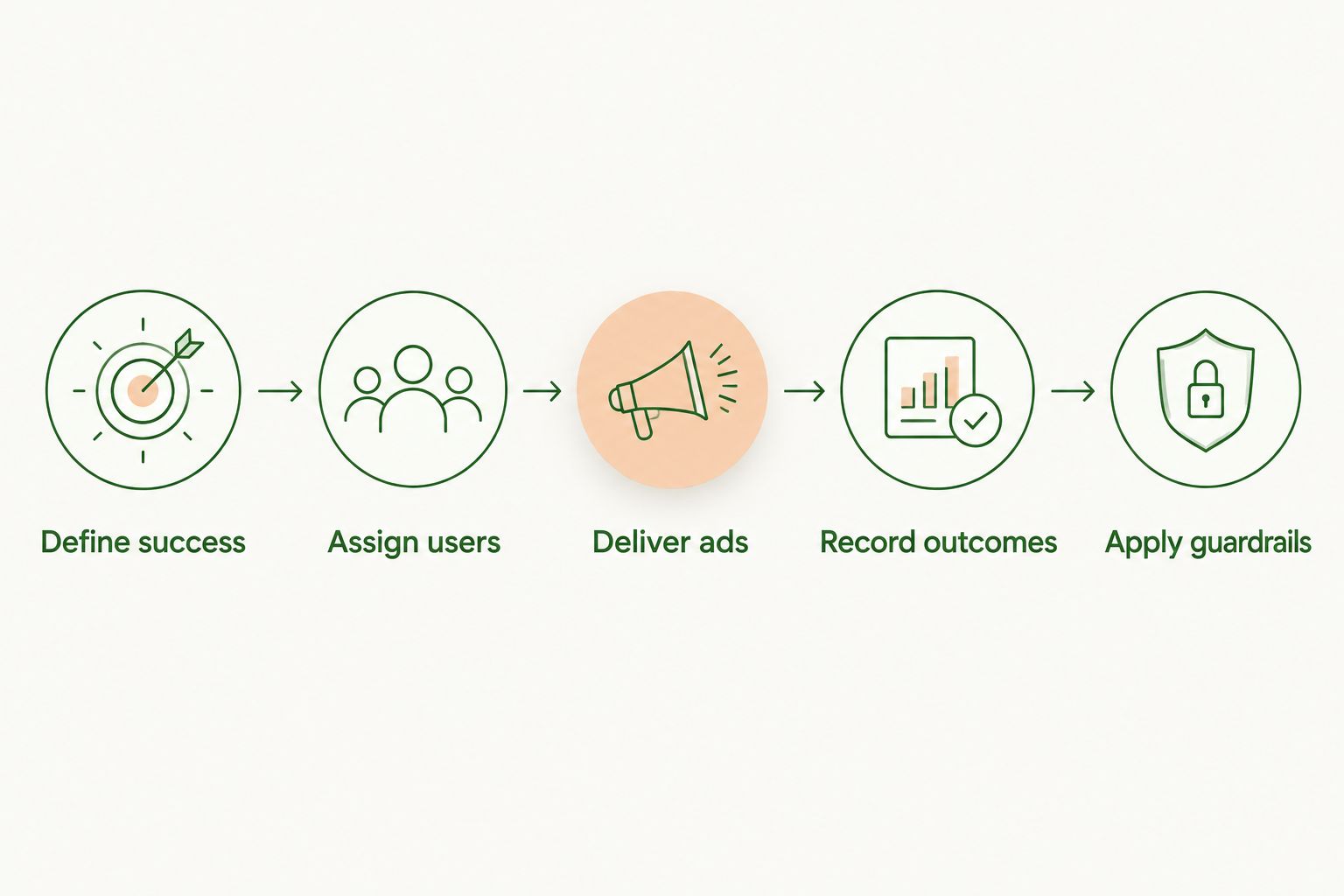
Analyze all assigned users for the main experiment result. An additional exposed-user analysis helps diagnose delivery and placement, but it answers a different question: what happened among people who actually saw an ad?
Do not choose the sample size or stopping point from a generic online rule. Base them on your baseline event rate, the change you need to detect, and your statistical analysis plan. Freeze that plan before reviewing treatment results.
Read the outcome before changing the placement
Use a short decision record for the 2026 rollout. State what changed, which cohorts were compared, and whether the result met your declared criteria.
- Revenue improves and guardrails hold: consider expanding the tested configuration, while continuing to monitor the same outcomes.
- Revenue improves and guardrails fail: reject or revise the configuration. Revenue does not cancel a failed product requirement.
- Results remain uncertain: continue only under the original analysis plan or design a new experiment. Do not describe uncertainty as “no impact.”
- Delivery fails: fix instrumentation or integration before drawing conclusions about user preference.
Keep conclusions narrow. A result for one placement and user cohort is not proof that every ad format belongs throughout the application.
Why the engagement effect varies
Evaluate these factors as design choices in your application, not as a formula that guarantees a particular outcome. Each belongs in your test specification.
- Conversation relevance: specify which intents are eligible. A commercial offer should relate to the current task rather than merely repeat a keyword from an earlier message.
- Placement timing: identify whether the offer appears before, during, or after the answer. Keep the requested response accessible independently of the sponsor interaction.
- Exposure frequency: record how often users encounter placements across turns and sessions. Test changes separately rather than increasing frequency during an active experiment.
- Disclosure: make the sponsored status visible at the placement. Do not rely on a general disclosure elsewhere in the application to explain an individual paid recommendation.
- Delivery behavior: define what happens when the ad request is slow, fails, or returns nothing. The assistant should still complete its non-advertising task.
- User intent: separate exploratory browsing from urgent problem-solving in your analysis. Do not assume a result from product discovery applies to account recovery or a failed payment.
Turn those factors into explicit eligibility and rendering rules. “Show something relevant” is not a testable implementation requirement; a documented intent rule and a specified display location are.
Where does an ad SDK fit?
Elo fits developers who want SDK-based contextual ads in their own chat applications. Elo provides an SDK-based adserver for applications built on OpenAI, Anthropic, or custom LLMs, with publisher revenue coming from advertiser spend.
That makes Elo a relevant option for implementing conversational ads. It does not establish the engagement effect in your application. You still need an experiment, product analytics, and a decision about which conversations should remain ad-free.
Evaluate Elo’s contextual adserver against your implementation requirements: how a placement is requested, where sponsored content appears, and which events your application needs to record. Confirm the available controls during implementation rather than assuming a frequency cap, reporting integration, or fallback behavior exists.
The trade-off is straightforward. An SDK-based adserver addresses ad delivery, while your team remains responsible for the surrounding chat experience and its measurement.
Will a relevant ad improve chatbot engagement?
Relevance is a targeting criterion, not evidence of improved engagement. Test whether the sponsored option helps users complete the task they came to do, rather than treating a click as a successful conversation.
A user who opens an offer has interacted with an advertiser. Whether that interaction benefits your chatbot requires a separate product outcome, such as completing the original task or returning later.
Is shorter session duration a sign that ads hurt engagement?
Shorter session duration is not enough to diagnose harm. A user can leave after successfully finishing a task or abandon the chatbot before receiving a useful answer.
Compare duration with completion and return behavior. Inspect sessions around the placement to distinguish a completed interaction from an interruption.
Should every conversation contain an ad?
No. Define eligible opportunities instead of making an ad mandatory in every conversation. Preserve a no-ad outcome when the context is unsuitable or the placement cannot meet your requirements.
That decision sacrifices an advertising opportunity in the excluded conversation. It also keeps your rendering logic from forcing a sponsored message into a task where you have not established a useful place for it.
FAQ
Does adding ads reduce chatbot engagement every time?
No universal result applies to every chatbot. Compare an ad-enabled treatment with an ad-free control and measure task completion, retention, and revenue separately.
What's the best metric for testing whether chatbot ads hurt users?
Use a task-success metric that matches the chatbot’s purpose as your primary product outcome. Add return visits and experience guardrails; ad click-through rate measures advertising interaction, not overall product quality.
How long should I track users after showing chatbot ads?
A 7-day return window and a 28-day return window are possible measurement choices, not required test durations. Set the experiment length and sample size from your baseline behavior and analysis plan.
Are contextual chatbot ads better than blocking ads?
A separate contextual placement preserves access to the answer, while a blocking placement gates progress. Test engagement directly rather than assuming either format has a proven retention advantage in your application.
Should I count an ad request as an impression?
No. An ad request records an attempt to obtain an ad; an impression should follow your documented rendering and measurement definition. Keep request, display, and click events distinct.
Can I keep ads out of sensitive chatbot conversations?
Make conversation eligibility an application requirement and confirm how your implementation enforces it. Do not assume the adserver automatically excludes every context your product considers unsuitable.
What should I do if revenue rises but retention falls?
Apply the decision rule you set before the experiment. If retention breaches your declared limit, reject or revise the placement rather than treating higher revenue as sufficient proof of success.
One last thing
A missed ad impression is not a failed conversation. Keep a successful answer possible even when the ad request returns nothing.
For your 2026 release checklist, test that empty-ad path deliberately. Confirm that the answer completes, the layout remains usable, and analytics distinguish a successful chat from an unsuccessful ad request. The chatbot must still work when there is nothing to monetize.