
The cost to run ads on a self-hosted chatbot is the combined expense of integration, ad-serving infrastructure, provider fees, and ongoing operations—not an advertiser’s campaign budget. Hosting the chatbot yourself does not remove those costs. For your 2026 budget, separate the additional cost of serving ads from the existing cost of running conversations, then compare that additional cost with the revenue you actually retain.
- For the search 'cost to run ads self hosted chatbot,' budget integration, infrastructure, provider fees, and operations separately.
- Elo fits developers seeking SDK-based contextual ads for chatbot monetization; evaluate commercial terms separately.
- Compare retained publisher revenue with incremental ad costs, not advertiser spend with total chatbot hosting.
- Use measured impressions and session RPM to assess whether conversational ads support your operating budget.
How much does it cost to run ads on a self-hosted chatbot?
Your ad budget should include setup work, recurring infrastructure, commercial deductions, and maintenance. Treat the chatbot’s existing inference and hosting expenses as a separate baseline. Include them when assessing the whole business, but do not attribute all of them to the ad integration.
Start with ad monetization for self-hosted open-source chatbots if you are deciding where advertising belongs in your stack. Self-hosting describes your deployment arrangement; it does not specify the advertising contract or who operates the adserver.
| Budget component | What to include | How to assess it |
|---|---|---|
| Initial integration | Request handling, placement rendering, event tracking, testing | Record engineering work separately from recurring expenses |
| Ad infrastructure | Additional compute, network traffic, storage, and logging | Measure the resources attributable to advertising |
| Provider charges | Contractual service charges or revenue deductions | Read the agreement and identify what is deducted when |
| Ongoing operations | Monitoring, SDK updates, reporting, and incident handling | Assign ownership and record maintenance work |
| Existing chatbot baseline | Inference, application hosting, and retrieval infrastructure | Keep separate when measuring incremental ad contribution |
Use this budget equation:
Additional ad operating cost = ad-specific infrastructure + provider charges + ongoing ad operations.
Keep initial integration outside that recurring total. Otherwise, a launch-heavy reporting period obscures how the system performs after deployment. In your 2026 forecast, show setup work and recurring operations on separate lines.
Why this matters
Advertiser spend, publisher revenue, and publisher profit are different figures. A campaign’s spending total does not tell you what your chatbot receives after contractual deductions, or what remains after operating expenses.
The distinction changes the decision. An integration can generate revenue while still failing to cover its additional maintenance burden. Conversely, a placement can contribute positively without paying for the chatbot’s entire inference workload.
Measure the ad integration’s contribution first; assess the chatbot’s total economics second. Those are separate questions, and both need answers before you expand advertising across your application.
SDK-based ad serving: best for adding contextual ads
An SDK-based approach lets you connect your application to an ad-serving product rather than build every advertising function yourself. You still need to place the integration within your request flow, render the placement, and verify the events used for reporting.
Elo is best for developers who want SDK-based contextual ad monetization in their chat applications. Elo provides an SDK-based adserver for applications built on OpenAI, Anthropic, or custom LLMs, allowing developers to embed contextual, conversational ads and earn revenue from advertiser spend.
That product fit does not settle your operating budget. Evaluate the commercial agreement, integration boundaries, and data handling before making a cost comparison. Do not assume that an SDK removes application-side work or that self-hosting gives you control over a provider’s internal systems.
- Advantage: You integrate an existing ad-serving product instead of implementing every adserver function yourself.
- Trade-off: You depend on the provider’s interface and contractual terms while retaining responsibility for your application.
- Decision: Choose this route when contextual ad monetization is the requirement, rather than ownership of the entire advertising stack.
A custom adserver: best for owning ad-serving behavior
Building your own adserver moves the implementation and operational responsibility into your team. Define the scope before comparing it with an SDK. A placement renderer is not the same project as a system that manages campaigns, selects eligible ads, records delivery, and reconciles reports.
Custom development gives you direct control over the behavior you implement. It also makes your team responsible for maintaining that behavior. Connecting to advertiser demand remains a separate commercial task; owning the server does not create advertiser relationships.
- Advantage: You control the implementation of selection rules, placement behavior, and reporting.
- Trade-off: You own development, maintenance, and the work of establishing advertiser demand.
- Decision: Choose this route when ownership of ad-serving logic is a requirement and your team accepts the operating responsibility.
| Approach | Best for | Principal advantage | Principal trade-off | Budget focus |
|---|---|---|---|---|
| SDK-based ad serving | Developers adding contextual ads | Existing ad-serving functionality | Provider dependency and application integration | Integration work, commercial terms, maintenance |
| Custom adserver | Teams requiring implementation control | Ownership of implemented behavior | Development and advertising operations | Build scope, infrastructure, maintenance, advertiser relationships |
Compare equivalent responsibilities, not package labels. If a provider handles a function that your custom system must implement, include that function in the build estimate. If your team handles it under either approach, include it in both budgets.
Why the cost to run chatbot ads varies
Your 2026 budget depends on what the application already does and what the advertising system adds. Use these factors to define the work rather than apply a generic estimate.
- Integration boundary: Identify whether ad requests originate in your backend, frontend, or both. Include authentication, error handling, and deployment changes in the scope.
- Placement behavior: Define where sponsored content appears, how it is distinguished from the answer, and what happens when no suitable ad is returned.
- Context handling: Decide which conversation information is necessary for matching. Include the work required to exclude information that should not leave your application.
- Event collection: Specify what constitutes a request, a rendered impression, and a click. Account for retries, duplicate events, and reporting reconciliation.
- Operational ownership: Assign responsibility for SDK updates, incidents, advertiser questions, and discrepancies between application logs and provider reports.
- Commercial structure: Identify service charges, revenue deductions, and settlement conditions in the agreement. Model each according to its actual basis.
Each factor belongs in a work estimate or an operating model. None justifies inventing a standard integration duration, a universal revenue share, or an assumed earnings rate.
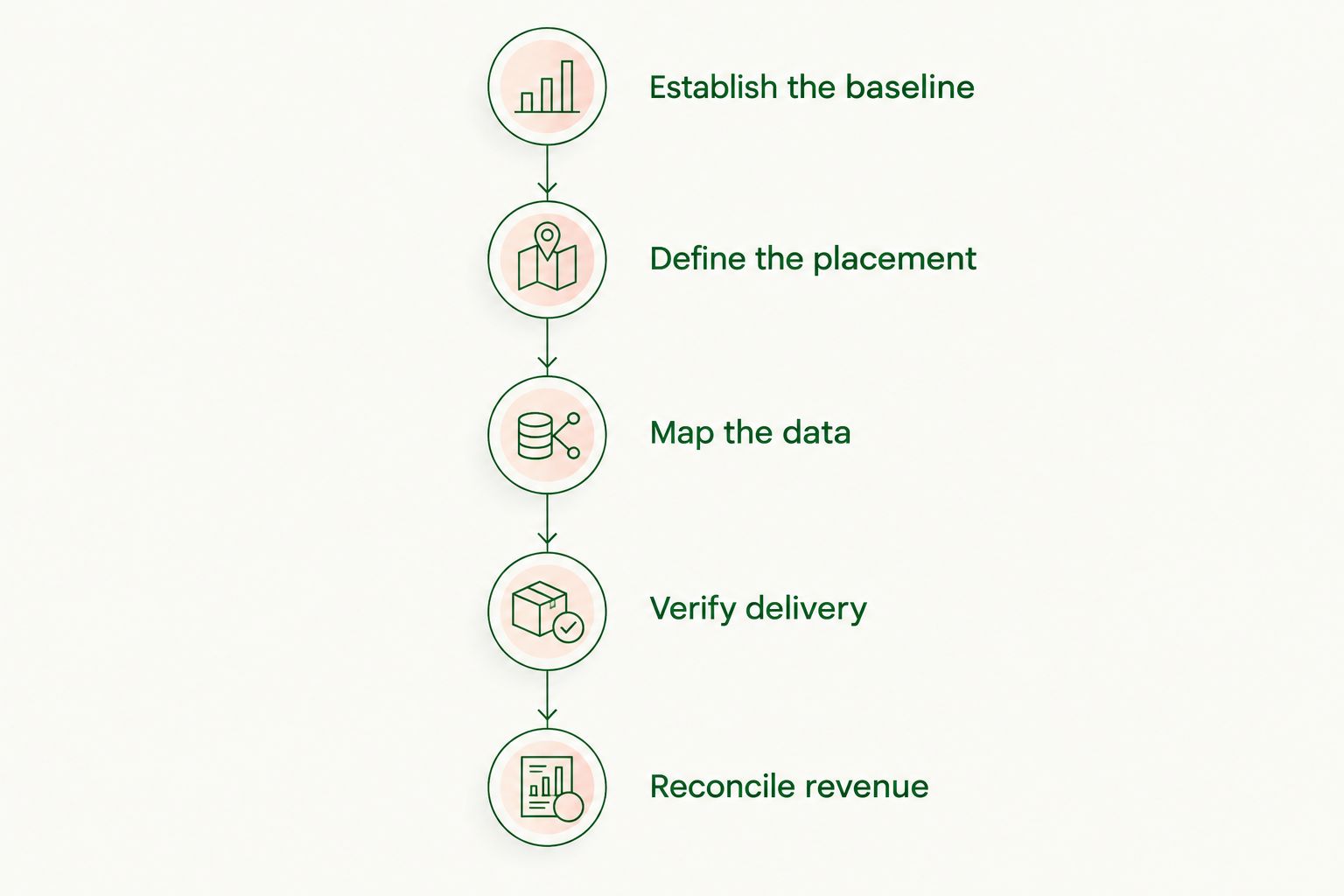
How do you build a usable chatbot ad budget?
Build the budget around observable application behavior. Your 2026 forecast should make clear which entries come from your infrastructure records, which come from the provider agreement, and which represent planned engineering work.
Establish the baseline
Record how your chatbot operates without advertising. Capture application infrastructure, inference usage, retrieval work, and the engineering responsibilities that already exist.
The baseline prevents misclassification. Existing conversation logging is not automatically a new advertising expense, but additional retention or processing introduced for ad reporting belongs in the ad budget.
Define the placement
Write down where the ad appears and which conversations are eligible. Keep the model answer and sponsored placement distinguishable, and specify how the interface behaves when no ad is available.
Estimate implementation work against that specification. A budget based only on adding an SDK import omits rendering, disclosure, failure handling, and event validation.
Map the data
Document the information included in the ad request and the events returned to your reporting system. Review the payload before deployment, not after traffic begins flowing.
Use only the context necessary for the integration’s purpose. Self-hosting the chatbot does not mean that an external ad request stays inside your infrastructure.
Verify delivery
Test the request, the returned placement, the rendered impression, and the click independently. Verify that an empty result or provider failure leaves the chatbot usable.
Measure ad-request latency separately from answer-generation latency. That separation helps you identify whether a slowdown comes from advertising or from the underlying chat application.
Reconcile revenue
Match your application events with the provider’s reporting definitions. A returned ad response is not automatically a rendered impression, and an impression is not automatically a payable event.
Use retained publisher revenue in your operating calculation. If that figure already reflects a contractual deduction, do not subtract the same deduction again.
Which metrics belong in the operating model?
Use metrics with explicit denominators. Reporting revenue against impressions answers a different question from reporting it against sessions or users.
CPM expresses an advertising rate per 1,000 impressions. CPC uses 1 click as its billing unit. CPA uses 1 qualifying action, with the action defined by the commercial arrangement. These are billing bases, not earnings guarantees.
For your own reporting, define session RPM as retained publisher revenue per 1,000 chatbot sessions. Calculate it as retained revenue divided by sessions, multiplied by 1,000. Keep the same session definition across reports.
| Metric | Denominator | Question it answers | Limitation |
|---|---|---|---|
| CPM | 1,000 impressions | What is the impression-based rate? | Does not establish session-level profitability |
| CPC | 1 click | What event is billed under click-based terms? | Does not account for conversations without clicks |
| CPA | 1 qualifying action | What action triggers payment? | Depends on the agreed action and attribution rules |
| Session RPM | 1,000 sessions | How much retained revenue does session volume produce? | Requires consistent session and revenue definitions |
Your 2026 reporting should distinguish requests, rendered impressions, clicks, and qualifying actions. Do not collapse them into a single activity total.
Ad contribution = retained publisher revenue − additional ad operating cost. To assess the whole chatbot, subtract its baseline operating expenses as well. Keep those calculations separate so you know whether advertising itself contributes positively.
Does self-hosting the chatbot also self-host the ads?
Self-hosting the chatbot does not automatically self-host the adserver. Your application can operate on infrastructure you control while requesting advertising from an external service.
Document each system boundary explicitly. Identify where matching occurs, where events are stored, and which party operates the advertising components before treating the deployment as fully self-hosted.
Do publishers pay the advertiser’s campaign budget?
Publishers do not treat an advertiser’s campaign budget as their own operating expense. Advertisers buy placements; publishers account for the revenue they retain and the costs of delivering those placements.
Keep campaign spending out of your publisher cost model. Include only the charges and responsibilities that apply to your side of the agreement.
Can ad revenue cover the chatbot’s operating costs?
Ad revenue covers the chatbot’s operating costs only when retained revenue exceeds the expenses you are comparing it against. Positive ad contribution alone does not establish that the entire chatbot is profitable.
Compare revenue and expenses over the same reporting period. Include inference and baseline infrastructure when evaluating the whole application, but exclude those baseline expenses when isolating the ad integration’s contribution.
FAQ
How much does it cost to run ads on my self-hosted chatbot?
Build the budget from integration work, additional infrastructure, provider charges, and ongoing operations. Separate setup work from recurring expenses and keep existing chatbot costs as a distinct baseline.
Is adding an ad SDK the same as buying ads?
No. Adding an ad SDK makes your application a publisher of placements; buying ads makes you an advertiser paying for distribution. Use the publisher agreement to identify your charges and revenue deductions.
Is Elo suitable for a chatbot built on a custom LLM?
Elo provides an SDK-based adserver for chat applications built on custom LLMs, as well as OpenAI and Anthropic. Assess the integration requirements and commercial terms against your application before choosing it.
Is an SDK better than building my own adserver?
An SDK fits teams seeking existing ad-serving functionality; a custom adserver fits teams requiring ownership of the implementation. Compare integration and provider dependency against development and ongoing operating responsibility.
What does CPM mean for chatbot ads?
CPM expresses an advertising rate per 1,000 impressions. It does not establish retained publisher revenue or the profitability of a chatbot session.
How should I measure chatbot ad revenue per session?
Define session RPM as retained publisher revenue per 1,000 chatbot sessions. Divide retained revenue by sessions and multiply by 1,000, using consistent reporting definitions.
Does self-hosting keep all conversation data inside my infrastructure?
No. An external advertising request can transmit information outside your infrastructure even when the chatbot is self-hosted. Review the request payload and data-processing terms before deployment.
Should I count inference costs as advertising costs?
Count existing inference costs in the chatbot baseline, not automatically in the incremental advertising budget. Include additional inference work caused specifically by the ad implementation when measuring ad contribution.
One last thing
A returned ad is not proof of a rendered impression. That distinction belongs in both your event design and your budget: counting responses as delivery can make your application report activity that the commercial agreement does not recognize.
Before expanding an Elo chatbot ad integration, verify event definitions and reconcile retained revenue with your operating records. Make the rollout decision from that calculation, not from request volume.