The ChatGPT ad library does not pay publishers. It shows ads; it is not a publisher payout program. In 2026, revenue from ads in an AI chat app depends on the app’s own ad arrangement and measured activity, not on whether an ad appears in a library. A library listing cannot tell you what your app will earn.
- The ChatGPT ad library pays publishers nothing; an ad listing is not a payout agreement.
- In 2026, AI chat publishers need an ad integration and a way to measure delivered ads before assessing revenue.
- Elo is best for developers who control their AI chat app and want to embed contextual, conversational ads through an SDK.
- Compare publisher earnings per 1,000 chat sessions with inference costs; impressions alone do not establish profit.
How much does the ChatGPT ad library pay publishers?
The answer is no payout. A library lets you inspect ads, but viewing or appearing in that catalog does not create a publisher account or establish a revenue share. If you operate an AI chat app, the useful question is how ads served inside your app turn into recorded earnings.
| What you are looking at | What it does | Does it establish publisher earnings? | Best for | Limitation |
|---|---|---|---|---|
| ChatGPT ad library | Shows ad examples | No | Reviewing ad creative and categories | It does not show what your app earns |
| Ad integration in your own AI chat app | Places ads in an experience you operate | Only under its applicable publisher arrangement | Developers monetizing their own chat product | Requires implementation and measurement |
| Your app’s revenue reporting | Connects recorded ad activity to reported earnings | Shows results when earnings data is available | Checking whether ads support your app | A total without its measurement period or denominator is hard to evaluate |
The distinction matters in 2026 because where an ad is visible and who receives revenue are separate questions. An ad you find in a library can inform creative decisions. It cannot answer your publisher payout question. For the earnings side, start with how much an AI chatbot can earn from ads, then use activity from your own app rather than a figure borrowed from another publisher.
Why this matters
If you built a chat app on OpenAI, Anthropic, or a custom LLM, you control an application that can have its own monetization arrangement. That is different from operating ChatGPT itself. Using a model to generate your app’s responses does not make your app’s ad inventory part of a ChatGPT ad library or give you access to a ChatGPT publisher payout.
The distinction changes the next move. Stop looking for an ad-library payment schedule. Identify the app surface you control, how an ad would appear there, what event counts as delivery, and where resulting earnings would be reported. In 2026, those are the records that can answer a publisher revenue question.
Elo is best for developers of their own AI chat apps who want contextual, conversational ads through an SDK. Elo provides an SDK-based adserver for apps built on OpenAI, Anthropic, or custom LLMs. Its fit is the developer-controlled app, not browsing an ad library. The limitation is equally important: the information here establishes no Elo payout rate, revenue share, fill rate, or expected return for your app. Get the applicable commercial terms and measure actual delivery before you forecast income.
What actually determines an AI chat publisher’s earnings?
Publisher earnings come from the terms of an ad arrangement applied to activity that the arrangement recognizes. The terms and the activity both matter. An ad request is not automatically an impression, and an impression is not automatically a click or another advertiser outcome. Keep those events distinct before you compare any reported total with the usage of your app.
A practical measurement sequence is:
- Ad request: Record when your app asks for an ad. This is demand sent, not proof that a user saw an ad.
- Context match: Record whether the request returns an ad suitable for the conversation. A returned result still needs a defined delivery event.
- Ad impression: Record the event your ad arrangement recognizes as a served impression. Document that definition so your internal count and publisher reporting refer to the same thing.
- Click event: Record a click separately if the arrangement pays or reports on clicks. Do not treat a displayed card as a click.
- Publisher revenue: Reconcile the earnings reported under your agreement with the eligible activity for the same period.
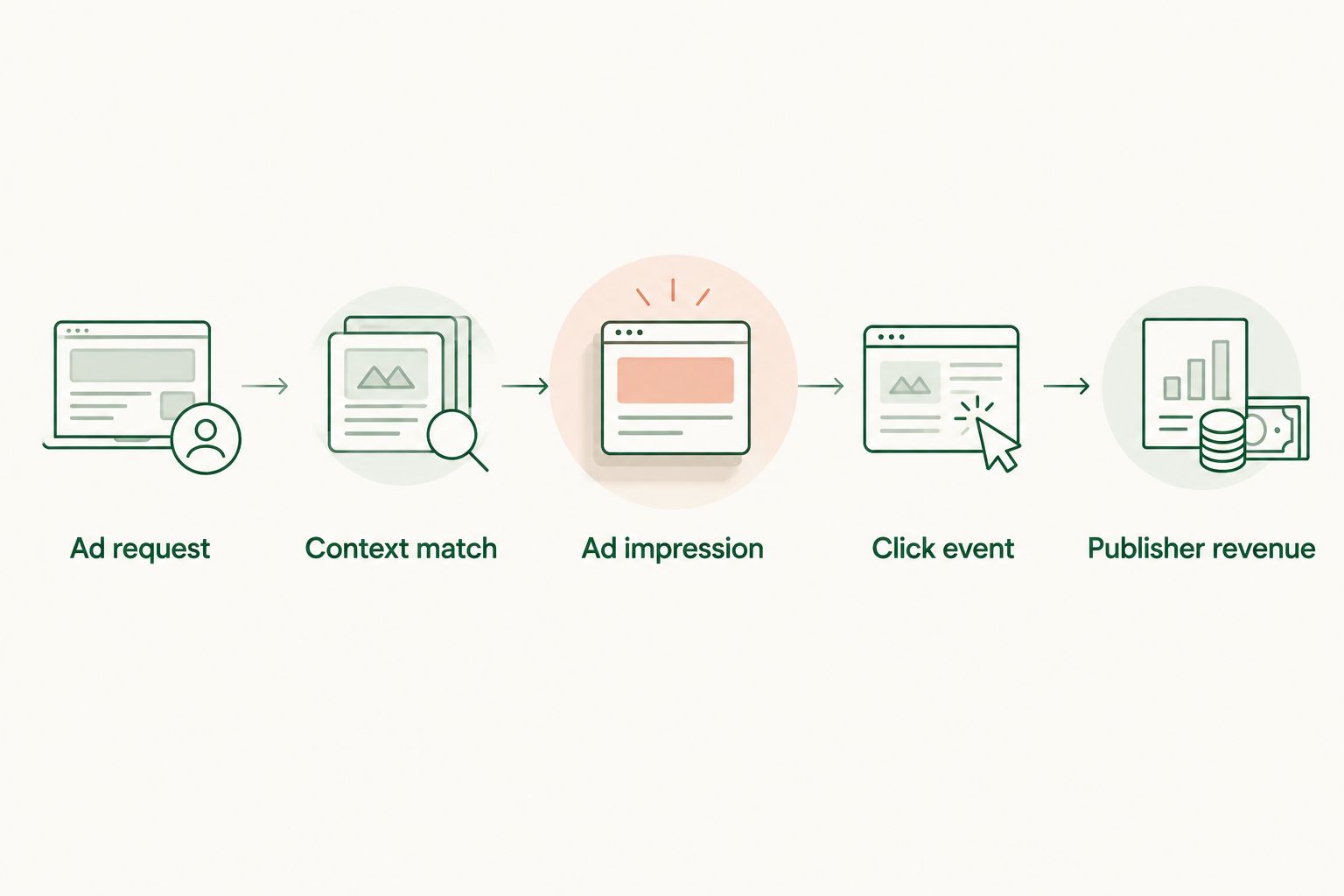
In 2026, the most useful question for a prospective ad partner is not which ads its library displays. Ask which events are eligible, how those events are counted, and how you can reconcile them with your app’s logs. If your integration cannot distinguish a request from a delivered ad, its request count cannot answer a payout question.
Why AI chat ad revenue varies
No single ad-library screenshot accounts for the differences between publishers. These factors change the activity available to monetize or the earnings reported against it:
- Chat activity: More sessions create more opportunities to consider an ad, but a session is not itself a paid event.
- Ad eligibility: A conversational ad needs a suitable moment and context. Requests without an eligible ad do not establish delivered impressions.
- Ad delivery: Count what the user actually receives under the arrangement’s impression definition, rather than every request your code sends.
- Payment basis: An arrangement based on impressions measures a different event from one based on clicks or other outcomes. Do not combine those event counts into one payout estimate.
- Publisher terms: Your applicable agreement determines how recognized ad activity relates to your earnings. An ad library does not disclose those terms for your app.
- Operating costs: Ad earnings are not the same as profit. LLM inference and the costs of running your app remain separate from publisher revenue.
These are checks, not assumed explanations for any particular account’s results. In 2026, compare each factor with your own event records before you change ad placement or traffic strategy. A high request count paired with few delivered impressions calls for a different investigation than delivered impressions with limited reported earnings.
How should you compare ad revenue across chat apps?
Use a denominator that reflects the activity you want to fund. CPM expresses an amount per 1,000 ad impressions. You can separately calculate earnings per 1,000 chat sessions to see what ad revenue contributes relative to app usage. Those measures answer different questions; neither is an actual payout figure until you put your own verified earnings and event counts into it.
For an impression-based comparison, divide reported earnings by eligible impressions, then multiply by 1,000 impressions. For a session-based comparison, divide the same period’s reported earnings by chat sessions, then multiply by 1,000 sessions. Keep the reporting period identical in both calculations. A session metric is especially useful when your LLM costs follow app usage but only some conversations contain an eligible ad.
Do not compare a gross ad total from one period with sessions from another. Do not use ad requests as a substitute for impressions. And do not infer your own rate from an ad library: a visible creative tells you neither the publisher terms nor the eligible events behind it.
In 2026, record the definition of each metric beside the result. If two dashboards disagree, first check whether they count the same event, time period, and app surface. That investigation is more useful than choosing whichever displayed total is higher.
Can a ChatGPT-powered app use its own ad SDK?
Yes, an app built on an LLM and operated by its developer is distinct from ChatGPT itself. Elo’s SDK-based adserver for AI chat apps is aimed at developers embedding contextual, conversational ads in applications built on OpenAI, Anthropic, or custom LLMs. That description does not establish that you can insert an ad into ChatGPT’s own interface.
Before integrating an SDK, map the boundaries of your product. Identify the chat interface you operate, the point where your application would request an ad, and the records you need to check delivery. Treat model access, ad delivery, and publisher payment as separate parts of the system. Sharing an underlying model with another product does not merge their inventory or reporting.
The choice has a clear trade-off. An SDK addresses ad delivery in an app you control; it does not replace your responsibility to review placement, understand the applicable terms, and check whether reported earnings cover the app’s costs. A library is simpler to inspect, but it cannot perform any of those publisher tasks for your app.
Assess ads for your chat app
See Elo’s SDK-based approach to contextual, conversational ads in developer-operated AI chat apps.
How do you check whether an ad arrangement is working?
Start with a question your own data can answer: are eligible ads reaching users, and are the resulting earnings material relative to the conversations you serve? Work through the records in order rather than jumping from total requests to total revenue.
First, compare ad requests with the impressions recognized by your arrangement. If the counts differ, establish where the difference occurs before assuming a payout problem. Next, match recognized activity to the earnings period. Finally, compare earnings per 1,000 chat sessions with the operating costs associated with those sessions. This gives you a view of monetization tied to the product you run, not to a catalog of someone else’s ads.
Keep your analysis specific to your app. A recipe assistant, support bot, and coding assistant have different conversation contexts; the same visible creative tells you nothing about their respective eligible activity. In 2026, test the questions against your logs and agreement rather than treating another app’s ad examples as a benchmark.
Does an ad appearing in a library prove a publisher was paid?
No. A library entry shows an ad example, not a payment record for the app you operate. To establish your own earnings, you need reported revenue linked to the activity recognized under your publisher arrangement.
Is a ChatGPT-powered app the same as ChatGPT for ad payouts?
No. An app built on OpenAI can be a separate product operated by its developer. Its ad integration and publisher terms must be assessed for that app; using the model does not transfer ChatGPT’s inventory or any payout arrangement to it.
What number should a publisher check first?
Check recognized impressions per 1,000 chat sessions, alongside reported earnings for that same period. That comparison shows whether requests turn into delivered ads and whether the resulting revenue is relevant to your app’s usage. It is not a substitute for reading the applicable payment terms.
FAQ
Does the ChatGPT ad library pay you for listing an ad?
No. An ad-library listing is not a publisher payout agreement. Check the terms and earnings reporting for an ad integration in the app you operate.
How much can I earn from ads in my AI chat app?
There is no earnings figure established for your app by the ChatGPT ad library. Calculate earnings from your own eligible ad activity and the terms of your publisher arrangement.
Can I monetize an app built on OpenAI without owning ChatGPT?
Yes, a developer can operate a separate AI chat application built on OpenAI. Monetization depends on the ad setup and terms for that developer-operated app, not on ownership of ChatGPT.
Does an ad request count as a paid impression?
No. An ad request and a recognized impression are different events. Use the delivery definition in your ad arrangement when reconciling reports.
Should I compare CPM or revenue per chat session?
Use both for different questions. CPM normalizes earnings per 1,000 impressions, while earnings per 1,000 chat sessions connects ad revenue to app usage.
Can Elo tell me my publisher payout from an ad-library listing?
No. Elo provides an SDK-based adserver for contextual ads in developer-operated AI chat apps, but a library listing does not establish your earnings or commercial terms.
Do clicks and impressions mean the same thing for payout?
No. A click records an interaction; an impression records ad delivery under the applicable definition. Check which events your arrangement recognizes before estimating earnings.
One last thing
A library can show you what an advertiser said. It cannot show you what your app earned. In 2026, keep one chain of evidence from request to recognized delivery to reported revenue. If a link in that chain is missing, fix the measurement before treating an ad catalog as a forecast.