
Yes—retargeting in AI chatbot ads is technically possible when the campaign can connect a permitted prior interaction to a later ad opportunity. It requires supported audience matching and appropriate data-use controls; contextual ad matching alone does not provide retargeting, and an SDK integration does not establish that those capabilities exist.
- Retargeting in AI chatbot ads requires a permitted prior-event signal and supported audience matching.
- Contextual targeting matches the current conversation; retargeting uses an earlier interaction to determine eligibility.
- Elo provides contextual conversational ads; that description does not establish retargeting support.
- Verify identity scope, audience expiration, conversion suppression, and opt-out handling before building a retargeting campaign.
Is retargeting possible inside an AI chatbot ad campaign?
Yes, as an architecture—not as an automatic feature of conversational advertising. A chatbot publisher can design a system that recognizes an eligible returning user and requests an ad based on a previous interaction. The advertiser, publisher, and adserver still need compatible targeting controls and permission to use that signal.
Elo provides an SDK-based adserver for developers to embed contextual, conversational ads in AI chat applications. That establishes a contextual monetization use case, not a claim that advertiser audiences, cross-session matching, or cross-app retargeting are supported.
These targeting approaches solve different problems:
| Approach | Signal used | Best for | Advantage | Limitation |
|---|---|---|---|---|
| Contextual targeting | Current conversation topic or intent | Ads relevant to the active task | Does not require a historical audience to select relevance | Does not identify returning prospects by itself |
| Session-based retargeting | Earlier qualifying event in the same session | Following up during an ongoing task | Keeps the event and follow-up within one session | Does not establish recognition after the session ends |
| Returning-user retargeting | Prior event linked to a returning user | Following up across visits within an app | Supports continuity when permitted matching exists | Requires persistent identity and audience controls |
| Cross-app retargeting | Prior event matched across separate properties | Advertisers with approved matching arrangements | Extends follow-up beyond the original property | Requires compatible identity, permissions, and platform support |
The test is whether the earlier event changes ad eligibility. If an ad appears solely because the current message concerns a topic, that is contextual targeting—even if the user discussed that topic yesterday.
Why this matters
Calling every relevant ad “retargeting” creates the wrong integration requirements. A contextual campaign needs a useful relevance signal. A retargeting campaign also needs a rule for remembering an earlier event, recognizing the eligible audience, and stopping the follow-up.
For a 2026 implementation review, separate the advertiser's targeting request from the publisher's available controls. A campaign brief is not proof that the inventory supports it.
That distinction also affects measurement. A click from a returning user does not prove the user was retargeted. Your delivery records must show that the prior event actually qualified the impression.
Contextual targeting: Match the current task
Contextual targeting selects an ad using the subject or intent of the active interaction. Consider a hypothetical assistant helping someone compare project-management workflows. An ad relevant to that task can be selected without placing the person into a historical audience.
Best for: publishers monetizing active conversation intent without building a returning-user audience. The advantage is a targeting decision grounded in the current task. The limitation is that contextual relevance alone cannot enforce an advertiser's request to reach previous visitors.
Use contextual targeting as the baseline when your requirement is “show a relevant offer now.” Do not add persistent identity merely to rename contextual matching as retargeting.
A useful starting point is the guide to matching ads to conversation context. Keep that relevance decision separate from any historical audience rule you later introduce.
Session-based retargeting: Follow up within the conversation
Session-based retargeting uses a qualifying event earlier in the same session. In a hypothetical implementation, someone opens a sponsored offer, returns to the assistant, and continues evaluating the same task. A later placement uses that interaction as an eligibility signal.
Best for: an explicitly supported follow-up inside an ongoing session. The benefit is a narrower recognition scope than matching a person across visits. The limitation is that session continuity does not establish durable identity or permission for broader tracking.
Define the session boundary before implementation. A page refresh, resumed conversation, and new login are different events; your application must specify which of them retains audience eligibility.
Also separate follow-up from repetition. Showing the same ad again without checking prior exposure is not a useful audience strategy. Specify when a previous click qualifies someone, when a dismissal excludes them, and when the session-based eligibility ends.
Returning-user retargeting: Recognize an eligible audience
Returning-user retargeting connects a qualifying interaction to a later visit. That requires an identifier or another supported matching mechanism that remains usable across those visits. An account identifier can provide application continuity, but continuity alone does not authorize advertising use.
Best for: publishers with a defined first-party audience use case and verified delivery support. The advantage is follow-up across visits within the intended scope. The trade-off is additional responsibility for audience membership, expiration, user choices, and suppression.
During a 2026 technical review, require an explanation of where the audience lives. Does the publisher evaluate membership and send an eligibility signal, or does the adserver maintain the audience? Those are different data flows.
Do not assume a hashed email address resolves permission or matching questions. Hashing changes the representation of an identifier; it does not establish the right to use it or guarantee that another system can match it.
Cross-app retargeting: Verify the matching arrangement
Cross-app retargeting attempts to reach someone on a property other than the one where the qualifying event occurred. A shared model provider does not create a shared advertising identity. Separate chat applications remain separate integration and permission boundaries.
Best for: campaigns with a documented, supported matching arrangement across the relevant properties. Its advantage is a broader follow-up scope. Its limitation is dependency on compatible identifiers, participating publishers, applicable restrictions, and actual campaign controls.
Do not promise this capability because an assistant uses OpenAI, Anthropic, or a custom LLM. The model generates responses; it does not, by itself, supply advertiser audience access.
Treat “reach our previous website visitors inside this chatbot” as a specific capability request. Ask for the matching method and supported inventory, not a general assurance that the platform offers personalization.
Why retargeting capability varies
Retargeting depends on the advertising implementation, not simply the presence of a chatbot interface. These factors determine what your campaign design requires:
- Identity scope: A session identifier supports a different recognition boundary from an account identifier or approved cross-property match.
- Event definition: A prior impression, offer click, and completed action represent different audience-entry conditions.
- Permission state: The system needs a defined response when advertising use is disallowed or a user changes their choice.
- Campaign controls: Audience inclusion, exclusion, expiration, and exposure limits need an actual enforcement point.
- Publisher boundaries: Recognition inside an app does not establish recognition across unrelated applications.
- Measurement access: Delivery and outcome records must support the campaign's stated eligibility and reporting rules.
Use these factors as acceptance criteria, not assumed SDK features. For your 2026 requirements document, attach each criterion to an owner: advertiser, publisher, or adserver. An unassigned control is an unresolved implementation requirement.
How do you validate a retargeting design before launch?
Validate the eligibility path before buying delivery. The following sequence is a proposed implementation checklist, not a description of any vendor's API.
- Qualifying event: Define the interaction that creates eligibility. Record only the information needed for that purpose; do not default to storing the full conversation.
- Permission check: Establish whether the intended advertising use is allowed. Define what happens when the permission state changes.
- Audience eligibility: Apply the identity scope, membership rule, and expiration condition. Specify whether evaluation happens in the publisher application or adserver.
- Ad selection: Apply audience eligibility alongside current-context relevance, placement rules, and exposure controls. An eligible audience does not make every offer appropriate.
- Suppression check: Remove or exclude users when the campaign's stopping condition applies. Test completed actions, dismissals, expiration, and withdrawn permission separately.
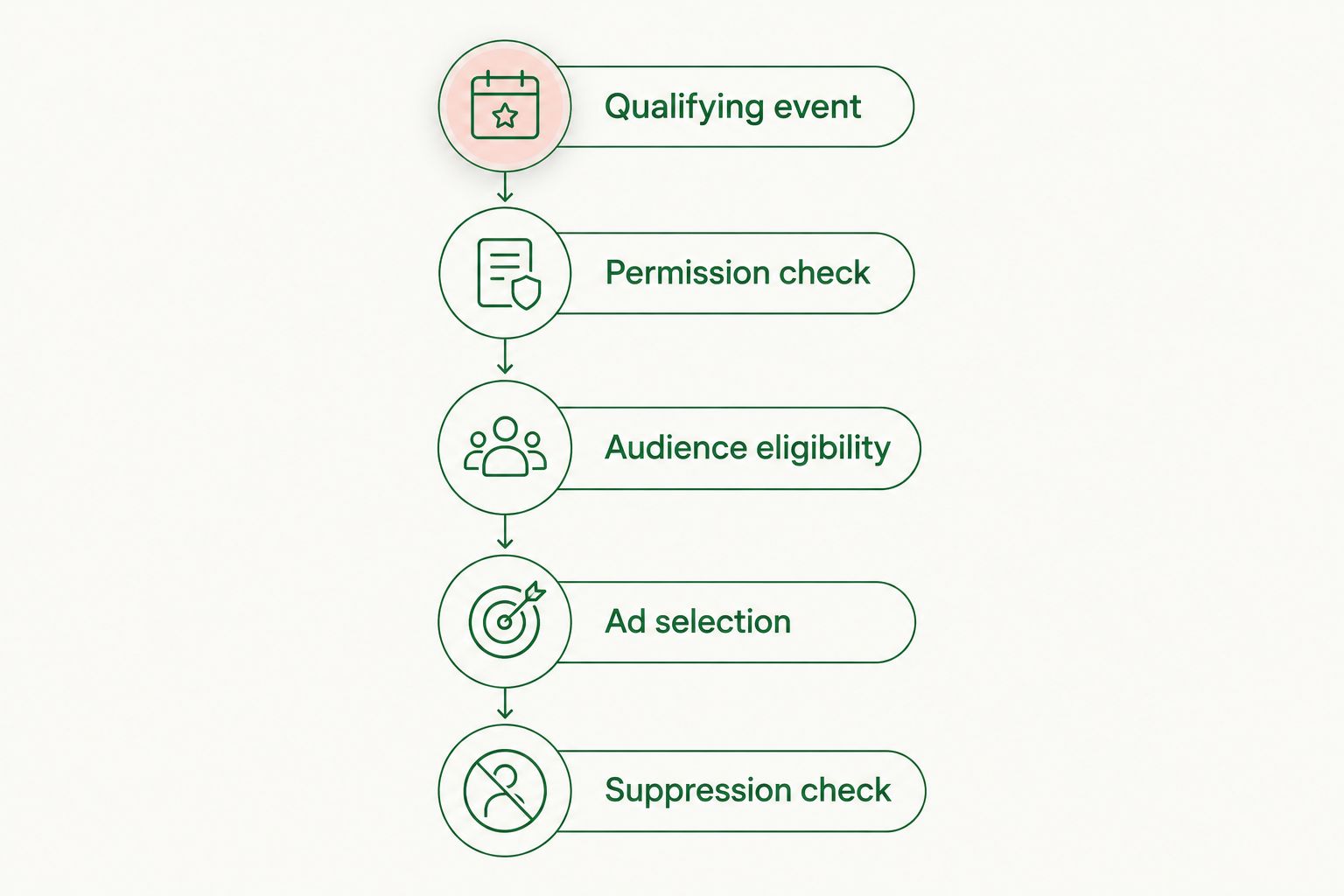
Test the negative paths as carefully as the successful match. A user outside the audience must not qualify merely because the conversation mentions the same topic. A user with expired eligibility must not remain targeted because a cached record still exists.
Keep an inspectable decision record without copying unnecessary chat content. Record the eligibility outcome, applicable rule, placement decision, and exclusion reason where appropriate. Use that record to distinguish a true retargeted impression from an ordinary contextual placement.
Can you measure conversions without retargeting users?
Yes. Conversion measurement links an ad interaction to a later outcome; retargeting uses an earlier event to influence a later ad decision. They are separate functions, even when an implementation uses related event data.
A campaign can measure attributed outcomes without creating a returning-user audience. Conversely, audience matching does not prove that conversion reporting works.
For a 2026 launch, test those functions independently. Confirm that the outcome event reaches the reporting system, then separately confirm that any required suppression rule reaches the delivery system. A conversion visible in a dashboard does not establish that follow-up ads have stopped.
Does retargeting require sending chat history to advertisers?
No. Retargeting does not inherently require exporting raw transcripts; a design can use a narrowly defined qualifying event and a permitted matching mechanism. Whether a particular integration supports that design requires verification.
Start with the smallest useful signal. For example, a hypothetical offer-interaction event is narrower than a transcript containing unrelated personal details. Do not treat every statement in a conversation as an advertising audience attribute.
Ask what leaves the application, who receives it, and how it is retained. “Contextual” and “first-party” describe aspects of a system; neither term is a blanket privacy assurance.
Where Elo fits
Elo is for developers monetizing AI chat applications with contextual, conversational ads. Its stated product is an SDK-based adserver that supports applications built on OpenAI, Anthropic, or custom LLMs and lets publishers earn revenue from advertiser spend.
That is a direct fit for evaluating contextual chatbot monetization. It is not sufficient evidence for promising retargeting: Elo's stated description does not establish historical audience matching, customer-list uploads, cross-app identity, or conversion-based suppression.
If retargeting is a launch requirement, make those controls explicit in your evaluation. If the requirement is simply to match an offer to the active conversation, assess contextual delivery on its own merits rather than adding an unsupported audience requirement.
FAQ
Can I retarget people who previously clicked an ad in my chatbot?
Yes, in a system that supports permitted recognition of that prior click and audience-based delivery. Verify the matching scope, audience expiration, and exclusion controls before treating it as a campaign capability.
Is showing an ad about the current chat topic retargeting?
No. Selecting an ad from the current conversation is contextual targeting; retargeting requires an earlier interaction to affect eligibility for a later ad.
Does installing an ad SDK automatically enable retargeting?
No. An SDK integration does not establish historical audience matching, persistent identity, or advertiser audience controls. Each capability needs separate verification.
Can I retarget someone across different AI chatbot apps?
Only when the participating systems support a permitted cross-app matching arrangement. Using the same LLM provider does not create a shared advertising identity.
Do I need to share entire conversations for retargeting?
No. A retargeting design can use a limited qualifying event instead of a raw transcript. Confirm the actual data flow and matching requirements of the chosen implementation.
Does Elo support retargeting in AI chatbot ads?
Elo's stated offering establishes contextual conversational advertising, not retargeting support. Verify audience matching and campaign controls directly before making retargeting a dependency.
Should retargeting stop after a user converts?
For an acquisition campaign, define conversion as a suppression condition when that matches the campaign objective. Test that the delivery system receives and enforces the exclusion; reporting the conversion alone is not enough.
One last thing
A correctly implemented retargeting rule sometimes means showing no follow-up ad. Once eligibility expires, permission changes, or the stopping condition applies, the previous interaction should no longer qualify the user for that campaign.
Make that exclusion test part of your 2026 launch checklist. Proving that an eligible user receives an ad tests delivery; proving that an excluded user does not receive the retargeted placement tests the boundary.