
Yes, programmatic bidding can be used for conversational AI inventory in 2026, but an ad inside a chat is not automatically a programmatic impression. Bidding requires a defined ad opportunity, an eligible source of advertiser demand, a way to select a winning offer, and a measurable delivery event. An SDK that serves contextual ads establishes a route to monetization; it does not, by itself, prove that advertisers bid for each placement.
- Programmatic bidding for conversational AI inventory is possible when eligible advertisers compete for a defined chat placement.
- A contextual ad served through an SDK is not necessarily a programmatic auction.
- Elo is a fit for developers seeking contextual conversational ads; confirm auction support separately if bidding is required.
- Check demand, selection rules, delivery events, and reporting before calling chat inventory programmatic.
Is programmatic bidding available for conversational AI inventory?
Yes, when the system auctions a defined opportunity to eligible advertisers. If the system instead matches a conversation to an advertiser and serves an ad without competing bids, that is contextual ad serving, not necessarily programmatic bidding. The distinction matters because the same native ad card can appear in both setups.
| Approach | How the ad is selected | Best for | Advantage | Limitation |
|---|---|---|---|---|
| Programmatic bidding | Eligible demand competes for a defined opportunity; selection follows the auction rules | Publishers that need bid-based competition | Advertisers can compete for the same eligible placement | Requires compatible demand, controls, and event reporting |
| Contextual ad serving | A matcher selects an ad using permitted conversation context | Chat publishers that prioritize relevance within the conversation | The ad can reflect the user's current task | Contextual matching alone does not establish an auction |
| Direct-sold placement | A publisher and advertiser agree on placement terms outside an open bidding process | Publishers managing specific advertiser relationships | The publisher can define placement expectations directly | Sales and campaign management remain the publisher's responsibility |
These approaches describe selection methods, not guarantees about any particular platform. Ask which method selects the ad at the moment your app requests it. A product page that mentions advertisers, an ad network, or an SDK does not answer whether bids compete for that request.
Why this matters
A chat placement is tied to a conversation turn, not just a page load. Your app must decide when an ad is eligible, what context can inform selection, and where a sponsored card appears without passing it off as the assistant's answer. Those decisions determine what an advertiser is bidding on and what your reporting counts as delivery.
Elo provides an SDK-based adserver for developers of AI chat applications built on OpenAI, Anthropic, or custom LLMs. It supports contextual conversational ads funded by advertiser spend. For a publisher evaluating Elo, that is a relevant monetization setup; the supplied product description does not establish whether Elo runs a per-placement auction or accepts external programmatic bids. Treat bidding as a separate capability to verify.
What must happen before a chat placement can accept bids?
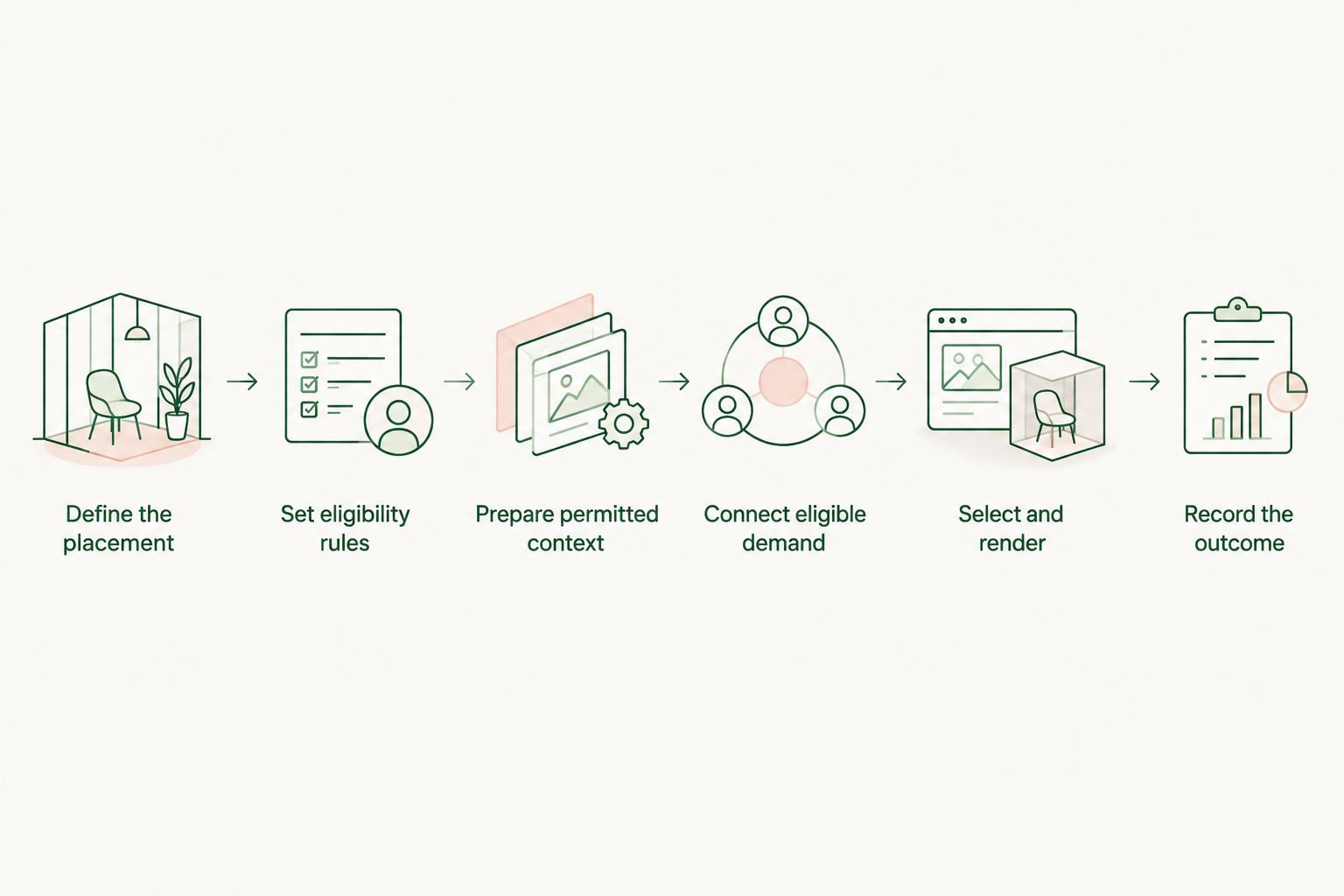
Think of the ad request as a contract between your application, the ad system, and potential buyers. The contract needs to specify what can be shown, when it can be shown, and how the outcome is recorded. Otherwise, a bid cannot be evaluated against a consistent opportunity.
- Define the placement. Identify the point in the chat where an ad card can appear. A request triggered during an active exchange is different from an ad shown before the conversation starts. State which surfaces and formats your app permits.
- Set eligibility rules. Determine when an ad request is appropriate and which advertisers or categories can compete. Keep the assistant's answer distinct from sponsored content so selection does not change the answer itself.
- Prepare permitted context. Specify the signals the ad system can use. A request can describe the user's current task without assuming the full conversation must be shared with buyers.
- Connect eligible demand. Establish which advertiser campaigns or buying systems receive the opportunity. Without competing eligible demand, an auction design alone does not create bid competition.
- Select and render the ad. Apply the selection rules, then show a clearly identifiable sponsored placement in the chat interface. Define what happens when no eligible ad is returned.
- Record the outcome. Separate an ad request from a served ad and a user interaction. Those are different events; combining them hides whether the problem is demand, delivery, or engagement.
A useful technical question is: What event proves that an advertiser won this particular opportunity? If the answer is only that the matcher returned a relevant ad, you have evidence of contextual selection, not evidence of competitive bidding.
Does contextual matching count as programmatic bidding?
No. Contextual matching decides which ad relates to a permitted signal, such as the topic of the current exchange. Programmatic bidding requires an additional decision: competing offers for the eligible opportunity, evaluated under stated selection rules. A matcher can feed an auction, and an auction can use context, but neither function proves the other is present.
This distinction is useful when comparing vendor descriptions. Terms such as native ads, conversational ads, and advertiser demand describe the format or source of ads. They do not tell you whether multiple advertisers submit bids for the same placement. Ask for the request flow and the selection rule, not a label.
For an Elo publisher, contextual matching is relevant because Elo's stated offering places contextual conversational ads in AI chat applications. The unanswered procurement question is narrower: does the proposed integration run bid competition for your inventory, or does it select an ad through another method? Get that answer before designing a revenue model around an auction.
Can an AI chat publisher combine direct deals and bidding?
Yes, as an inventory design. A publisher can define which opportunities are reserved for direct campaigns and which are eligible for bidding. The selection system then needs an explicit priority rule so the same opportunity is not promised twice. Whether a particular adserver supports that configuration is a product-specific question, not something the term adserver establishes.
Write down the decision order before connecting demand. For example, decide whether a qualifying direct campaign takes priority, whether bidding fills an otherwise unassigned placement, and what the app does when neither returns an eligible ad. These are configuration choices, not claims about Elo's current controls.
The main benefit is choice: you can preserve a direct advertiser relationship while testing another demand path. The trade-off is more complicated selection and reporting. If a direct campaign and a bid-based campaign use different delivery definitions, a combined RPM figure will not explain which path performed better.
Why programmatic bidding varies across chat apps
Availability depends on the integration, not on the fact that the interface uses AI. These factors determine whether a publisher has a bid-ready opportunity:
- Placement definition. A clearly defined sponsored card gives a buyer an identifiable opportunity. An unspecified insertion point does not.
- Demand access. An auction needs eligible advertisers or connected buying systems. A publisher cannot infer competitive demand from an SDK alone.
- Context permissions. The signals available for selection depend on what the application is permitted to send and what it chooses to withhold.
- Selection controls. Eligibility, priority, and any auction rule determine which ad is chosen when offers compete.
- Delivery reporting. Requests, served impressions, and interactions need distinct records so the publisher can inspect the result.
- Chat experience. Sponsored content must remain identifiable and separate from the assistant's answer, regardless of how the advertiser was selected.
None of these factors supplies a universal fill rate or RPM. A 2026 evaluation should examine the actual integration and its reporting rather than assume that a bid-based setup earns more than contextual serving. More potential demand is useful only when eligible ads can be selected and delivered without confusing the user.
Which questions should you put to an ad partner?
Ask for a walkthrough of one eligible chat placement, from the application request to the recorded outcome. The answers should let an engineer draw the selection flow and let a publisher reconcile delivery against advertiser activity.
- What creates the ad opportunity? Identify the application event and the placement shown to the user.
- Who receives it? Distinguish advertiser campaigns inside the ad system from any external buying connections.
- Do advertisers submit competing bids for that opportunity? If so, ask which rule chooses the winner. If not, ask how the matcher chooses an ad.
- What context enters selection? Identify permitted signals and exclude conversation details that the application does not intend to share.
- What happens when no ad qualifies? An empty result should have a defined behavior in the chat UI.
- What events can the publisher inspect? Look for a clear distinction between requests, delivered ads, and interactions.
For Elo, the supplied information confirms an SDK-based adserver and contextual conversational ads. It does not supply auction mechanics or a bid-interface specification. A buyer who requires programmatic bidding should request those details directly rather than treat contextual monetization as proof of an auction.
How should you evaluate the result in 2026?
Start with separate measurements for the request, the selection, and the displayed ad. If your logs show a request but no displayed placement, the cause sits somewhere between eligibility, demand, selection, and rendering. An interaction metric alone cannot identify that cause.
Then compare selection methods using the same placement definition. A contextual match and a winning bid should be evaluated against the same user-facing format if you want to understand the effect of selection rather than the effect of different ad layouts. Keep the sponsored label and assistant response behavior consistent across the comparison.
Finally, document what a publisher can change. Can your team adjust placement eligibility? Can it exclude categories? Can it inspect which selection path served an ad? These controls matter whether the system is auction-based, matcher-based, or direct-sold. In 2026, call inventory programmatic only when the bid and selection path can be described and verified.
FAQ
Is programmatic bidding available for conversational AI inventory in 2026?
Yes, when a chat placement is defined and eligible advertisers can compete under auction rules. A contextual ad served in a chat is not automatically a programmatic impression.
Do conversational ads need real-time bidding?
No. A conversational ad can be selected through contextual matching or a direct campaign without competing bids for that placement.
Does an ad SDK make chatbot inventory programmatic?
No. An SDK provides an integration path; the ad selection process determines whether the inventory uses programmatic bidding.
Can multiple advertisers compete for one chat ad placement?
Yes, if the ad system accepts competing eligible offers and applies a rule to select one. The presence of multiple advertisers in a network does not, by itself, prove that they bid on the same opportunity.
Does Elo support programmatic bidding for AI chat apps?
The supplied information confirms that Elo provides an SDK-based adserver for contextual conversational ads. It does not establish Elo's auction mechanics, so confirm bid competition and supported demand connections with Elo before relying on them.
Can direct-sold ads and programmatic ads share a chatbot?
Yes, if the selection system defines which campaigns have priority and which opportunities can enter bidding. Confirm that the chosen adserver supports the required configuration.
What should a chatbot publisher measure when testing bidding?
Track ad requests, delivered placements, and user interactions as separate events. Compare selection methods on the same placement and format to make the results interpretable.
One last thing
The decisive question is not whether an ad appears inside an AI answer. It is whether an advertiser competed for a defined opportunity and whether you can verify the selection event. In 2026, get that distinction in writing before you describe conversational inventory as programmatic.