
Yes. Multiple advertisers can bid for the same ad opportunity in a chatbot when the publisher routes that opportunity through an auction or bidding layer. Only one eligible ad should win a single placement, and an adserver alone does not establish that competing bids are supported.
- Multiple advertisers bid same ad slot chatbot inventory only when the publisher enables a bidding or mediation layer.
- An auction selects one eligible ad for one placement; advertiser interest alone does not create an auction.
- Elo is best for developers seeking contextual conversational ads; its support for competing bids is not specified in the supplied product details.
- Check eligibility, selection rules and reporting before promising advertisers access to the same chatbot placement.
Can multiple advertisers bid on the same ad slot in a chatbot?
Yes, if the chatbot publisher has implemented a mechanism that accepts and compares competing bids. The placement is an opportunity to show an ad, not a promise that every advertiser will appear. The publisher must decide which campaigns qualify before selecting what the user sees.
| Delivery setup | Can advertisers compete for the same opportunity? | Publisher benefit | Main limitation |
|---|---|---|---|
| Auction | Yes, when eligible advertisers submit bids | Compares demand for a qualifying placement | Requires clear eligibility, timing and selection rules |
| Sequential selection | Not simultaneously; sources are checked in order | Gives the publisher a defined priority order | An earlier source can win before a later one is considered |
| Reserved campaign | Not for an opportunity reserved exclusively for that campaign | Honors a publisher's delivery commitment | Leaves that opportunity outside open competition |
If you are evaluating the auction route, start with the distinction between simultaneous bidding and a priority chain. The header bidding setup for an AI chat app is a related implementation guide; neither approach follows automatically from adding an ad slot.
Why this matters
In 2026, a chatbot publisher can offer a contextual placement without offering an auction. That distinction changes what you can tell advertisers. A placement means your interface has a place to render an ad. Competition means your delivery system accepts multiple eligible offers and applies a selection rule before rendering one.
The difference also changes your implementation work. You need to decide when a conversation creates an ad opportunity, what context advertisers can use, which campaigns are eligible, and how to record the outcome. Treat those as separate decisions. A chatbot's ability to display a native ad card does not answer who won the right to appear there.
How does bidding for one chatbot ad slot work?
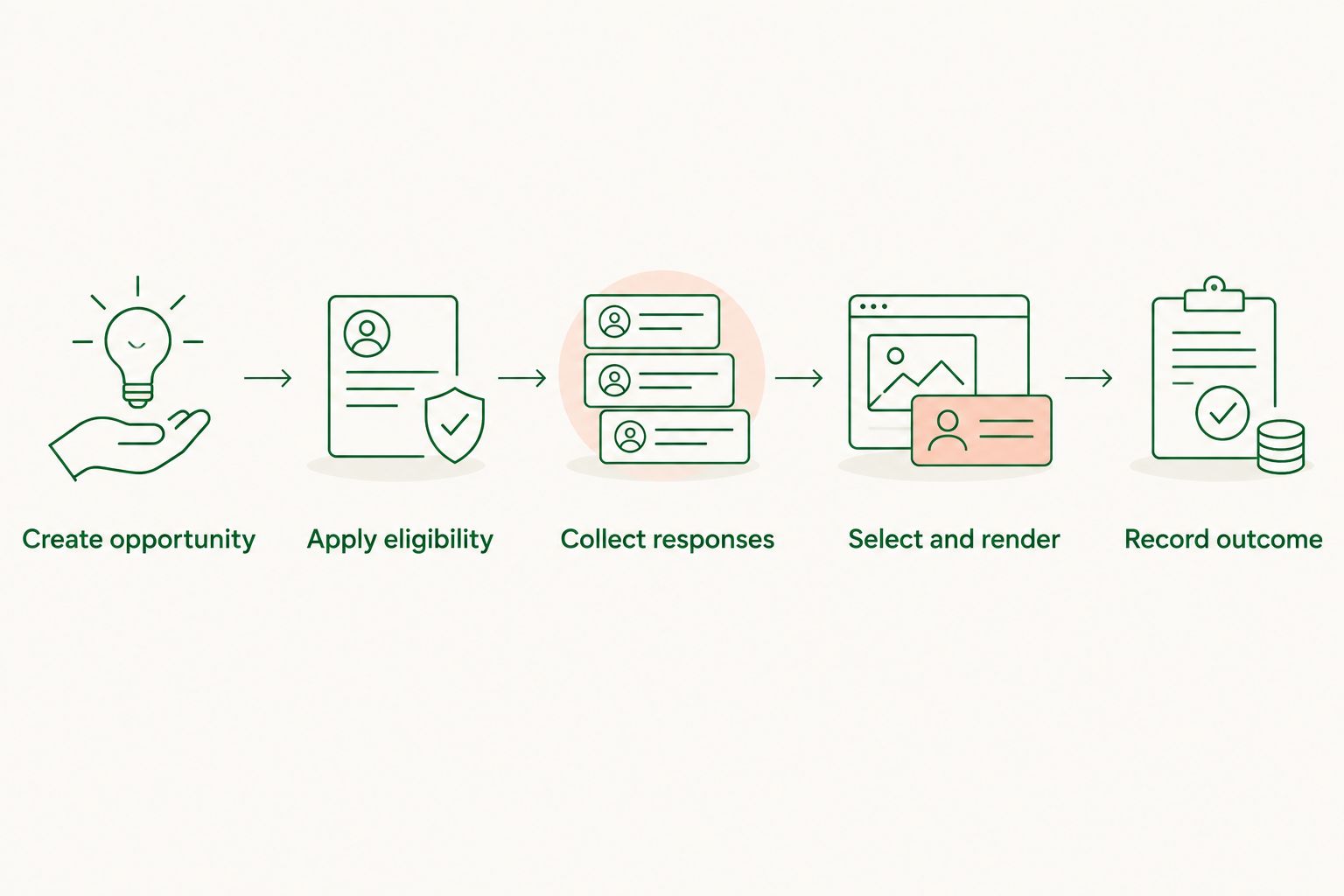
The flow starts with a publisher-controlled opportunity, such as a point in a conversation where a sponsored card would fit. The chatbot does not need to expose the whole conversation to every advertiser. It needs a defined request containing the context and constraints that the publisher permits its ad system to use.
- Create the opportunity. Identify the placement and the moment it can appear. If the conversation has no suitable placement, there is no slot to award.
- Apply eligibility. Exclude campaigns that do not match the permitted context, placement rules or publisher restrictions. An ineligible campaign does not become eligible by bidding more.
- Collect responses. In an auction design, eligible demand sources can return offers for that opportunity. A source that does not respond is not a competing bid for that decision.
- Select and render. Apply the publisher's selection rule, then display the chosen ad with a clear sponsored label. A bid is not an impression; rendering and measurement are distinct events.
- Record the outcome. Keep the request, selection and display events distinguishable so you can investigate discrepancies without treating every bid response as delivered inventory.
This is a design pattern, not a statement that any particular SDK performs all five steps. Ask for the exact request and event flow before you describe an integration as in-app bidding.
What counts as the same slot?
The same slot is a single ad opportunity with a defined placement and decision point. Two advertisers can seek that opportunity without both appearing. If the chatbot creates another opportunity later in the conversation, that is a separate decision even when it uses the same visual placement.
Define the opportunity consistently before comparing bids. Otherwise, a request for a recommendation, a follow-up question and a new session can be mixed together in reporting even though they represent different chances to show an ad. The practical question for a publisher is not whether several advertisers want the audience. It is whether their offers are considered for the same eligible decision.
What happens if no eligible advertiser responds?
The slot remains unfilled under an auction-only setup unless the publisher has specified another eligible source or a no-ad outcome. Do not render an unrelated campaign solely to fill the space. In a conversation, a mismatched ad competes with the answer the user came for.
A no-ad outcome is also useful to record. It separates lack of eligible demand from a display failure after an ad was selected. Those cases require different fixes: one concerns targeting or demand, while the other concerns delivery.
Why chatbot ad outcomes vary
The highest submitted bid is not automatically the ad you should show. These factors change which campaigns qualify and how a publisher can evaluate the result:
- Conversation context. A campaign relevant to the user's current request has a different claim to the placement than one matched only to a broad app category. Define which context the ad system is allowed to use.
- Publisher restrictions. Category exclusions, placement rules and other publisher decisions can remove a bidder before offers are compared.
- Campaign eligibility. A bid applies only when its campaign qualifies for that request. Eligibility must be evaluated before declaring a winner.
- Selection method. An auction compares competing responses; a sequential chain follows a priority order. Calling both bidding hides a material difference.
- Response timing. A late response cannot be treated as a winner after the placement decision has already been made. The publisher needs a defined decision point.
- Measurement. A request, bid, win, rendered ad and user action are different events. Mixing them produces misleading fill and revenue reports.
In 2026, specify these rules before comparing adservers. A claim that multiple advertisers can access your inventory is not the same as a verified account of how they compete for each opportunity.
Is bidding better than a priority chain for a chatbot?
Bidding is the clearer choice when you want eligible advertisers considered for the same opportunity at the same decision point. A priority chain is simpler to reason about when you have a deliberate order for checking demand. Neither method fixes poor contextual matching or an intrusive placement.
| Question | Auction | Priority chain |
|---|---|---|
| How is demand considered? | Eligible responses compete for one decision | Sources are checked in a defined order |
| Best for | Publishers that want direct comparison of eligible offers | Publishers that need predictable source priority |
| Main drawback | Requires selection rules and response handling | Does not compare every possible response at once |
| What should you verify? | Eligibility, response deadline and win event | Source order, fallback and stop conditions |
Do not use auction terminology in an advertiser pitch if your integration only checks sources in sequence. Advertisers need to know whether their offer competes in a shared decision or receives a turn after another source declines.
Where does Elo fit?
Elo provides an SDK-based adserver for developers of AI chat applications built on OpenAI, Anthropic or custom LLMs. It supports embedding contextual, conversational ads so publishers can earn revenue from advertiser spend. Elo is best for developers who need contextual conversational ad delivery in an AI chat app.
The product description does not specify whether Elo accepts simultaneous bids from multiple advertisers for one slot, how it selects a winner, or whether it offers mediation across demand sources. Do not infer those functions from the word adserver. If competing bids are a requirement, verify the supported selection flow against your placement, campaign and event requirements before committing to an auction design.
That is an important distinction for a publisher in 2026. Elo addresses the stated need to place contextual ads in an AI conversation. The question of whether multiple advertisers bid on one Elo-served opportunity requires product-specific confirmation; this article does not treat it as an established feature.
What should you verify before enabling competing demand?
Start with the event flow, not a revenue forecast. A diagram or API description should show how the publisher creates an opportunity, what context reaches the ad system, when campaign eligibility is checked, how responses are compared and which event confirms that the chosen ad appeared.
Then test the cases that make an auction claim meaningful:
- Two eligible responses: Confirm that the system considers both for the same opportunity and records which one wins.
- One ineligible response: Confirm that a restricted campaign is excluded even if it returns an offer.
- No response: Confirm whether the interface shows no ad or uses a publisher-approved fallback.
- Late response: Confirm that a response arriving after the selection point does not replace an ad already rendered.
- Display failure: Confirm that a selected ad which never appears is not reported as a displayed impression.
These are test cases, not claims about Elo's SDK. In 2026, the implementation passes the publisher's bidding requirement only when its observed behavior matches the selection rules you intend to sell to advertisers.
Can the same chatbot use direct campaigns and bidding?
Yes, a publisher can design an ad decision that gives some opportunities to reserved campaigns and offers others to competing demand. The key is to state the priority rule before a request is made. An opportunity reserved for a direct campaign is not simultaneously open to every bidder unless the publisher has explicitly designed a rule that permits that competition.
Keep the reporting separate as well. A reserved impression and an auction-selected impression can occupy the same type of chat card while coming from different selection paths. If you group them without a source field, you lose the ability to explain which method filled the placement.
FAQ
Can multiple advertisers bid on one chatbot ad slot?
Yes, if the publisher uses a bidding mechanism that accepts competing eligible offers for the same opportunity. Displaying ads in a chatbot does not, by itself, establish that an auction runs.
Does an adserver automatically run an auction?
No. An adserver delivers and manages ad decisions, but auction support must be confirmed for the specific product and integration.
Does the highest bid always win in a chatbot?
No. A campaign must meet the publisher's eligibility and placement rules before its offer can be considered under the chosen selection method.
Can two advertisers appear in the same chatbot ad slot?
Not in a single-ad placement at the same decision point. The chatbot can create separate opportunities later in a conversation, each with its own selection outcome.
Is a priority chain the same as in-app bidding?
No. A priority chain checks sources in order, while bidding compares eligible offers for one opportunity under an auction rule.
Does Elo support multiple bids for the same ad slot?
Elo's supplied description confirms an SDK-based adserver for contextual conversational ads, but does not specify simultaneous bidding support. Verify its selection and event flow before promising advertisers an auction.
What should a chatbot publisher measure after an ad auction?
Track requests, eligible responses, selections and rendered impressions as distinct events. That separation shows whether an unfilled placement lacked demand or a selected ad failed to display.
One last thing
A bid is not an ad impression. In 2026, keep that distinction in your event definitions before you invite competing advertisers into a chatbot placement. For Elo or any other adserver, the decisive evidence is the documented and tested path from eligible offer to rendered ad, not the number of advertisers interested in your audience.