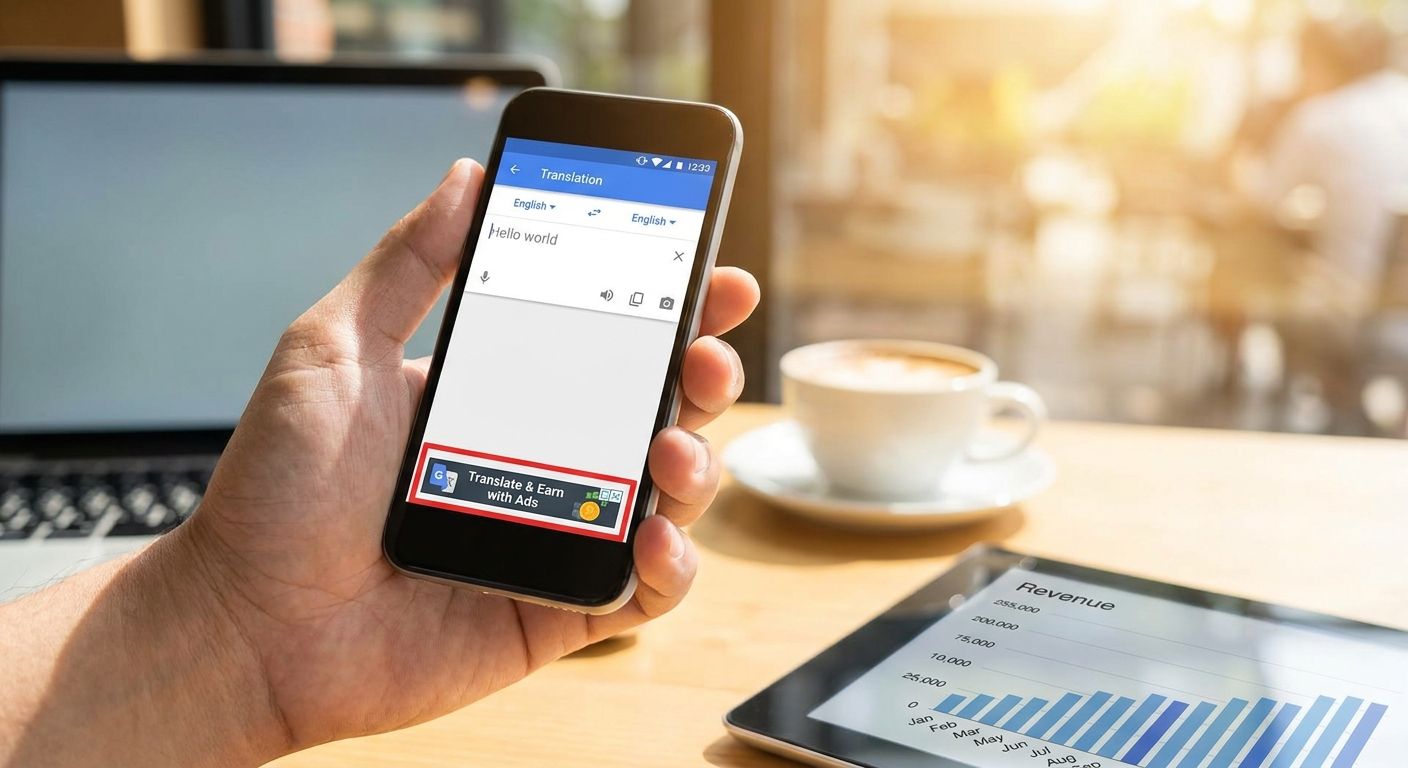
Ad monetization for AI translation assistant apps means fitting revenue into a product built for short, high-frequency sessions instead of long chats. This guide breaks down what actually holds up in 2026, which approaches to skip, and where translation-specific quirks change the calculus.
- Ad monetization for AI translation assistant apps works best with native contextual cards, not banners or interstitials.
- Elo's SDK integrates into a translation chatbot in twelve lines of code, without touching the translation pipeline.
- Match ads to translated intent, not source-language keywords, or relevance and fill both drop.
- Direct advertiser deals rarely scale for translation apps in 2026 without a mediation layer underneath them.
Why this matters
Translation assistants have a monetization problem most chat apps don't: sessions are short, usage is high-frequency, and users rarely stick around long enough to convert on a subscription paywall. Someone translating a phrase for a trip or a work email opens the app, gets an answer, and leaves in seconds.
That pattern kills subscription-first monetization but it's actually good news for advertising. High session volume with low per-session engagement is exactly what conversational ad inventory is built for — you're not asking one user to sit through a long ad experience, you're serving a small, relevant offer across thousands of short exchanges.
The catch: get the placement or the matching wrong and you slow down the one thing users came for, which is a fast, accurate translation.
Who this is for
This is for developers running a translation, phrasebook, or subtitle-assist chatbot on OpenAI, Anthropic, or a custom LLM stack, with a free tier that isn't converting to paid at a rate that funds the product. If you're weighing whether to gate features behind a subscription or monetize the free tier directly, an ad SDK like Elo is built for exactly that second path — earning revenue from advertiser spend on traffic that was never going to pay you directly.
What to look for in ad monetization for AI translation assistant apps
Ad latency that doesn't touch the translation itself
Translation apps are judged on speed. If loading an ad adds even a half-second delay to the response the user actually asked for, you've broken the core product to sell an impression. The ad call needs to run parallel to or after the translation renders, never blocking it.
Context matching on translated intent, not source text
A matcher that only reads the source-language input will misfire constantly — someone typing in Spanish and reading in English needs an ad matched to the meaning of the exchange, not the raw string. Matching on intent instead of literal keywords is what keeps fill rates and relevance both intact across language pairs.
Native card placement, not banner or interstitial
Translation UIs are minimal by design: a text box, an output box, maybe a history list. A banner or full-screen interstitial looks foreign in that layout and trains users to associate the app with pop-ups. A native card that sits below the translation output, styled like the rest of the interface, gets engagement without feeling like an ad break.
Session-volume economics over per-session engagement
A single translation session might last under a minute, so optimizing for time-on-ad or deep engagement per session is the wrong lens. What matters is revenue per active user across dozens of short sessions a month, which means the ad model has to work at volume, not depth.
Brand safety across every language you support
Translation apps see unpredictable input — medical phrases, legal language, personal messages — in every language they support, not just English. An ad matcher that's only tuned for English-language brand safety will let mismatched or inappropriate ads through on other language pairs. Coverage has to extend to every locale you serve, not just your primary market.
See how the SDK matches ads to context
Twelve lines of code, no change to your translation pipeline.
Top picks for ad monetization for AI translation assistant apps
The safe pick: contextual matching on translated intent
The spec that matters here is what the matcher reads — output meaning, not input string. A matcher built for context-based ad matching in LLM apps scores relevance off the full exchange, which is the only approach that holds up when your users are switching between two or more languages in a single session. Verdict: Buy for any translation app serving more than one language pair.
The build-first pick: native ads for custom LLM stacks
If your translation assistant runs on a custom LLM rather than a wrapped OpenAI or Anthropic API, ad tooling built for contextual advertising on custom LLM chatbots fits without forcing you onto a specific model provider. The one number that matters: integration runs in twelve lines of code, regardless of which model sits underneath. Verdict: Buy if you're not locked into a single vendor's chat SDK.
The UX-guard pick: ads that don't break the translate flow
The risk in translation apps specifically is that any friction reads as a bug, not an ad. A setup built around adding conversational ads without hurting chat UX keeps the native card decoupled from the translation render, so the ad shows after the answer, never before or during it. Verdict: Consider this your integration checklist before shipping ads to a live user base.
What to avoid
- Full-screen interstitials between translations. They look like standard mobile ad units but they interrupt a workflow users expect to be instant, and translation apps live or die on speed.
- Display or banner networks retrofitted into chat. These were built for scrollable feeds, not a text-in, text-out interface, and they tend to show up as dead space or misaligned creative in a translation UI.
- A single hardcoded advertiser deal with no fallback. One advertiser can't cover every language pair or topic your users translate, so unfilled impressions just go unmonetized without a mediation layer behind the primary deal.
How the approaches stack up
| Approach | Best for | Latency impact | Verdict |
|---|---|---|---|
| Contextual intent matching | Multi-language translation apps | Minimal — runs parallel to output | Buy |
| Native ads for custom LLM stacks | Apps not on a wrapped chat SDK | Minimal — twelve lines of code | Buy |
| UX-guarded ad placement | Any translation app going live with ads | None if sequenced after render | Consider |
| Full-screen interstitials | Nothing translation-specific | High — blocks the workflow | Skip |
| Single advertiser, no mediation | Low-volume test apps only | None, but low fill | Skip |
FAQ
What's the best way to monetize an AI translation assistant?
Native, contextual ad cards matched to translated intent perform best in 2026 because they fit a fast, minimal UI without slowing the translation itself. Banner and interstitial formats built for other app types tend to underperform in this layout.
Is advertising better than subscriptions for a translation app?
For high-frequency, low-engagement apps like translation assistants, advertising usually earns more from the free tier than a subscription paywall would convert. Subscriptions still make sense for power users doing bulk or professional translation.
How much code does it take to add ads to a translation chatbot?
Integrating a conversational ad SDK like Elo's into a chat interface takes twelve lines of code, without changes to the underlying translation pipeline. Most of the setup time goes into placement testing, not the integration itself.
Do conversational ads slow down translation response time?
They shouldn't, if the ad call runs after or parallel to the translation render rather than blocking it. Any setup that adds latency to the actual translation output is misconfigured for this use case.
Can ads run in a translation app built on a custom LLM?
Yes — contextual ad matching works on custom LLM stacks the same way it does on OpenAI or Anthropic-based apps, since the matcher reads conversation output rather than a specific model's API. The integration path stays the same regardless of the underlying model.
Is conversational advertising GDPR compliant for a multilingual app?
Compliance depends on how consent and data handling are configured in the SDK, not on the language the app operates in. Check the specific compliance guidance for the ad SDK you choose before launching in EU markets.
What's the difference between ad mediation and a single ad network for a chat app?
Mediation routes each impression across multiple advertiser sources to maximize fill, while a single network relies on one source and leaves unmatched impressions unmonetized. Translation apps spanning many languages and topics generally need mediation to keep fill rates consistent.
One last thing
Translation apps get judged by a metric most chat products ignore: sessions per user per month, not minutes per session. A user who opens your app eight times a day for ten-second translations is worth more in ad impressions than a user who has one long conversation — size the ad strategy around frequency, not depth, and the revenue math for 2026 looks a lot better than it does through a subscription lens.