
Advertisers can target the topic of a chatbot conversation in 2026 — not the person having it and not a specific transcript. The ad matches to conversation context in real time (a recipe question, a mortgage rate query, a B2B tooling search), the same way a page's content decides which display ad shows on a website. The caveat that headline answer skips: no compliant ad SDK passes raw chat text or personal identifiers to the advertiser — only a matched category or campaign event leaves the conversation.
- Advertisers target the subject of a chat conversation, not the individual user, when using a chatbot ad SDK in 2026.
- Elo's matcher reads conversation context live and serves a native ad card, not a banner, based on what's being discussed.
- No compliant ad network shares raw chat transcripts or personal identifiers with advertisers.
- Category, keyword, and intent-level targeting are standard; identity-level targeting of a specific conversation is not available on any platform built for compliance in 2026.
Why this matters
Developers building on the ad SDK for cooking and recipe assistant apps or a B2B copilot get asked the same question by advertisers before they'll spend a dollar: what exactly are you targeting? The honest answer shapes what CPM an advertiser will pay, whether the ad slot passes a brand-safety review, and whether the integration survives a privacy audit. Get the targeting model wrong in a pitch deck and the advertiser walks; overstate it and you've made a compliance promise you can't keep.
The distinction that matters in 2026 is contextual versus identity-based targeting. Contextual targeting reads what's happening in the current exchange. Identity-based targeting would require knowing who the user is across sessions — and that's the layer every credible chatbot ad network, Elo included, refuses to build.
Can advertisers target specific chatbot conversations in 2026?
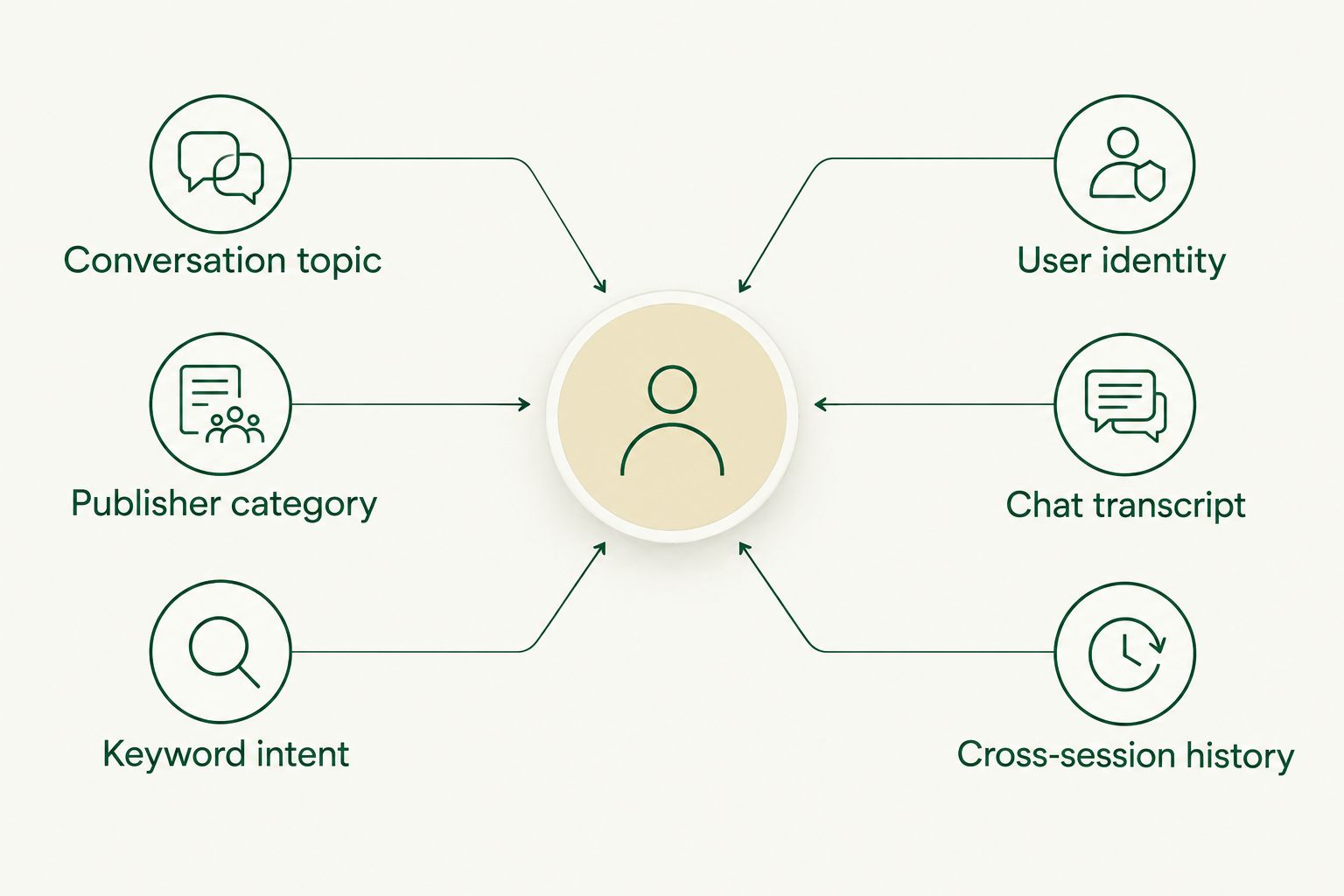
Here's what advertisers actually buy versus what they're often assumed to be buying:
| Targeting type | What advertisers get | Available in 2026? |
|---|---|---|
| Contextual (topic/content) | Ad matched to what the current conversation is about | Yes |
| Category (publisher vertical) | Ad matched to the app's category — mortgage, cooking, HR, legal | Yes |
| Keyword/intent | Ad matched to a specific phrase or question inside the chat | Yes |
| Individual conversation identity | Ad aimed at one named user's specific chat | No |
| Cross-session behavioral profile | Ad using a user's past conversations across sessions | Rare, and disclosed when it exists |
The top three rows are where the entire chatbot ad market operates. The bottom two are what people mean when they ask "can advertisers target specific conversations" — and the answer stays no on any network built to survive a 2026 privacy review.
Contextual targeting: matching ads to what's being said
This is the layer that does the actual work. A matcher parses the live conversation — not history, not identity, just the current exchange — and picks an ad relevant to that content. Ask a cooking assistant for a substitute for buttermilk and a contextual matcher can surface a kitchen-brand card; ask a mortgage assistant about refinance rates and it can surface a lender. Elo's matching layer works this way: it reads the exchange, scores it against advertiser categories, and returns a native card, never a banner injected mid-response.
The upside for advertisers is relevance without needing a user profile. The upside for the developer is a monetization layer that doesn't require collecting new personal data — which matters more every year GDPR and CCPA enforcement tightens.
Category targeting: matching ads to the app's vertical
One level up from single-message context, advertisers buy against the category the chat app operates in. A B2B SaaS copilot sells against a different advertiser pool than a personal-finance assistant or a travel-planning app. This is closer to how programmatic display buying works: an advertiser picks a content category and a bid, and the ad shows across any conversation in that category that meets the bid.
This is the layer most advertisers actually plan budget against in 2026, because it's predictable at scale — a mortgage lender buys "finance and lending assistants," not one user's one chat.
Audience-level targeting: what's off-limits
Advertisers cannot buy access to a named user's conversation history, their identity, or the raw transcript. That line exists for two reasons: privacy law and trust. Making conversational ads GDPR compliant means the matching decision happens on conversation content, not personal data, and that no identifiable information crosses to the advertiser side of the bid.
A chatbot app that promised advertisers identity-level targeting in 2026 would be promising something that fails a data-protection audit on day one. It's also a poor pitch to users — a chat interface that feels surveilled gets abandoned, not monetized.
Why chatbot ad targeting varies by platform
How granular the targeting gets depends on a handful of concrete factors:
- The LLM the app is built on. OpenAI, Anthropic, and custom/self-hosted models expose different amounts of conversation metadata to a matching layer.
- Ad format chosen. A native card carries more contextual signal than a banner squeezed into a chat window.
- Frequency caps set by the publisher. Capping how often the same context re-triggers an ad changes how aggressively a matcher can target a single session.
- Regional privacy law. GDPR in the EU and CCPA in California narrow what signals can legally inform a match.
- Publisher vertical. Finance, healthcare, and legal chat apps carry tighter brand-safety filtering than a recipe or travel assistant.
Does ChatGPT show targeted ads to users?
Not inside ChatGPT's own interface — OpenAI does not sell third-party ad placements inside ChatGPT itself as of 2026. Third-party chat apps built on the OpenAI API, Anthropic's Claude, or a custom LLM can add contextual ads through an SDK, and that's where chatbot ad targeting is actually happening today, not inside the host apps themselves.
Can advertisers see the actual text of a chat conversation?
No — advertisers receive a matched ad category and performance data, never the raw conversation text, when buying through a compliant chatbot ad SDK. What reaches the advertiser side is impressions, clicks, and conversions tied to a context bucket like "personal finance" or "home improvement," not a transcript of what the user typed.
Is contextual advertising in AI chat GDPR compliant in 2026?
It can be, provided the matching runs on conversation content rather than user identity and no personal data crosses to a third party during the bid. Compliance depends on where the matching decision actually happens — inside the app on content signals, or somewhere that touches identifiable user data — and that architecture choice is what a data-protection review checks first.
See how contextual matching works
Add ads that match conversation content, not user identity.
FAQ
Can advertisers target specific chatbot conversations in 2026?
No — advertisers target the topic or category of a conversation, not an individual user's specific chat. Contextual matching reads what's being discussed right now and never a personal identifier.
What's the difference between contextual and identity-based ad targeting in chat apps?
Contextual targeting matches an ad to what the conversation is currently about; identity-based targeting would require knowing who the user is across sessions, which compliant chatbot ad networks don't offer.
Do advertisers see chat transcripts when they buy chatbot ads?
No, advertisers see matched ad categories and aggregate performance data like impressions and clicks, never the raw text a user typed into the chat.
Is chatbot conversation targeting GDPR compliant?
It can be when the matching decision runs on conversation content inside the app rather than on personal data shared with a third party during the ad bid.
Does ChatGPT run targeted ads inside its own interface?
Not as of 2026 — OpenAI doesn't sell third-party ad placements inside ChatGPT itself. Targeting happens in third-party chat apps that add an ad SDK.
Can a chatbot app target ads by keyword or intent?
Yes, keyword and intent-level targeting is standard in 2026 — an ad can match a specific phrase or question inside a conversation without identifying the user who asked it.
What is category-level ad targeting in an AI chat app?
Category-level targeting matches ads to the app's vertical, such as mortgage assistants or cooking assistants, letting advertisers buy against a content category rather than a single conversation.
One last thing
The targeting model isn't what makes or breaks chatbot ad revenue in 2026 — disclosure is. A native card labeled clearly as sponsored gets clicked because the user understands why it's there; an ad that hides its sponsorship gets reported as a bug instead of engaged with. Contextual targeting earns the click. Honest labeling is what keeps the user from dismissing the app entirely.