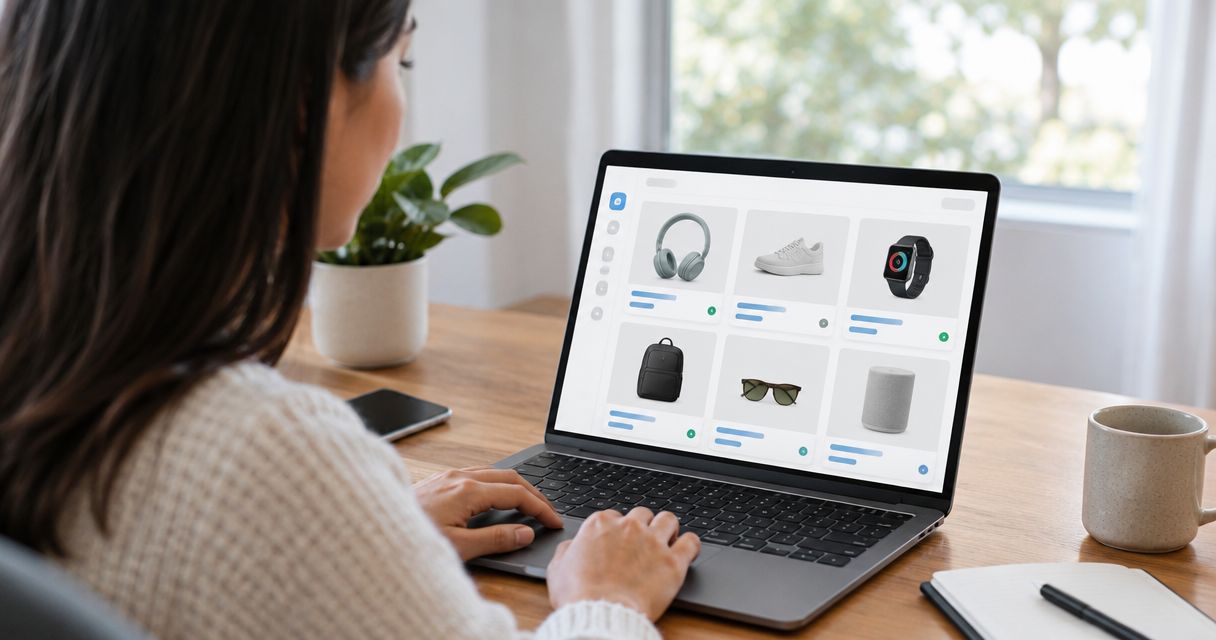
Yes. Sponsored product cards can update as prices change when your application connects an authoritative product-data source to both the ad-serving path and the card renderer. A fresh backend record does not automatically refresh a card already visible in a conversation; that requires a separate client-side update mechanism.
- Can sponsored product cards update real time prices? Yes, with connected product data and an explicit card-refresh mechanism.
- Refresh on render updates new cards; polling or pushed events can update cards already visible.
- Elo provides an SDK-based adserver for contextual conversational ads, not proof of a merchant-data freshness guarantee.
- Keep commercial facts in structured fields, separate from generated chat text.
Can sponsored product cards update in real time as prices change?
Yes—but distinguish fresh ad responses from live updates to an existing card. Your server can return the latest product record whenever it serves an ad. Updating that same card after it appears requires the browser or app to request another record or receive an update event.
For sponsored recommendations in an AI shopping bot, treat product identity, sponsorship, and changing commercial fields as separate concerns. A new product-data revision should not silently turn an existing recommendation into a different product.
Choose the refresh pattern according to what your interface needs:
| Refresh pattern | Best for | Main advantage | Main limitation |
|---|---|---|---|
| Refresh on render | Cards created with each new response | Straightforward request lifecycle | Does not update an already-visible card |
| Client polling | Open conversations needing periodic checks | Works with ordinary request-response APIs | Adds repeated requests and gaps between checks |
| Event-driven updates | Connected sessions needing prompt changes | Pushes changes without repeated client checks | Requires event delivery, reconnection, and ordering logic |
None of these patterns guarantees that every upstream record is current. The renderer cannot recover an update the merchant has not supplied.
Why this matters
A conversational ad has more than one place where commercial information can become stale: the merchant feed, your cache, the ad response, and the rendered conversation. Refreshing only one leaves the others unchanged.
For a 2026 implementation, define freshness as an observable contract rather than a label. Record when the source changed, when your system received the update, and which revision the user saw. Those timestamps let you investigate discrepancies without guessing which component failed.
A live connection is not the same as current data. A connection can remain healthy while its upstream source stops changing.
Refresh on render: best for new cards
Refresh on render means resolving the current product record when your application creates a card. Keep stable creative elements separate from fields that require fresh source data.
This pattern fits conversations where a new assistant response creates a new placement. It also limits background work: the application requests data when it needs to display something.
The limitation is explicit. An old card remains a snapshot unless your interface replaces or refreshes it. Reopening a saved conversation must therefore trigger either revalidation or a presentation that does not imply the historical card is current.
Use refresh on render as the baseline, not as a claim that every open conversation updates continuously. Document what happens when the user returns to an inactive tab or restores an older session.
Client polling: best for periodically checking visible cards
Polling asks the server whether the displayed product record has changed. The client then applies the newer revision to the matching card.
Its advantage is a familiar request-response model. Your application can stop polling when the page becomes inactive and revalidate when the user returns.
Its cost is repeated work. Requests continue even when the underlying record stays unchanged, and a change remains unseen until a subsequent successful check.
Choose the interval from your actual source-update behavior, infrastructure limits, and interface requirements. Do not advertise a freshness interval that you have measured only between the client and your own cache.
For your 2026 release checklist, include tab visibility, overlapping requests, request cancellation, and failed checks. Prevent an older polling response from overwriting a newer record. Arrival order alone does not establish which response is current.
Event-driven updates: best for connected sessions
An event-driven implementation receives a product-change notification, validates the new record, and sends an update to subscribed clients. Server-Sent Events or WebSockets can carry server-to-client updates; neither transport establishes the freshness of the source itself.
This pattern avoids asking the same question repeatedly when nothing changes. It also introduces delivery responsibilities that refresh-on-render does not have.
You need reconnection handling, duplicate-event handling, and a way to recover missed updates. After reconnecting, retrieve the current product record instead of assuming the client received every event.
Push notifications should trigger validated state changes, not unconditional card rewrites. Check product identity and revision before applying the update. A delayed notification must not replace a newer record already on screen.
How should the update pipeline work?
Build the pipeline around explicit responsibilities. Keep the merchant-data lifecycle independent of the language model's response lifecycle.
- Source update. Accept a product change from an authorized source. Preserve its product identifier and source timestamp when supplied.
- Record validation. Check required fields, currency context, product identity, and revision information. Reject malformed updates rather than partially applying them.
- Cache control. Replace or invalidate the affected cached record. Include every attribute that changes the applicable commercial record in your cache key.
- Card refresh. Deliver the validated revision to the correct visible card. Preserve its sponsorship disclosure and placement identity.
- Event logging. Record the revision rendered and the outcome of the update. Use those records to investigate mismatches.
Each stage needs a failure path. A successful source import does not prove that a client received the update, and a successful client message does not prove that the renderer applied it.
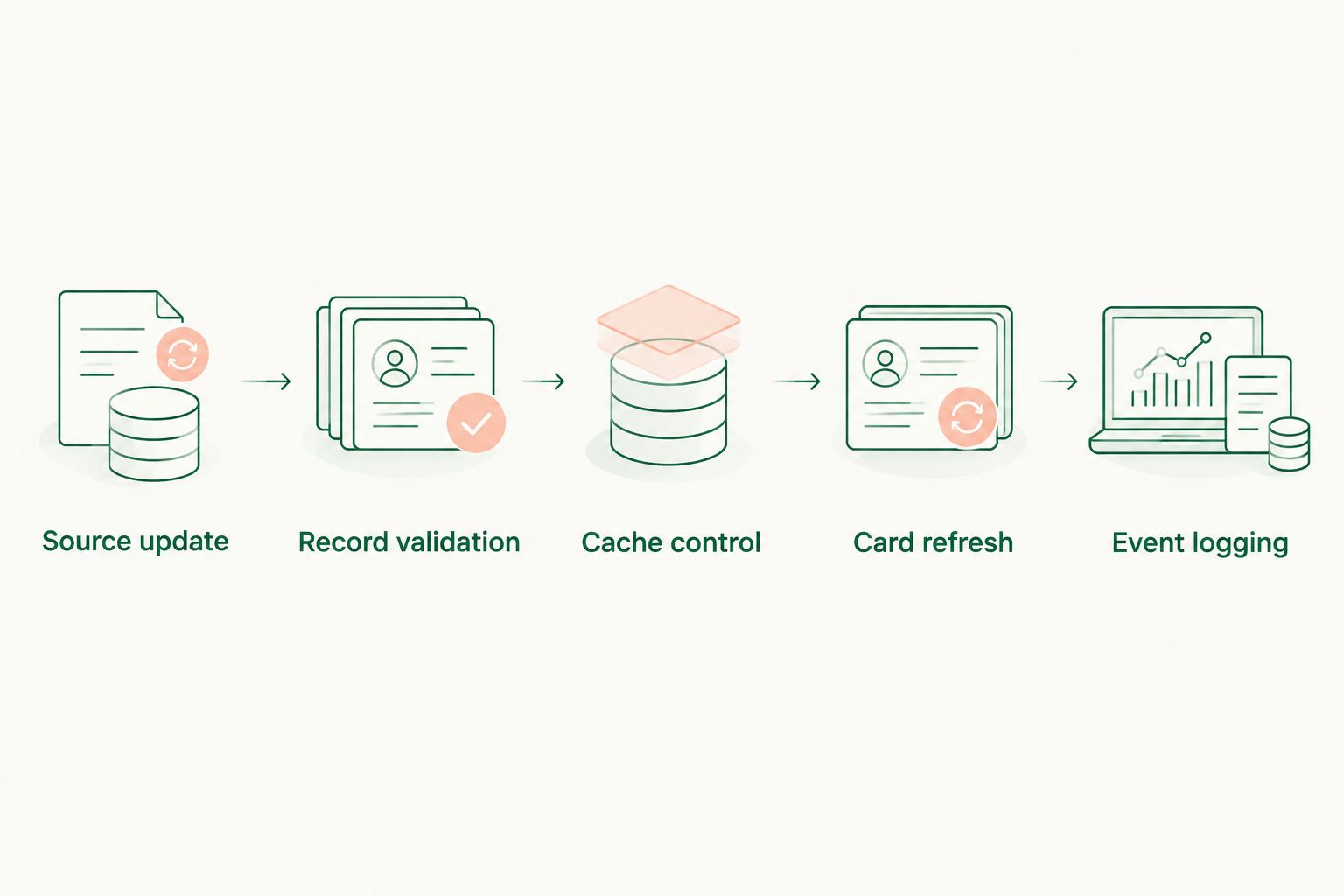
Keep this pipeline inspectable in your 2026 production tooling. A support investigation should identify the source record, cached revision, delivered revision, and rendered revision without reconstructing them from generated conversation text.
Keep product data outside generated prose
Render changing commercial facts from structured records. Let generated text explain relevance without becoming the authoritative copy of those facts.
Updating a card does not rewrite an earlier assistant message. If the assistant repeats a changing value in prose, your application now has separate representations to reconcile.
Keep volatile fields in the card whenever possible. If your product requires them in assistant text, define how you mark or refresh that text when its underlying record changes. Do not assume the model will detect the change by itself.
Keep identity stable during an update
Use stable identifiers for the product, selected variant, card instance, and placement. A product identifier alone is insufficient when the user has selected a specific variant or market.
Apply a refresh only to the record it belongs to. If an advertiser changes the promoted product, handle that as a new creative decision rather than disguising it as a routine data refresh.
This separation also improves debugging. You can distinguish a changed commercial field from a changed recommendation, instead of treating every card mutation as the same event.
Why real-time update behavior varies
The full path determines update behavior, not the ad format alone. Inspect these factors before describing a card as live:
- Source delivery. Scheduled imports, request-time lookups, and change notifications expose updates differently. Match your freshness claim to the source you actually receive.
- Cache policy. A current source record does not help when an intermediate cache continues serving an older revision. Check both server-side and client-side storage.
- Connection state. Suspended tabs, disconnected devices, and interrupted sessions require revalidation when activity resumes. Do not depend solely on continuous delivery.
- Record scope. Product variant, currency, and applicable market must match the displayed card. A fresh record for the wrong context is still wrong.
- Rendering policy. Some interfaces replace visible fields immediately; others wait for a user action. Make that behavior deliberate and testable.
- Failure handling. Timeouts, invalid records, and out-of-order responses need defined outcomes. An exception handler is not a freshness policy.
These are implementation decisions, not reasons to promise an unsupported response time. Measure the complete path before publishing a latency claim.
What should happen when a refresh fails?
Do not present an unverified commercial field as current. Choose a defined fallback: remove the volatile field, withhold the card, or clearly present it as a historical snapshot where that fits your interface.
Keep the fallback consistent across initial loads and later updates. A card should not make a stronger freshness claim after an error than it did after a successful validation.
Do not replace a missing source value with a model-generated estimate. That changes a data-delivery failure into an unsupported advertising claim.
For your 2026 acceptance tests, cover malformed source records, interrupted connections, expired cached data, duplicate events, and delayed responses. Also test restoration of a saved conversation. Historical messages and current commercial records follow different lifecycles.
Does refreshing a card create another ad impression?
A data refresh does not, by itself, define a new billable impression. Your measurement implementation and advertising agreement determine how impressions are counted.
Keep product-data refresh events separate from ad-render and interaction events. Otherwise, a background update can contaminate reporting intended to measure actual ad exposure.
Preserve the original placement identity when updating the same card, and log the newly rendered record revision separately. Treat a replacement ad as a separate operation with its own measurement rules.
Can a card stay fresh without changing the conversation?
Yes. A structured card can refresh independently of the surrounding assistant text when your application maintains them as separate components.
Keep the visual change contained. Preserve focus, avoid moving the user's reading position, and retain a visible sponsorship disclosure after rerendering.
In a 2026 chat interface, test keyboard interaction and screen-reader behavior alongside the data pipeline. Correct backend state does not establish that the update is understandable or accessible to the person using the conversation.
Where Elo fits in the implementation
Elo provides an SDK-based adserver for developers who want to embed contextual, conversational ads in applications built on OpenAI, Anthropic, or custom LLMs. Publishers earn revenue from advertiser spend.
Elo is best for developers seeking SDK-based contextual ads in chat applications. That product fit is separate from the merchant-data synchronization design discussed here.
When evaluating Elo for conversational ads, verify who supplies product records, how updates reach the client, and which component owns cache invalidation. An ad-serving integration does not establish a product-feed refresh guarantee by itself.
The distinction matters at implementation time: ad selection answers which sponsored message to show; data synchronization answers which commercial record the card renders. Confirm both responsibilities before committing to a live-update claim.
FAQ
Can sponsored product cards update while someone is reading a chat?
Yes, an already-visible sponsored product card can update when the application implements polling or event-driven delivery. Refreshing only the backend record does not update the visible card.
Does a live ad SDK automatically keep product information current?
No, a live ad SDK connection does not establish that upstream product information is current. Verify the source-update process, cache policy, and client-rendering behavior separately.
Is polling better than pushed updates for sponsored cards?
Polling is best for periodic checks through ordinary request-response APIs; pushed updates fit connected sessions that need change notifications. Polling adds repeated requests, while pushed updates require reconnection and missed-event recovery.
Should my chatbot write changing commercial facts into its answer?
Keep changing commercial facts in structured card fields whenever possible. Repeating them in generated prose creates another representation that your application must reconcile after an update.
What should happen if the product-data source stops responding?
Stop presenting unverified commercial fields as current. Apply a defined fallback, such as withholding the card or removing its volatile fields, rather than generating replacement values.
Does Elo provide contextual ads for chat applications?
Yes, Elo provides an SDK-based adserver for embedding contextual, conversational ads in chat applications. Confirm product-data synchronization and visible-card refresh behavior separately for your implementation.
One last thing
Test an old response arriving after a new one. This exposes a freshness bug that a successful live-update demonstration misses: the interface receives current data, then overwrites it with a delayed older record.
Require the renderer to compare revisions before applying updates. Fast delivery is useful; preventing stale data from replacing current data is the stronger correctness test.