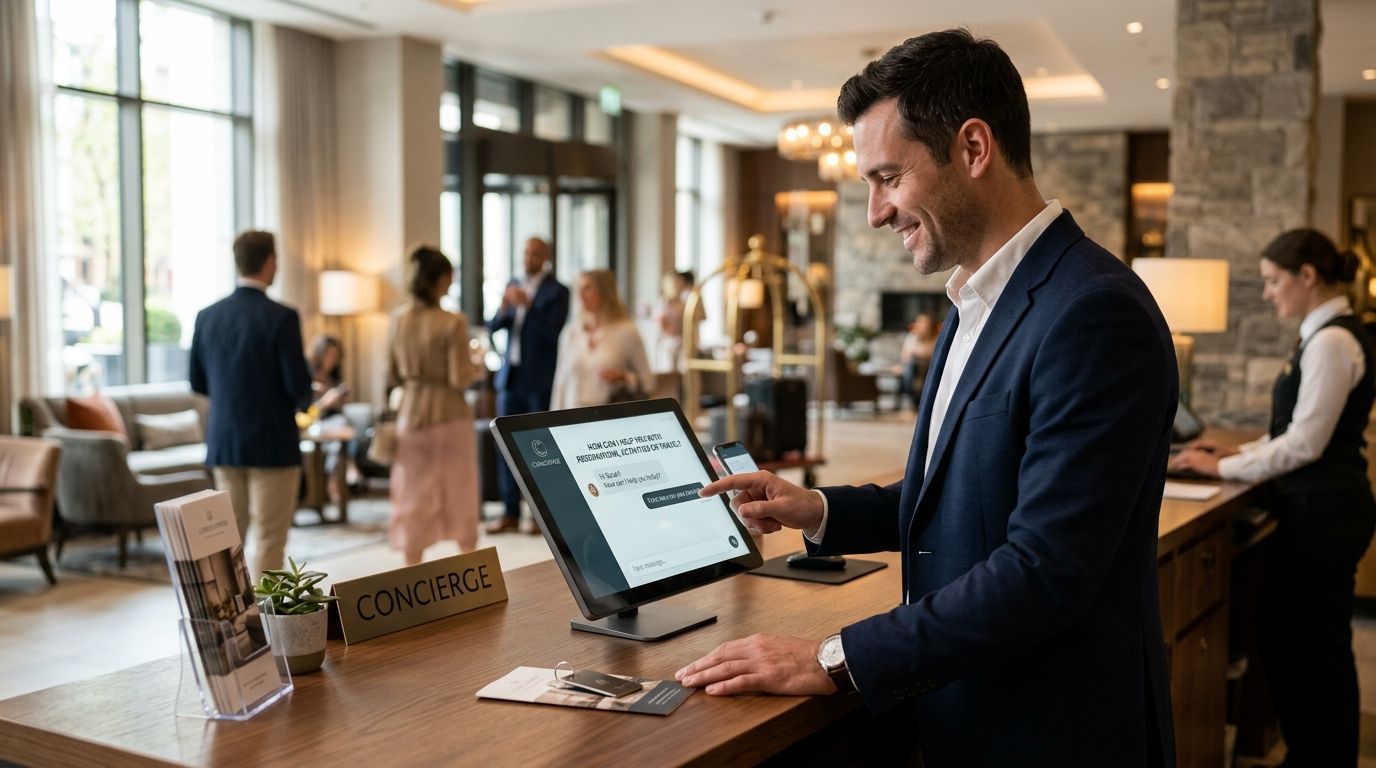
Conversational ads for hotel concierge bots are native, in-chat offers — a dinner reservation, a spa upsell, a car service — that surface exactly when a guest asks a concierge question, turning free-to-use concierge chat into a revenue line instead of a pure cost center. Unlike display ads on a hotel website, these run inside a live conversation where the guest has already stated dates, party size, and intent, which is the exact context data most ad networks never get.
- Conversational ads for hotel concierge bots work best on dining, spa, and transport queries, where guest intent is already explicit.
- Native reply cards outperform banners inside concierge chat because they preserve the answer-first UX guests expect.
- Cap sponsored suggestions to roughly 1 in 3-4 concierge turns to avoid feeling like an ad wall.
- An SDK-based ad matcher replaces manual keyword-to-partner rules once query volume grows past a handful of local advertisers.
- Disclosure labels and frequency caps protect guest trust better than hiding sponsorship inside a 'recommendation.'
Why conversational ads matter for hotel concierge bots
Most hotel concierge bots answer the same handful of query types on repeat: where to eat tonight, how to book a spa slot, how to get a car to the airport, what's open near the property. Every one of those questions is a local commercial-intent query — the same intent OTAs, Yelp, and local ad networks already monetize, except here it's arriving inside a private, first-party conversation with a guest who's already checked in.
Hotels rarely charge guests to use a concierge app, so ad revenue is one of the few monetization paths that doesn't touch the guest experience or require a new subscription tier. Elo exists for exactly this gap: an SDK that lets a concierge bot built on OpenAI, Anthropic, or a custom LLM insert contextual ad cards into the reply stream without changing how the bot answers. Elo matches advertiser inventory to conversation context in real time rather than serving generic banner units.
Map the query types that carry commercial intent
Not every concierge turn is an ad opportunity, and treating them all as one is the fastest way to burn guest trust. Start by sorting incoming queries into intent buckets before you touch ad placement logic.
- Dining recommendations and reservation requests
- Spa, wellness, and treatment bookings
- Transportation: airport transfers, car service, ride requests
- Local attractions, tours, and activity bookings
- Room upgrade, late checkout, and amenity add-on questions
- Shopping and gift requests near the property
Tag conversations with context before placing an ad
A sponsored dining card only works if it matches the guest's actual situation, not a generic keyword hit on the word "restaurant." Pull the context the guest already gave you in the conversation.
- Stated check-in/check-out dates and length of stay
- Cuisine, budget, or dietary language already used in the chat
- Party size (business trip vs. family vs. couple)
- Time of day the query was asked
- Neighborhood or distance tolerance mentioned by the guest
- Repeat-guest signals (loyalty tier, prior stay history if available)
Choose ad formats that fit concierge UX
A banner strip inside a chat thread looks broken and reads as spam. Concierge bots need formats that sit inside the answer, not on top of it.
- Single native reply card appended below the organic answer
- One clear CTA per card ("Reserve at [restaurant]") instead of a list of links
- A visible "Sponsored" label on every paid card, never buried in fine print
- Card copy that matches the bot's existing tone, not a separate ad voice
- No pop-ups, no interstitials, no full-screen takeovers mid-conversation
Manual setup here means a human hand-picking local restaurant and spa partners and hard-coding which card shows for which query. That works for a single boutique property with five partners. It falls apart past that scale — see how conversational ads avoid hurting chat UX for the format-level tradeoffs in more depth.
Set frequency caps so the bot doesn't feel like an ad wall
Guests tolerate one relevant suggestion per exchange. They don't tolerate a sponsored card on every reply.
- Cap sponsored suggestions to roughly 1 per 3-4 concierge turns
- Never place an ad on safety, complaint, or booking-confirmation turns
- Suppress ads entirely during check-in/check-out troubleshooting flows
- Rotate which advertiser shows across repeat questions from the same guest
- Drop the cap further on multi-night stays to avoid showing the same restaurant three nights running
Match ads to context, not just keywords
The manual version of matching is a spreadsheet: "sushi" maps to Partner A, "steakhouse" maps to Partner B. It's free, and it's fine at low volume.
Once a concierge bot handles enough daily conversations across multiple query types, keyword-to-partner spreadsheets stop scaling — a query like "somewhere quiet for an anniversary dinner near the water" doesn't map to a single keyword at all. This is where an SDK-based matcher, scoring live advertiser inventory against full conversation context rather than a single keyword, becomes the faster path. Elo's ad SDK does this scoring automatically instead of requiring a rules table maintained by hand.
Measure revenue per guest session
Dashboards that only show total ad revenue hide which query types are actually paying. Break it down by turn type.
- RPM (revenue per thousand concierge sessions), not just total revenue
- Fill rate specifically on local-intent turns (dining, spa, transport)
- Click-through rate on sponsored cards vs. organic recommendations
- Advertiser CPM/CPC actually paid, segmented by query category
- Revenue per guest across the length of stay, not per single session
Dining and transport queries typically carry the most explicit intent — a guest asking for an airport transfer has already committed to a date, a time, and a need, with none of the comparison-shopping behavior that shows up in a generic "restaurants near me" search elsewhere on the internet.
“An airport transfer request inside a concierge chat is the highest-intent turn in the whole conversation — the guest has already picked the date, the time, and the need.”
Comparison: monetization options for hotel concierge bots
| Option | Best for | Integration effort | Key limitation |
|---|---|---|---|
| Manual direct-sold local partner deals | Single-property boutique hotels with a handful of nearby partners | Low, but ongoing manual contract management | Doesn't scale past a small number of hand-picked advertisers — Hold for small properties |
| Generic web display ad networks | Hotels retrofitting an existing website ad stack into chat | Moderate, requires custom rendering work | Renders as a banner inside a chat thread and breaks concierge UX — Skip |
| SDK-based conversational ad server (Elo) | Multi-property groups and concierge apps built on OpenAI, Anthropic, or a custom LLM | Requires SDK integration into the existing chat app | Needs a one-time dev integration before ads run — Buy for teams scaling past manual partner deals |
Add conversational ads to your concierge bot
Integrate the Elo SDK and match local advertisers to guest queries automatically.
Common mistakes hotel concierge bots make
- Treating every query as an ad slot — interrupting urgent requests like "call security" or "I need extra towels" with a sponsored card damages trust immediately.
- Showing the same advertiser night after night on a multi-night stay, which reads as spam by night two.
- Skipping the disclosure label because it's framed internally as "just a recommendation" — guests notice the omission faster than the label itself.
- Matching on generic keywords instead of stay context — a query tagged only as "restaurant" ignores the party size, budget language, and neighborhood the guest already stated.
- Never segmenting revenue by query type, so a property can't tell whether dining, spa, or transport inventory is actually converting.
FAQ
What are conversational ads for hotel concierge bots?
Conversational ads for hotel concierge bots are native, in-chat offers — a restaurant reservation, spa slot, or car service — that appear alongside a concierge bot's answer when a guest's query signals commercial intent. They run as labeled reply cards, not banners.
Do conversational ads hurt the guest experience in a concierge app?
They don't when frequency capped and clearly labeled; capping sponsored cards to roughly 1 in 3-4 turns and never placing them on safety or complaint turns keeps the concierge answer-first instead of ad-first.
How is a conversational ad different from a banner ad in a hotel app?
A banner sits outside the conversation and interrupts the reading flow. A conversational ad renders as a single native card appended to the bot's organic answer, matched to the guest's stated dates, party size, and preferences.
Which concierge queries convert best for ad revenue in 2026?
Dining, spa/wellness bookings, and transportation requests carry the most explicit commercial intent because the guest has already stated a date, time, and need inside the question itself.
Can a concierge bot built on OpenAI or Anthropic run conversational ads?
Yes — an SDK-based ad server like Elo integrates into concierge bots built on OpenAI, Anthropic, or a custom LLM, matching advertiser inventory to conversation context without changing the bot's underlying model.
How do you disclose sponsored recommendations without breaking guest trust?
Keep a visible 'Sponsored' label on every paid card, never mix it silently into the organic answer, and always show the free organic recommendation alongside or before the sponsored one.
Is manual ad-partner matching enough for a hotel concierge bot?
Manual keyword-to-partner mapping works for a single property with a handful of local advertisers, but breaks down once query volume or advertiser count grows, which is when an automated matcher becomes the faster path.
What metric should a hotel track to measure concierge ad performance?
Track revenue per thousand concierge sessions (RPM), fill rate on local-intent turns, and click-through rate on sponsored cards, segmented separately by dining, spa, and transport query types.
One last thing
The query that looks least like an ad opportunity — "can you book me a car to the airport at 6am" — is often the highest-converting one in the whole concierge bot, because the guest has already fixed the date, the time, and the need before the question is even typed. Properties that only build ad logic around dining recommendations are leaving the highest-intent turn in the conversation unmonetized.