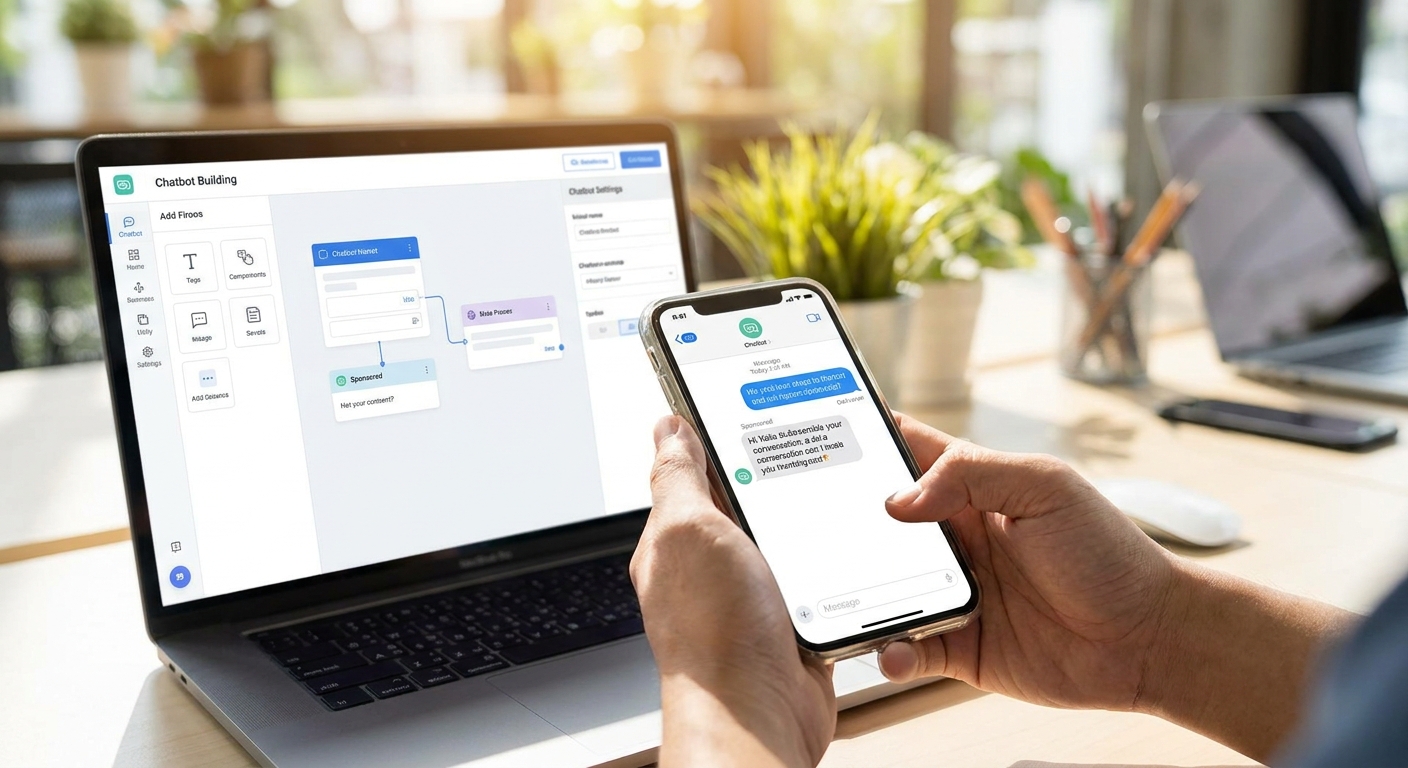
No-code chatbot builders like Voiceflow, Botpress, Landbot, and Chatbase let founders ship a bot without touching a backend — but monetizing that bot past a subscription tier still means wiring in an ad layer, and most ad networks were built for banners, not turns of dialogue.
- Elo's SDK adds conversational ads for no-code chatbot builders through one webhook step — Buy for GPT-backed Voiceflow and Botpress flows in 2026.
- Custom LLM backends behind a no-code frontend get the deepest targeting control on contextual-advertising-for-custom-llm-chatbots — Buy.
- Voice-first no-code assistants need ad mediation built for audio turns, not banner logic — Consider ad-mediation-for-voice-ai-assistants before launch.
- Skip banner networks bolted onto chat UIs in 2026 — they break conversational flow and drop retention.
Why this matters
Most no-code chatbot builders monetize one way: a subscription tier on the platform itself, or a flat fee the bot owner passes to their own users. Neither pays out on the free-tier chats that never convert, and free-tier chats are usually the majority of volume.
Conversational ads for no-code chatbot builders close that gap by turning every chat turn into a potential revenue event, whether the user buys anything or not. The bot owner earns on impressions and clicks the same way a publisher earns on a web page — except the inventory is a dialogue, not a banner slot.
The catch: bolt a display-ad SDK onto a chat interface and it looks like an interruption, not a native part of the conversation. The ad has to render as a card inside the flow, matched to what the user just asked, or it gets ignored — or worse, it gets the bot uninstalled.
Who this is for
This guide is for people running bots on no-code platforms — Voiceflow, Botpress, Landbot, Chatfuel, Tars, or a custom Retrieval-Augmented Generation (RAG) stack wrapped in a drag-and-drop builder — who want ad revenue without hiring an engineer to build a matcher from scratch. If your bot already has real conversation volume in 2026 and you're leaving that volume unmonetized, the criteria below apply directly to you.
What to look for in conversational ads for no-code chatbot builders
Drop-in setup inside the builder's canvas
If the integration requires a custom backend service, it doesn't belong in a no-code stack. Look for a webhook or API step that drops into Voiceflow, Botpress, or Landbot's existing flow builder without a new server.
Native card rendering, not banner injection
A conversational ad should render as a card inside the chat bubble stream — same visual language as the rest of the conversation. Banner injection breaks the illusion of a single continuous chat and reads as an ad network slapped on top.
Contextual matching that reads intent, not keywords
Keyword-matched ads misfire constantly in chat — a user asking about "credit card debt" doesn't want a credit card ad. Matching needs to read the intent of the turn, not just the words in it, or relevance collapses fast.
Revenue visibility per bot, per flow
No-code builders often run multiple bots or multiple flows inside one bot. You need a dashboard that breaks revenue down by bot and by flow, not one blended number, or you can't tell which flow is worth optimizing.
Fallback behavior when no ad matches
Not every turn has a good ad match. A system that forces a low-relevance ad into every turn burns trust fast. The better systems skip the slot silently and wait for a higher-confidence match on a later turn.
Top picks by builder type
GPT-backed no-code flows — the default pick
If your Voiceflow or Botpress bot runs on OpenAI's GPT models, conversational ads for OpenAI GPT chat apps is the direct-fit integration — it plugs into the same API layer your builder already calls. Setup is a single webhook step, not a new service. Buy for any GPT-backed no-code flow shipping in 2026.
Custom LLM behind a no-code frontend — the flexible pick
Some no-code builders sit on top of a custom or fine-tuned model rather than a stock GPT endpoint. Contextual advertising for custom LLM chatbots handles matching against any model output, not just OpenAI's schema, which matters once you start swapping models to cut inference cost. Buy if your no-code stack routes through a custom or self-hosted model.
Voice-first no-code assistants — the audio pick
Voice adds a wrinkle: there's no visual card to render, so the ad has to live inside the spoken turn or a follow-up text summary. Ad mediation for voice AI assistants is built for that constraint specifically. Consider it if your no-code builder outputs audio; test read-through rates before committing full inventory.
RAG-based support and knowledge bots — the support-bot pick
Bots built on retrieval-augmented generation for internal knowledge bases or customer support tend to have longer, denser turns with less obvious ad slots. This use case has a dedicated integration path, but matching quality depends heavily on how narrow the knowledge base is — a bot answering only refund policy questions has thin ad inventory. Consider for high-volume support bots; Skip for narrow, single-topic internal tools where there isn't enough conversational variety to match against.
What to avoid
- Static banner networks retrofitted for chat. They render as a rectangle inside a bubble stream and get ignored at a rate that makes the integration not worth the engineering time, even for a no-code webhook step.
- Keyword-only matching. Ads that trigger on literal keyword hits instead of intent misfire on ambiguous phrasing constantly — a chatbot conversation has far more ambiguity than a search query.
- Redirect-based ad units. Any ad format that pulls the user out of the chat to a landing page kills the session. A native card that keeps the user inside the conversation performs differently than one that doesn't.
Verdict comparison
| Builder type | Setup effort | Ad format fit | Verdict |
|---|---|---|---|
| GPT-backed no-code (Voiceflow, Botpress) | Single webhook step | Native card, high match rate | Buy |
| Custom LLM behind no-code frontend | Webhook + model-agnostic config | Native card, model-independent | Buy |
| Voice-first no-code assistant | Webhook + audio handling | Spoken turn or summary card | Consider |
| RAG-based narrow support bot | Webhook step | Thin inventory on single-topic bots | Consider / Skip |
FAQ
What are conversational ads for no-code chatbot builders?
They're ad units that render as native cards inside a chat conversation, matched to what the user just said, rather than banner ads bolted onto the interface. No-code builders like Voiceflow and Botpress can add them through a webhook step instead of custom backend code.
Do Voiceflow and Botpress bots support conversational ads in 2026?
Yes, through an SDK integration that plugs into the existing flow builder as a webhook or API step. The setup does not require a new backend service or engineering hire in 2026.
How much does it cost to add conversational ads to a no-code bot?
Cost structures vary by ad platform and are typically based on revenue share from advertiser spend rather than a flat integration fee. Check current terms directly with the ad SDK provider before committing a bot's inventory.
Is contextual ad matching better than keyword targeting for chatbots?
Yes, because chat turns are far more ambiguous than search queries, and keyword-only matching misfires on phrasing that doesn't literally contain a trigger word. Intent-based matching reads what the user meant, not just what they typed.
Can a no-code chatbot builder use Elo without an engineering team?
Yes, Elo's SDK is designed to drop into a no-code canvas as a single webhook step rather than a custom-built backend service. The setup targets builders on Voiceflow, Botpress, Landbot, and similar platforms directly.
What's the difference between ad mediation and direct ad serving?
Ad mediation routes a request across multiple demand sources to find the best-paying match, while direct ad serving connects to a single ad source. Voice-first and multi-channel no-code bots typically benefit more from mediation because inventory and format needs vary by channel.
Do conversational ads work in voice-based no-code assistants?
Yes, but the ad has to live inside a spoken turn or a follow-up summary since there's no visual card to render. Read-through rates should be tested before committing full inventory on a voice-first bot.
How fast can a no-code bot start earning ad revenue?
Integration is typically a single webhook step inside the existing flow builder, so the technical setup itself is fast. Actual revenue ramp depends on chat volume and how well the ad matcher performs against your bot's conversation topics.
One last thing
The bots that monetize best on conversational ads in 2026 aren't the highest-traffic ones — they're the ones with the most topic variety per session, because variety gives the matcher more chances to find a relevant ad instead of skipping the slot. A narrow, single-purpose bot with huge volume can still underperform a smaller, chattier bot on revenue per session.