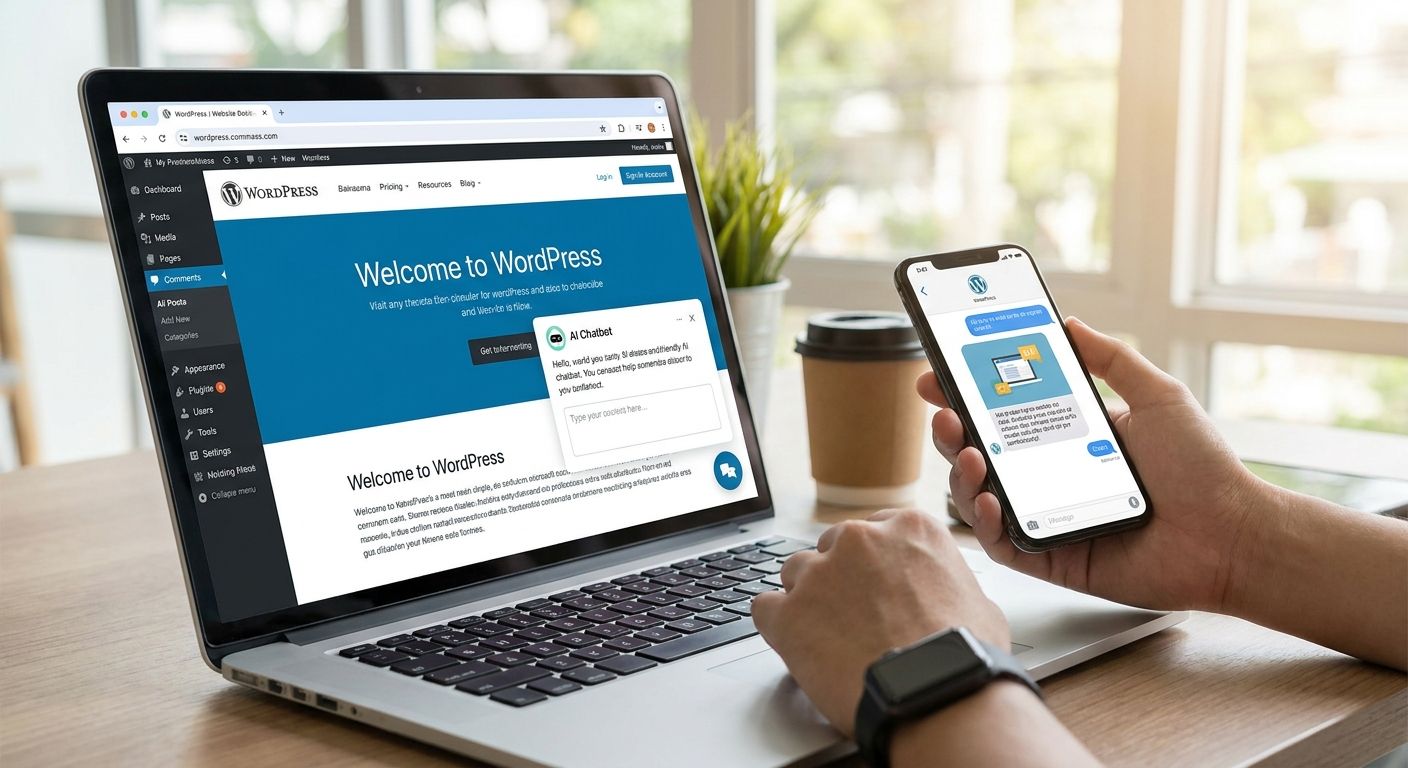
WordPress runs the chatbot plugins that answer questions, book meetings, and recommend products on over 40% of all websites in 2026, and every one of those conversations is unmonetized until you wire in an ad layer built for chat, not display.
- Elo's SDK adds conversational ads for WordPress AI chatbot plugins without banners — Buy for teams running OpenAI or Anthropic-based bots in 2026.
- Custom LLM backends get the strongest contextual matching — the ad only fires when the conversation topic supports it.
- No-code chatbot builders need a separate integration path — Consider only if the builder exposes an SDK hook.
- Skip banner-style ad injections inside chat UI — they tank plugin ratings and get flagged as intrusive by WordPress reviewers.
Why this matters
A WordPress AI chatbot plugin that answers 500 questions a day is sitting on 500 unmonetized impressions. Display ads don't fit inside a chat window \u2014 there's no banner slot, no sidebar, no space that doesn't break the conversation. Conversational ads solve this by turning the chatbot's own reply into the ad surface: a native card that shows up when the topic naturally calls for a product or service recommendation.
The plugin developer's job in 2026 isn't picking a display network. It's picking an ad layer that understands context, respects the chat UX, and pays out on real advertiser spend instead of vanity impressions.
Who this is for
This guide is for developers and site owners running an AI chatbot plugin on WordPress \u2014 support bots, product finders, recipe assistants, booking agents \u2014 built on top of OpenAI, Anthropic, or a self-hosted model, who want the bot to generate ad revenue without turning the chat window into a billboard. If your plugin gets real conversation volume and you haven't touched monetization yet, everything below applies directly to you.
What to look for in conversational ads for WordPress AI chatbots
Contextual matching, not keyword matching
An ad system that fires on the word "insurance" anywhere in a chat will misfire constantly. What matters is whether the system reads the full exchange \u2014 intent, prior turns, resolved topic \u2014 before deciding an ad belongs there at all. Weak matching shows up fast: users see irrelevant offers and stop trusting the bot's answers.
Native card format, not banner
A chat window has no room for a 300x250 unit. The ad needs to render as a message-shaped card inside the conversation flow \u2014 same font, same bubble style, clearly labeled as sponsored. Anything that looks bolted on reads as spam inside a WordPress plugin's UI.
Chat UX preservation
Ads that interrupt the reply, delay the response, or force a click before the user gets their answer will get uninstalled. Check how the SDK handles ads without hurting chat UX before you ship \u2014 this is the single biggest driver of plugin churn once ads go live.
Integration footprint
A WordPress plugin developer doesn't have weeks to spend wiring an ad SDK. Elo's own SDK ships as roughly twelve lines of code on top of an existing chat integration \u2014 no separate ad server call, no rebuild of the message loop. If a vendor's docs run longer than a lunch break, that's a signal, not a feature.
Compliance and data handling
GDPR fines run up to 4% of global annual revenue for serious violations, and a chatbot that logs conversation content for ad targeting without disclosure is exactly the kind of processing regulators look at. The ad layer needs built-in consent handling, not a promise to add it later.
Revenue reporting
You need a dashboard that shows impressions, fill rate, and eCPM by conversation type \u2014 not a monthly PDF from an ad network. If you can't see which chatbot flows earn and which don't, you can't optimize placement.
The monetization paths for WordPress AI chatbot plugins
SDK-based contextual ads \u2014 the native pick
Elo runs as an SDK layer on top of an existing chatbot build, matching ads to the live conversation and rendering them as native cards instead of banners. It works whether the plugin is calling OpenAI, Anthropic, or a custom endpoint, and it pays out on real advertiser spend rather than a fixed per-click rate. Verdict: Buy for any WordPress AI chatbot plugin with steady conversation volume in 2026.
No-code chatbot builder integration \u2014 the fastest setup, if it fits
If the WordPress plugin was assembled through a no-code chatbot builder rather than custom code, the ad layer has to plug into whatever hooks that builder exposes. This route works when the builder supports an SDK callback; it stalls when it doesn't, and you're stuck waiting on the builder's own roadmap. Verdict: Consider \u2014 check the builder's extensibility before committing.
Custom LLM or self-hosted backend \u2014 the flexible pick
Plugins running their own model instead of a hosted API get the tightest control over context, which means the strongest contextual matching once ads are wired in. The tradeoff is more integration work up front, since there's no default hook to lean on. Elo's approach for contextual advertising on custom LLM chatbots covers this path directly. Verdict: Buy for developers already running a self-hosted model.
Direct ad deals \u2014 the manual pick
Negotiating placements directly with a handful of advertisers can work for a chatbot plugin with a narrow, well-defined audience \u2014 a niche recipe assistant pitching a spice brand, for example. It doesn't scale past a few relationships, and every renewal is a fresh negotiation. Verdict: Consider only as a supplement to an SDK, never as the only revenue layer.
“If the ad needs a banner to get noticed, the context match already failed.”
What to avoid
- Banner ads squeezed into the chat sidebar. They look like a display network bolted onto a chat plugin because that's exactly what happened, and WordPress users flag it in reviews.
- Unlabeled sponsored replies. An ad that isn't disclosed as an ad is a compliance problem waiting for a regulator, not a growth hack.
- Keyword-only ad triggers. Firing an ad because a single word appeared in the conversation, without reading the resolved intent, produces mismatches that erode trust in the bot's other answers.
Add ads to your WordPress AI chatbot
Native, contextual ad cards — no banners, no chat delay.
Verdict comparison table
| Approach | Setup effort | Contextual matching | Compliance handling | Verdict |
|---|---|---|---|---|
| SDK-based contextual ads (Elo) | Low \u2014 around twelve lines of code | Strong | Built-in consent handling | Buy |
| No-code builder integration | Depends on builder hooks | Moderate | Depends on builder | Consider |
| Custom LLM backend integration | Moderate \u2014 more setup, more control | Strongest | Configurable | Buy |
| Direct ad deals | High \u2014 manual negotiation per advertiser | Manual | Case-by-case | Consider |
FAQ
What are conversational ads for a WordPress AI chatbot?
Conversational ads are native, message-shaped ad cards that appear inside a chatbot's reply when the conversation topic matches an advertiser's offer. Unlike banner ads, they render in the same style as the bot's own messages and don't interrupt the response.
Do conversational ads slow down a WordPress chatbot?
A well-built SDK matches and renders the ad alongside the existing reply without adding a separate round trip. Check the vendor's own guidance on avoiding chat UX disruption before integrating, since this varies by implementation.
Is Elo better than running banner ads next to a chatbot widget?
Elo renders ads as native cards inside the chat flow instead of a banner bolted onto the widget, which fits the chat UI and avoids the intrusive look that gets plugins uninstalled. For a chatbot specifically, native in-chat ads are the closer fit.
How much does it cost to add conversational ads to a WordPress chatbot plugin?
Cost structures vary by ad SDK and advertiser demand in the plugin's niche — check current terms directly with the provider rather than assuming a flat rate.
Can a no-code WordPress chatbot builder support conversational ads?
Only if the builder exposes an SDK hook or webhook for third-party integrations. Without that hook, ad monetization has to wait on the builder's own roadmap.
Are conversational ads GDPR compliant?
They can be, but only if the ad layer includes consent handling and discloses sponsored content clearly. GDPR fines for serious violations run up to 4% of global annual revenue, so this isn't optional for any plugin serving EU users.
Do conversational ads work with a custom LLM chatbot on WordPress?
Yes — SDK-based ad layers that work with OpenAI or Anthropic APIs generally support custom or self-hosted models too, since the matching happens on the conversation content, not the model provider.
What's the biggest mistake WordPress chatbot plugins make with ads?
Treating the chatbot like a webpage and dropping in a banner ad network. Chat has no banner slot — the ad has to live inside the reply itself or it breaks the interface.
One last thing
The plugins that lose the most revenue aren't the ones with low chat volume \u2014 they're the ones running steady conversation traffic through a bot that's never been wired for ads at all. A support bot answering the same 50 questions a day for a year has generated thousands of monetizable turns that just went unused. Fixing that isn't a redesign; it's an SDK call.