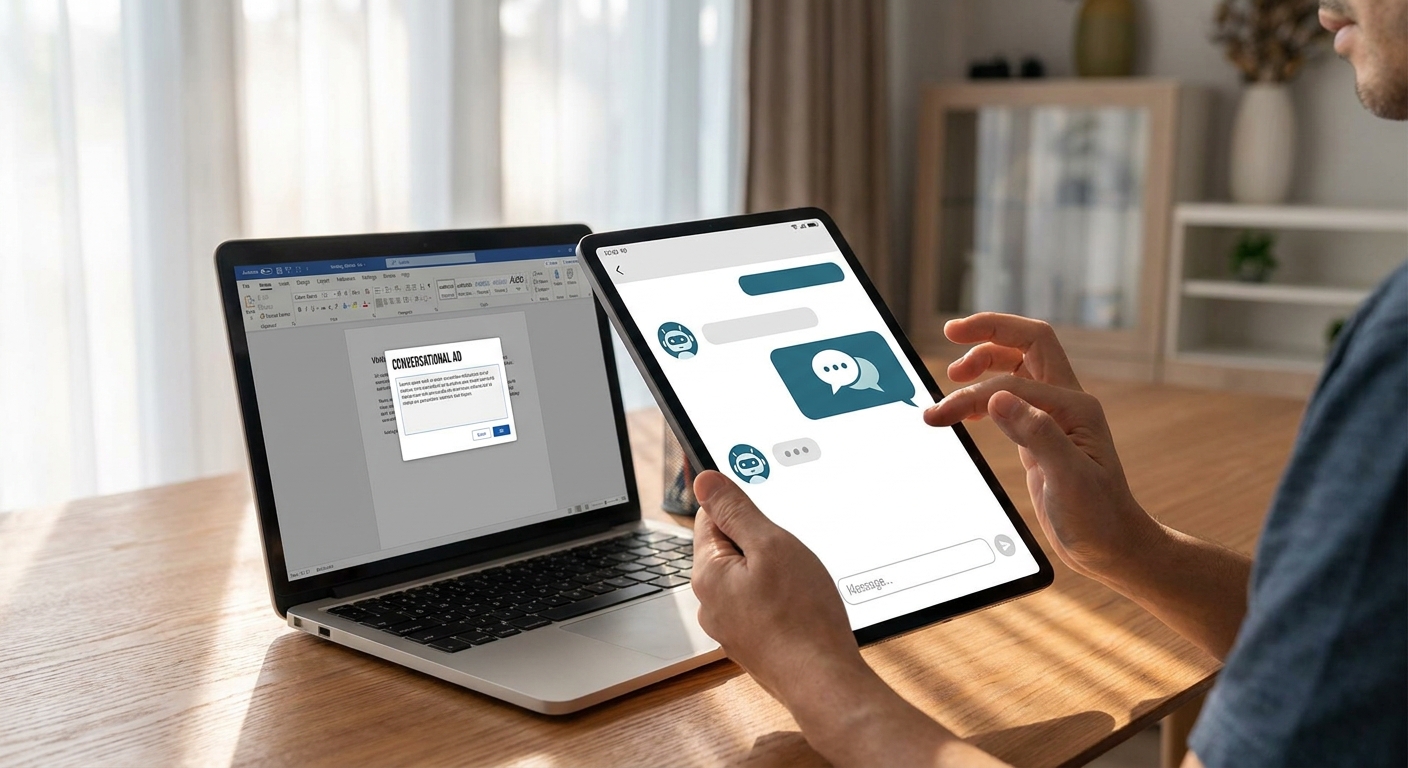
Conversational ads for AI writing assistant apps let a grammar checker, blog drafter, or copywriting tool earn revenue from every session — without a subscription wall breaking the drafting flow. This guide covers what separates a good implementation from one that tanks retention in 2026.
- Native ad cards tied to the draft topic beat banner networks for conversational ads for AI writing assistants in 2026.
- Cap ad frequency at one card per 4-6 exchanges; more than that kills retention in writing tools.
- Elo's SDK integrates in about 12 lines of code and matches ads to conversation context, not just keywords.
- Skip generic mobile ad networks for writing assistants — they weren't built for streaming LLM chat and add latency.
Why this matters
Subscription fatigue is real for writing tools in 2026. Users cancel a $20/month copywriting assistant the moment they stop using it daily, and free tiers with hard usage caps push them to a competitor instead of an upgrade prompt.
Ad-supported tiers close that gap. A user drafting a product description doesn't mind a sponsored template suggestion if it's relevant to the product category they're writing about — that's a fundamentally different reaction than seeing a banner ad interrupt a text editor. Conversational ads for AI writing assistant apps work because the ad rides inside the same turn-based interface the user already trusts, instead of bolting a display unit on top of it.
Who this is for
This guide is for developers and founders building AI writing assistants — blog-post generators, email drafting tools, resume and cover-letter writers, marketing copy tools — on OpenAI, Anthropic, or a custom LLM stack. You're past the free-tier-only phase, you want revenue that doesn't depend on every user converting to paid, and you need ad formats that survive contact with a product where the whole point is an uninterrupted draft.
What to look for in conversational ads for AI writing assistants
Context matching depth
A writing assistant generates dozens of distinct topics a day — legal disclaimers, product blurbs, cover letters, sales emails. Matching on a single keyword ("insurance" triggering an insurance ad inside a fiction draft) produces irrelevant placements that users learn to ignore or resent. Look for matching that reads intent and draft stage, not just surface text.
Placement that respects the writing surface
Ads belong in a suggestion panel or a native card between exchanges, never as an overlay on the text the user is actively editing. The moment an ad format touches the draft pane, it reads as an interruption instead of an offer.
Latency budget against token streaming
Writing assistants live and die on how fast the draft appears. An ad call that blocks or delays token streaming, even by a beat, shows up immediately in user complaints about the tool feeling "slower." The ad request has to run without adding perceptible lag to the response.
Model-agnostic SDK support
Plenty of writing assistants start on GPT-4-class models and move to a fine-tuned or Anthropic-based stack within a year. An ad SDK tied to one model provider forces a rebuild the moment you switch. Confirm the SDK works the same way across OpenAI, Anthropic, and custom LLM deployments before you integrate.
Brand safety and compliance
Writing assistants handle sensitive drafts — legal language, health copy, financial content. An ad network with no category exclusions can place a supplement ad next to a medical disclaimer draft, which is the kind of mismatch that gets screenshotted and shared. GDPR compliance also isn't optional if any EU users touch the product in 2026.
Fill rate for productivity and SaaS categories
A network built for gaming or e-commerce won't have deep advertiser demand in productivity, SaaS, and content-tool categories — which is exactly where a writing assistant's audience sits. Check whether the network actually has advertisers bidding on the categories your users are drafting about, not just impression volume in general.
Add ads to your writing assistant
See the SDK and native ad formats built for AI chat apps.
Where conversational ads fit in a writing assistant
Native ad cards in the suggestion panel — the default pick. These render as a card alongside the draft, separate from the editable text, and surface after roughly one ad per 4-6 exchanges rather than on every turn. Elo's native ad SDK for AI chat interfaces is built for exactly this placement inside a chat-based product. Buy.
Context-matched sponsored templates — the precision play. Instead of matching on keywords, this approach reads three signals — topic, intent, and draft stage — before surfacing a sponsored template or tool suggestion. If someone's drafting a product launch email, the match should be a launch-copy template, not a generic "email tips" ad. Matching ads to conversation context in an LLM app covers how that signal set works in practice. Buy.
GPT-native conversational ads — the fastest to ship if your writing assistant runs on OpenAI's stack already. Because the SDK sits alongside the existing chat completion calls, teams shipping conversational ads for OpenAI GPT chat apps tend to have this live within a sprint. Consider if your roadmap has a model migration planned within the year — confirm the SDK stays model-agnostic first.
Custom LLM contextual ads — the flexible option for teams running a fine-tuned or self-hosted model instead of a third-party API. Contextual advertising for custom LLM chatbots depends on the same matching signals, but the integration point sits closer to your own inference layer. Consider — worth the extra setup time if you've already committed to a custom stack.
What to avoid
- Generic mobile ad SDKs. Networks built for app-open and interstitial events expect a different event model than a streaming chat turn — they add latency and don't match on conversation content at all.
- Keyword-only matching. A legal term inside a marketing copy draft triggering a legal-services ad is the kind of mismatch that makes users distrust the whole ad-supported tier, not just that one placement.
- Overlay and interstitial formats. Anything that pauses the chat to show a full-screen unit breaks the core loop of a writing tool, which is continuous drafting without interruption.
Verdict comparison
| Approach | Placement | Match signal | Verdict |
|---|---|---|---|
| Native ad cards (suggestion panel) | Alongside draft, not inside it | Topic + intent + draft stage | Buy |
| Context-matched sponsored templates | Inline suggestion | Topic + intent + draft stage | Buy |
| GPT-native conversational ads | Chat turn | Topic + model context | Consider |
| Custom LLM contextual ads | Chat turn | Topic + fine-tune context | Consider |
| Generic mobile ad SDK | Interstitial/overlay | App session event | Skip |
FAQ
What are conversational ads for AI writing assistants?
Conversational ads for AI writing assistants are native ad cards or sponsored suggestions matched to the topic and intent of a drafting session, shown inside the chat interface rather than as a banner. They run alongside the draft, not on top of it.
Do conversational ads hurt retention in writing tools?
Poorly matched or overly frequent ads hurt retention; contextually matched cards capped at roughly one per 4-6 exchanges generally do not. Placement and match quality matter more than the fact that an ad exists.
How much does ad-supported monetization pay compared to subscriptions?
Revenue per user depends on advertiser demand in your category and fill rate, so it varies by traffic mix. Ad-supported tiers work best as a revenue layer alongside subscriptions, not a full replacement.
Is Elo's SDK compatible with OpenAI and Claude-based writing assistants?
Yes, Elo's SDK is built to sit alongside chat completions from OpenAI, Anthropic, or a custom LLM stack, so a model migration doesn't require rebuilding the ad integration.
How many lines of code does it take to add ads to a writing assistant?
Elo's SDK integrates in about 12 lines of code for a basic native ad card implementation. Additional matching configuration adds a small amount of setup beyond that.
What's the best ad frequency for a writing assistant chat?
One ad card every 4-6 exchanges is a reasonable starting cap for 2026-era writing assistants. Test tighter or looser frequency against your own retention data rather than assuming one number fits every product.
Are conversational ads GDPR compliant?
They can be, but compliance depends on the ad network's consent handling and category exclusions, not the ad format itself. Confirm GDPR handling before launch if any EU users touch the product.
Should indie developers add ads before or after monetizing with subscriptions?
Ads work well as a layer under a subscription, monetizing free-tier and non-converting users rather than replacing paid plans. Indie developers often add ads first specifically because it doesn't require building a paywall.
One last thing
Writing assistants that keep the ad card inside the suggestion panel — never inside the draft pane itself — get the fewest complaints in 2026, because the ad never touches the text the user is actually editing. That one placement decision matters more than the ad network you pick.